
Evaporative emission canister (Emission control)
- Make
- Land Rover
- Model
- Freelander Workshop Manual
- Year
- 1998–2000
- Section
- Description and operation › Evaporative emission canister
Evaporative emission canister
The evaporative emission canister contains charcoal which absorbs and stores fuel vapour from the fuel tank while the engine is not running. When the canister is not being purged, the fuel vapour remains in the canister and clean air exits the canister via the air inlet port.
When the engine is running, the ECM decides when conditions are correct for vapour to be purged from the canister, and opens the canister purge valve. This connects a manifold vacuum line to the canister and fuel vapour is drawn from the canister’s charcoal element to be burned in the engine. Clean air is drawn into the canister through the air inlet port to fill the displaced volume of vapour.
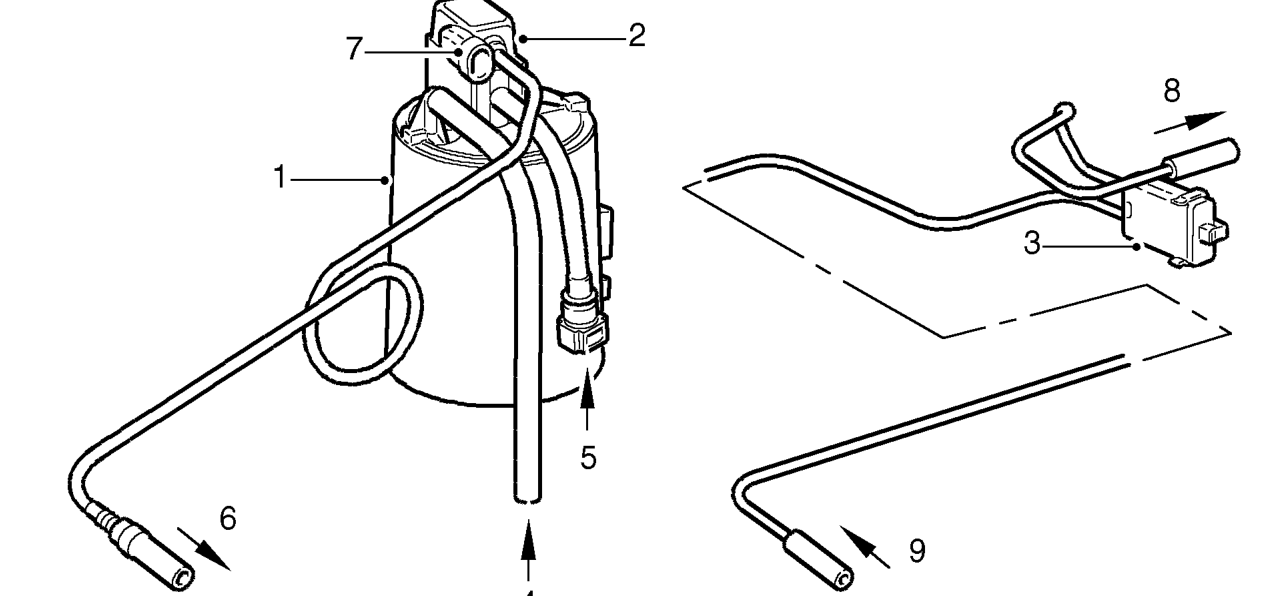
1. Carbon canister 2. Purge Control Valve 3. Fuel trap 4. Air inlet port 5. Fuel vapour inlet (from fuel tank) 6. Purge port (from carbon canister to inlet manifold) 7. Harness connector (to ECM) 8. Fuel trap to ECM pipe 9. Inlet manifold to fuel trap pipe
Evaporative emission canister purge valve
The operation of the evaporative emission canister purge valve is controlled by the ECM. The purge valve is located on top of the carbon canister. The valve remains closed below preset coolant and engine speed values to protect engine tune and catalytic converter performance. If the charcoal canister was purged during cold running or at idling speed, the additional enrichment in fuel mixture would delay the catalytic converter light off time and cause erratic idle. When the purge valve is opened, fuel vapour from the charcoal canister is drawn into the throttle housing for combustion.
Parts & tools for this job For 1998 Land Rover Freelander
- PARTExhaust gasketSearch: Land Rover Freelander 1998 exhaust gasket
- TOOLPenetrating oilSearch: penetrating oil
- TOOLOBD2 scannerSearch: OBD2 scanner
Links open Amazon search results in a new tab. As an Amazon Associate I earn from qualifying purchases.