Cooling system operation (Cooling system - L Series)
- Make
- Rover
- Model
- 200 Workshop Manual
- Year
- 1995–1999
- Section
- Description and operation › Cooling system operation
COOLING SYSTEM OPERATION
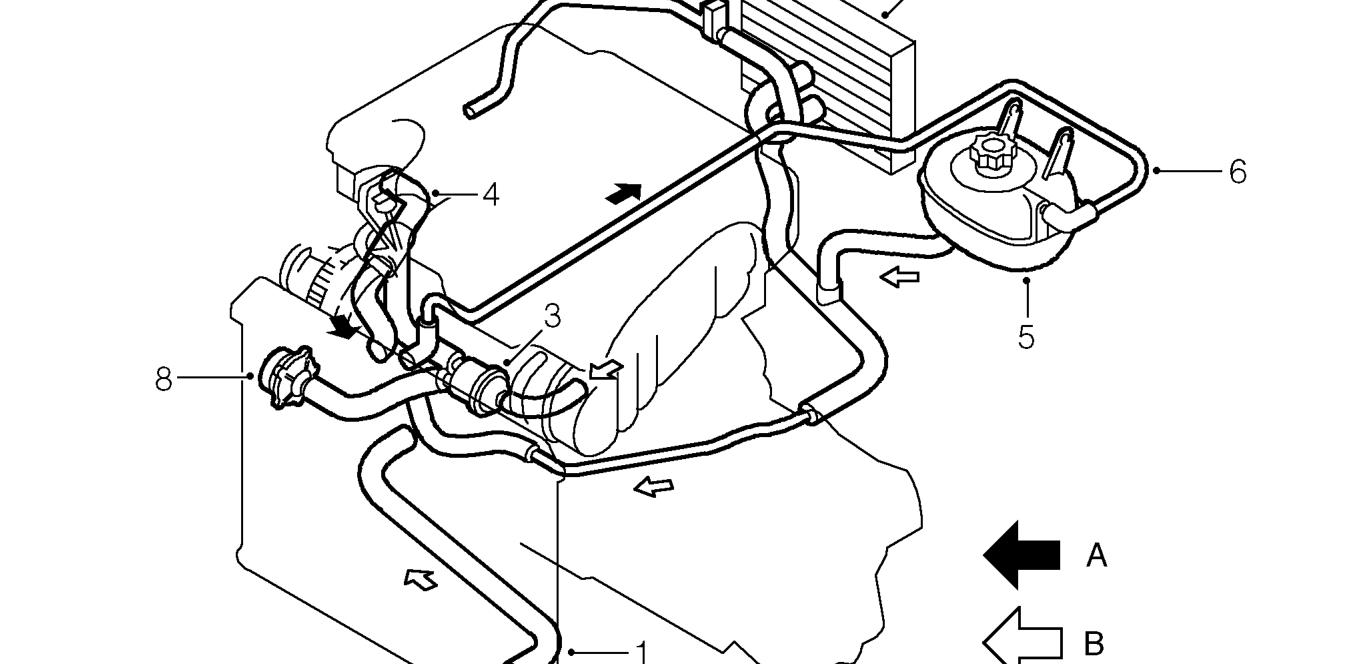
The cooling system employed is the bypass type.
When the engine is cold the thermostat closes off the coolant feed from the radiator bottom hose (1). Coolant is drawn via the heater matrix (2) from the top of the cylinder block, this allows some heat transfer to the radiator via the top hose by convection while retaining the majority of the heat within the cylinder block.
The siting of the thermostat (3) in the inlet rather than the outlet side of the system provides a reduced warm up time by circulating a small amount of coolant around a shorter tract, this also prevents temperature build up within the cylinder head prior to the thermostat opening.
As temperature increases the thermostat gradually opens, bleeding cool fluid into the cylinder block and allowing hot coolant to flow to the radiator via the top hose (4), balancing the flow of hot and cold fluid to maintain temperature. As the thermostat opens further so the full flow of coolant is drawn through
A = HOT B = COLD
the radiator.
Any excess coolant created by heat expansion is returned to the expansion tank (5) via hose (6).
The radiator (7) is a copper/brass cross-flow type with moulded plastic end tanks which incorporate sensor mountings and is mounted on rubber bushes directly into the front body member. The top of the radiator is supported by means of mounting brackets bolted to the radiator and bonnet locking platform.
For additional air flow, at times when the vehicle is stationary, an electric cooling fan is fitted. This is triggered by the low temperature switch (on vehicles fitted with an intercooler) mounted in the top right hand side of the radiator or by the Engine Control Module (ECM) on non-intercooler vehicles.
The coolant pump (8) is a rotor type pump which draws coolant directly from the thermostat. The coolant pump is driven from the ABS pump.
Parts & tools for this job For 1995 Rover 200
- FLUIDCoolantSearch: Rover coolant antifreeze
- PARTThermostatSearch: Rover 200 1995 thermostat
- TOOLCooling system pressure testerSearch: cooling system pressure tester
Links open Amazon search results in a new tab. As an Amazon Associate I earn from qualifying purchases.