
Injection timing device (Engine management system)
- Make
- Rover
- Model
- 600 620 Diesel Repair Manual Supplement
- Year
- 1995–1999
- Section
- Description and operation › Injection timing device
Injection timing device
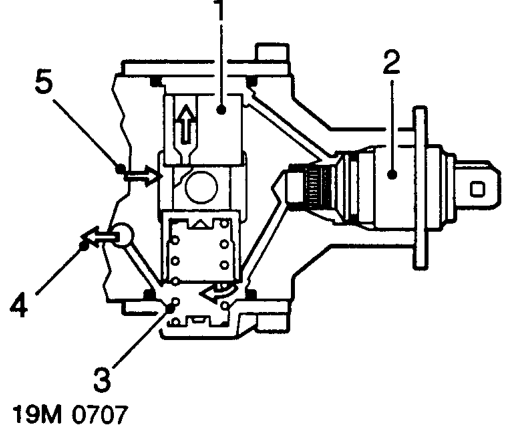
- Plunger
- Solenoid
- Spring
- Pump feed pressure
- pump internal pressure
The injection timing device consists of a spring loaded plunger and a solenoid. The spring loaded plunger acts against a cam plate driven by the injection pump shaft.The spring loaded plunger moves under the influence of pump working pressure.
The injection timing solenoid is responsible for the characteristic ’buzzing’ sound when the ignition is turned on. The solenoid operates at 50 Hz and by varying the operating frequency the engine control module alters the fuel pressure on the plunger, moving it against spring tension. By moving the plunger against the spring, the height of the plunger acting against the cam plate is changed, retarding the ignition. Injection timing is fully advanced with the solenoid de-energised.
The engine control module receives a feedback signal from the needle lift sensor and will attempt to correct the injection timing accordingly by altering the signal to the solenoid. If a change does not occur or differs by a substantial amount the engine control module will assume a fault exists and reduce the amount of fuel injected.
Fuel shut-off solenoid
The fuel shut-off solenoid is located in the high pressure section of the injection pump. When the ignition is switched on the engine control module sends a signal to the solenoid. The solenoid energises opening a valve allowing fuel to flow.
When the ignition is switched off, or in the event of a serious engine problem, the control unit will remove the supply to the solenoid, closing the valve and cutting off the fuel supply to the injectors.
EXHAUST GAS RECIRCULATION (EGR)
During certain running conditions the EGR system directs exhaust gases into the intake manifold to be used in the combustion process. The principal effect of this is to reduce combustion temperatures, which in turn reduces Oxides of Nitrogen emissions.
The EGR diaphragm valve is vacuum operated through a solenoid valve, mounted in the centre of the bulkhead. When the Engine Control Module (ECM) determines that exhaust gas recirculation should take place, the solenoid valve is modulated and vacuum, supplied by the brake servo vacuum pump, opens the EGR valve. Exhaust gases are then fed through a pipe into the inlet manifold.
An air flow meter, mounted in the air intake pipe, senses the volume of air entering the engine. Using the principle that an increase in EGR will lead to a decrease in the intake air flow, the air flow meter is used by the ECM to monitor the amount of exhaust gases being recirculated. This feedback signal allows the ECM to accurately control the volume of exhaust gases being recirculated.
Parts & tools for this job For 1995 Rover 600
- PARTEngine gasket setSearch: Rover 600 1995 engine gasket set
- TOOLTorque wrenchSearch: 3/8 inch torque wrench
- TOOLFeeler gauge setSearch: feeler gauge set
Links open Amazon search results in a new tab. As an Amazon Associate I earn from qualifying purchases.