
Checking for leaks
- Make
- SEAT
- Model
- Leon León
- Year
- 5F, 2012–2020
- Section
- Brake system: › Checking for leaks
Checking for leaks
Note
- The average earth atmospheric pressure at sea level is 1,013 mbar and falls the higher you travel (approx. 100 mbar / 1,000 m height). Local and temporal fluctuations also affect vacuum creation.
- Engine idling affects vacuum creation negatively.
Before starting work, check all vacuum hoses for damage (e.g. cracks or marten bite) and to check that they are correctly and firmly attached
Connect the Brake servo tester VAS 6721 Chapter “Checking vacuum system”.
Open cut-off valve (A).
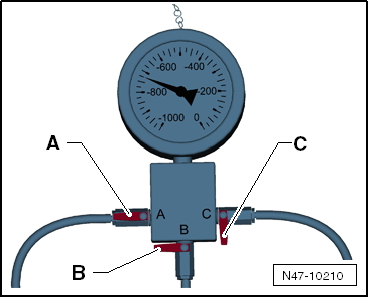
Close cut-off valves (B+C).
Start warm engine (>60 ℃), press accelerator briefly once (engine speed more than 2,000 rpm).
- Under normal conditions (see notes) the vacuum created should lie between 600 and 950 mbar (dependent upon engine type).
Open cut-off valve (C) to evacuate brake servo.
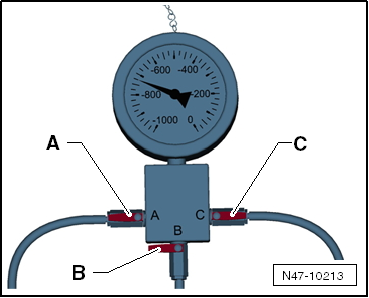
Switch off the engine.
Read and make a note of measured value shown.
- The vacuum may reduce by 400 mbar in a 12 hour period.
Should the vacuum decrease by more it is to be checked whether the leak is in the area of ..
- Brake servo unit or,
- Non-return valve, vacuum hoses with plug-in connectors and vacuum pump/intake pipe.
Where bigger leaks are concerned the vacuum rapidly decreases within several seconds.
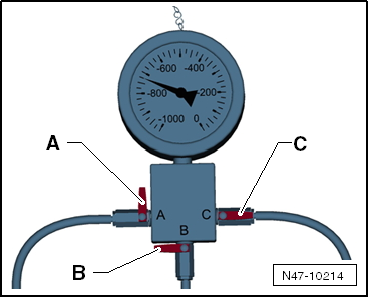
After creating the vacuum, close the shut-off valve (A), in order to check the vacuum system from the brake servo.
After creating the vacuum, close the shut-off valve (C), in order to check the vacuum system from the brake-servo tester VAS 6721 up to the intake pipe or vacuum pump.
Open cut-off valve (B) to facilitate removal of hose connections and adapter.
Parts & tools for this job For 2012 SEAT Leon
- PARTBrake padsSearch: SEAT Leon 2012 brake pads
- TOOLBrake bleeder kitSearch: one man brake bleeder kit
- FLUIDBrake fluidSearch: brake fluid
As an Amazon Associate we earn from qualifying purchases.