
Testing for leaks
- Make
- SEAT
- Model
- Leon León
- Year
- 5F, 2012–2020
- Section
- Brake system: › Testing for leaks
Testing for leaks
Note
- The average earth atmospheric pressure at sea level is 1.013 mbar and falls the higher you travel (approx. 100 mbar / 1,000 m height). Local and time fluctuations also influence vacuum generation.
- A cold engine, a switched-on air-conditioning system as well as engine idling have an adverse influence on generation of a vacuum.
Before starting work, check all vacuum hoses for damage (e.g. cracks or marten bite) and to check that they are correctly and firmly attached
Connect brake servo vacuum gauge VAS 6721 Chapter “Checking vacuum system”.
Open cut-off valve (A).
Close cut-off valves (B+C).
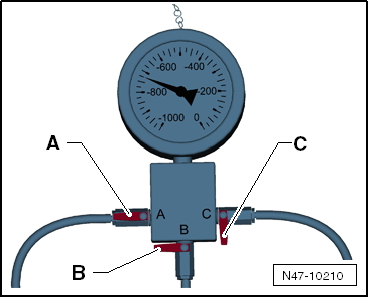
Start warm engine (>60° C), press accelerator briefly (engine speed greater than 2000/min).
Normally (see notes), the vacuum that is generated should be between 600 and 950 mbar (depending on engine size).
Open cut-off valve (C) to evacuate brake servo.
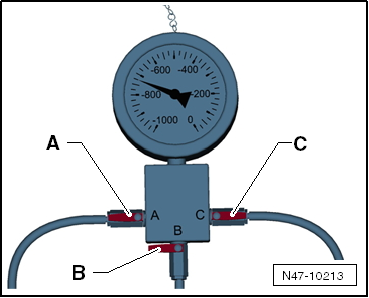
Switch off the engine.
Read and make a note of measured value shown.
A vacuum decrease of 400 mbar in 12 hours is permissible.
If the vacuum decrease is greater, check for leaks in the vicinity of ..
- Brake servo unit or
- non-return valve, vacuum hoses with connectors or vacuum pump/intake manifold
If there are large leaks, the vacuum decreases steeply within a few seconds.
After generation of vacuum, close cut-off valve (A) in order to check brake servo vacuum system.
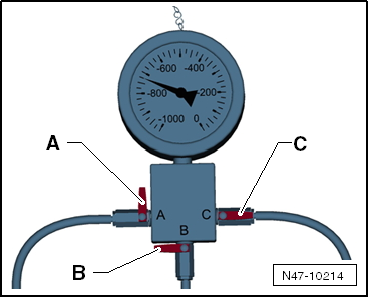
Once vacuum pressure has been generated, close shut-off valve (C) in order to check vacuum system using brake servo vacuum gauge VAS 6721 up to intake manifold or vacuum pump.
Open cut-off valve (B) to facilitate removal of hose connections and adapter.
Parts & tools for this job For 2012 SEAT Leon
- PARTBrake padsSearch: SEAT Leon 2012 brake pads
- TOOLBrake bleeder kitSearch: one man brake bleeder kit
- FLUIDBrake fluidSearch: brake fluid
As an Amazon Associate we earn from qualifying purchases.