skoda Workshop Repair Guides

Skoda Workshop Service and Repair Manuals

Disassembling and assembling the reverse shaft > < Disassembling and assembling the output shaft (input shaft)
Setting output shaft
(Determine adjusting washer for output shaft)
Special tools and workshop equipment required
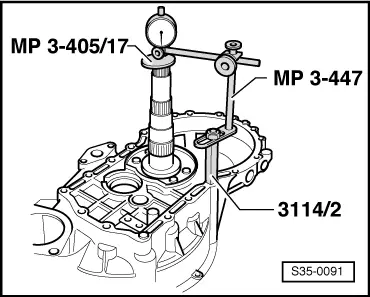
t  Gauge block plate - 50 mm -MP3-405/17-
t  Universal dial gauge holder -MP3-447 (VW 387)-
t  Threaded part -MP3-4004/2-
The output shaft must be re-set when the following components were replaced:
t  Drive train
t  Clutch housing
t  Tapered-roller bearing
Setting overview → Chapter.
  Note
t  New tapered-roller bearings for the differential gear are low friction. Therefore the friction torque has limited value as a control parameter. Correct setting of the bearing preload is only possible by determining the thickness of the adjusting washer.
t  Do not additionally treat new tapered-roller bearing for measuring friction torque with gear oil. The bearings are already factory-pretreated with a special oil for this purpose.
–  Press in outer ring/tapered-roller bearing small in the clutch housing with a 0.65 mm thick adjsuting washer up to the stop → Chapter.
–  Insert output shaft and tighten nuts for the bearing support to 25 Nm and turn a further 90°.
   
–  Insert dial gauge (3 mm measuring range) and set to “0” with a 1 mm bias.
–  Move the output shaft up and down, read off and write down the clearance on the dial gauge (e.g. 0.30 mm).
  Note
Do not turn the output shaft while measuring as otherwise the bearings will settle and the measuring result will be inaccurate.
Determine the adjusting washer
The prescribed bearing preload is reached as follows:
By adding to the established measured value (0.30 mm) and to the inserted adjusting washer (0.65 mm) a constant compression value (0.20 mm).
Example:
  S35-0091
inserted washer0.65 mm
+ measured value0.30 mm
+ compression
(constant value)
0.20 mm
Thickness of the adjusting washer1.15 mm

–  Remove output shaft and extract small outer ring/tapered-roller bearing → Chapter
The following adjusting washers are available:
   
Thickness (mm)Parts No.
0,65
0,70
020 311 391 P
020 311 391 Q
0,75
0,80
0,85
020 311 391
020 311 391 A
020 311 391 B
0,90
0,95
1,00
020 311 391 C
020 311 391 D
020 311 391 E
1,05
1,10
1,15
020 311 391 F
020 311 391 G
020 311 391 H
1,20
1,25
1,30
020 311 391 J
020 311 391 K
020 311 391 L
1,35
1,40
020 311 391 M
020 311 391 N

Different tolerances allow to measure the required thickness for each washer very precisely.
–  Press in outer ring/tapered-roller bearing with the determined adjusting washer (1.15 mm in the example) ( → Chapter) and install output shaft. Tighten nuts for the bearing support in the clutch housing to 25 Nm + turn a further 90°.
Check friction torque
  Note
t  New tapered-roller bearings for the differential gear are low friction. Therefore the friction torque has limited value as a control parameter. Correct setting of the bearing preload is only possible by determining the thickness of the adjusting washer.
t  Do not additionally treat new tapered-roller bearing for measuring friction torque with gear oil. The bearings are already factory-pretreated with a special oil for this purpose.
–  Screw in screw M10 ( → Chapter, fig. S35-0202, Pos.40) on the output shaft.
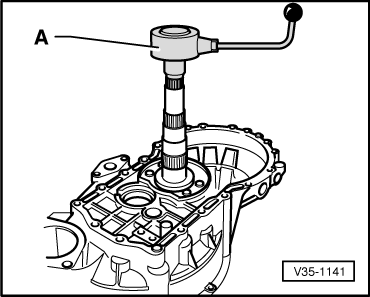
–  Insert corresponding shoulder onto torque spanner -A- and measure friction torque.
   
A = torque spanner 0 ... 600 Ncm.
The friction torque must be 130 ... 180 Ncm for new tapered-roller bearings.
The friction torque must be at least 30 Ncm for used tapered-roller bearings.
  V35-1141

Disassembling and assembling the reverse shaft > < Disassembling and assembling the output shaft (input shaft)