
Checking electrolyte level
- Make
- Volkswagen
- Model
- Caddy Mk2
- Year
- 1996–2004
- Section
- Battery › Checking electrolyte level
Checking electrolyte level
Special tools and workshop equipment requiredCommercially available hydrometer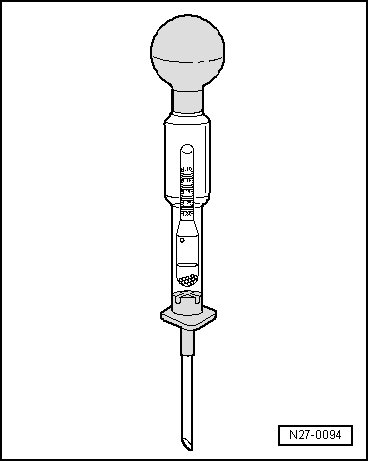
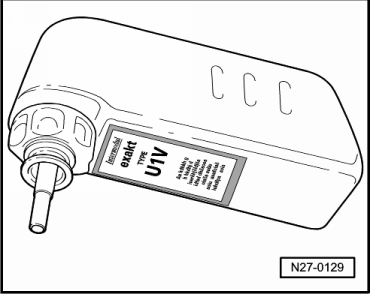
Warning When handling battery acid, you must absolutely adhere to the accident prevention procedures.
Suitable protective clothing must be worn.
Use only an electric torch to illuminate the inside of the battery housing.
Never illuminate the inside of a battery housing with an open flame.
Never work with an open flame or burning cigarette in the vicinity of a battery.
Obey all regulations for the disposal of batteries and sulphuric acid when disposing of batteries.
A correct electrolyte level in the battery is an important factor in ensuring a long battery service life.
When the electrolyte level is too low the cell plates project above the surface and there is a loss of battery capacity (loss of power). If the cell plates are not covered by electrolyte (battery acid) the plates, the plate bridges and the cell connections will corrode. This corrosion ensures the battery function can no longer be guaranteed. The battery will be unusable.
If the electrolyte level is too high, damage will be caused outside the battery by the leaking electrolyte (sulphuric acid/water mixture) e.g. components in engine compartment.
A visual check of the battery electrolyte level is all that is required on batteries with recognisable minimum and maximum marks on the battery housing.
Switch off ignition.
Check electrolyte level visually at the min. and max. markings on the battery housing.
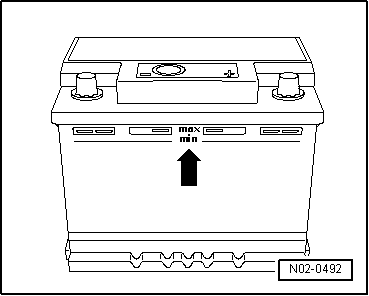
The electrolyte level is OK when the fluid level is between the minimum and maximum marking.
Check electrolyte level visually. Look inside the battery.
If there are no min. and max. marks on the battery housing or if the electrolyte level cannot be seen. You must remove the cell plugs It is then possible to look inside battery to check electrolyte level.
The electrolyte level is OK when the fluid level is the same height as the visible plastic peg.
The plastic peg equates to the max, marking for the electrolyte level.
Note
- If the battery must be topped-up with distilled water, the battery filler bottle VAS 5045 is the ideal medium for this work process. The design of the filler nozzle prevents any spilling or over filling. Once the max. fill level has been reached, further filling of the battery is prevented due to the special nozzle feature of the battery filler bottle VAS 5045.
- Use distilled water only, this prevents contamination of the battery electrolyte and the associated increased self discharge.
If the electrolyte level is too low, correct as follows:
Remove battery cell plug.
Then use the battery filler bottle VAS 5045 to top-up with distilled water, but only to the max. mark. The battery filler bottle VAS 5045 is the ideal medium for this work process.
Note
- Perform a battery load test if you have top-up the battery with distilled water.
Battery load test → Chapter.
If electrolyte level is too high, extract excess electrolyte using a commercial hydrometer. The electrolyte level must align with the internal electrolyte level marking.
Once the battery has been topped-up or the electrolyte level has been reduced to normal the cells must be sealed again using genuine cell plugs.
It is imperative that the original/genuine sealing plugs are used in the battery threaded openings (filling points for battery cells), to ensure the battery is sealed correctly.
Always use genuine sealing plugs of the same type if lost or damaged.
The sealing plugs must be fitted with an O-ring.
Parts & tools for this job For 1996 Volkswagen Caddy
- TOOLBattery testerSearch: car battery tester
- TOOLDigital multimeterSearch: automotive digital multimeter
- TOOLBattery terminal cleanerSearch: battery terminal cleaner
As an Amazon Associate we earn from qualifying purchases.