
Checking specific gravity
- Make
- Volkswagen
- Model
- Caddy Mk2
- Year
- 1996–2004
- Section
- Battery › Checking specific gravity
Checking specific gravity
Note
- The following specific gravity test should only be performed on batteries without magic eye.
Warning When handling battery acid, you must absolutely adhere to the accident prevention procedures.
Suitable protective clothing must be worn.
Use only an electric torch to illuminate the inside of the battery housing.
Never illuminate the inside of a battery housing with an open flame.
Never work with an open flame or burning cigarette in the vicinity of a battery.
Obey all regulations for the disposal of batteries and sulphuric acid when disposing of batteries.
The electrolyte temperature must be at least 10 °C.
The specific gravity must be checked in all battery cells as follows:
Switch off ignition.
Remove all battery plugs (battery cell sealing plugs).
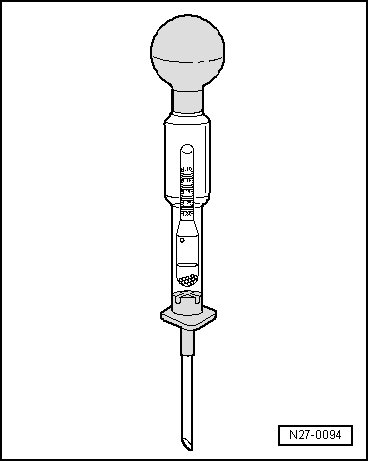
Immerse end of hydrometer in a cell and extract sufficient electrolyte so that float swims free in the electrolyte.
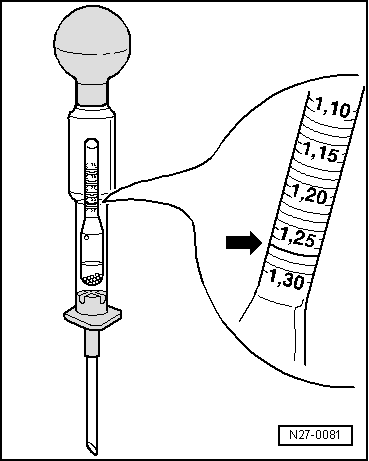
The denser the extracted electrolyte the higher the float swims.
The density in kg/dm3 can be read off the scale of the hydrometer (specific gravity of electrolyte).
Read off measured value on hydrometer and compare with table:
| Charge condition in normal climatic zones | Specific densities in kg/dm3 |
|---|---|
| Discharged | 1.15 |
| Half charged | 1.22 |
| Well charged | 1.28 |
The electrolyte density must be at least 1.24kg/dm3.
Charge battery if electrolyte density (specific gravity) is insufficient.
Repeat electrolyte density (specific gravity) check after charging battery.
The measured value for the specific gravity of the individual battery cells must not differentiate from one another by more than 0.03 kg/dm3.
| Battery cell: | 1 | 2 | 3 | 4 | 5 | 6 |
| Specific gravity deviations in kg/dm3 per cell | ||||||
| Example 1: | 1.24 | 1.25 | 1.25 | 1.10 | 1.24 | 1.25 |
| Example 2: | 1.26 | 1.26 | 1.25 | 1.14 | 1.18 | 1.24 |
Example 1:
The specific gravity in cell 4 is too low.
Example 2:
The specific gravity in cells 4 and 5 is too low. The the specific gravity figures between the battery cells is greater than 0.03 kg/dm3.
If the specifications are not obtained, renew battery.
If the specifications are obtained, screw plugs in again.
It is essential to fit genuine battery sealing plugs in the battery openings to prevent battery leakage.
Always use genuine sealing plugs of the same type if lost or damaged.
The sealing plugs must be fitted with an O-ring.
Use only genuine sealing plugs.
Parts & tools for this job For 1996 Volkswagen Caddy
- TOOLBattery testerSearch: car battery tester
- TOOLDigital multimeterSearch: automotive digital multimeter
- TOOLBattery terminal cleanerSearch: battery terminal cleaner
As an Amazon Associate we earn from qualifying purchases.