| –
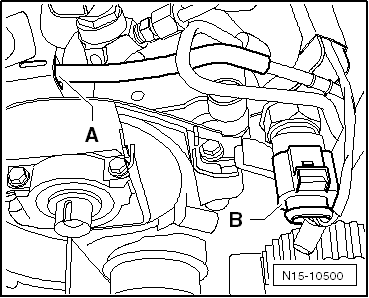
| Unscrew fuel pressure sender -G247-. |
| –
| Use suction device to extract dirt from fuel rail bore (threads and sealing surface). Do not use tools or other instruments for this purpose. |
| –
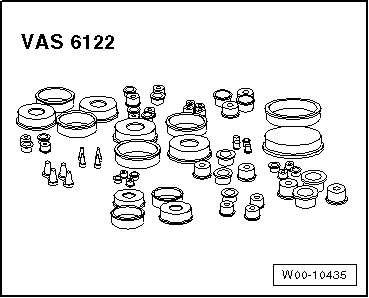
| Seal open fuel rail bore using a bung from engine bung set -VAS 6122-. |

Note | t
| Fuel pressure sender -G247- has a deformable sealing lip, not a seal, for sealing purposes. |
| t
| Check that sealing surfaces (deformable sealing lip) and threads on fuel pressure sender -G247- are undamaged. Reusing fuel pressure sender -G247- if possible if it has been tested OK. |
| t
| Check sealing surface at fuel rail bore. |
| t
| Start of thread and deformable sealing lip of fuel pressure regulating valve -N276- must be moistened with diesel. |
| –
| Tighten fuel pressure sender -G247- by hand. |
| –
| Then tighten fuel pressure sender -G247- to specified torque. |
| –
| After installing fuel pressure sender -G247-, allow engine to run at moderate speed for a few minutes in order to bleed the fuel system. |
Note | The high-pressure connections must „not“ be opened for bleeding; fuel system bleeds itself automatically. |
| –
| Carefully check entire fuel system for leaks. |
| –
| Renew the affected component if leakage still occurs after tightening to the correct torque. |
| –
| Then road-test the vehicle. Accelerate with full throttle at least once, then check the high-pressure section again for leaks. |
Note | If there is any air left in the fuel system, the engine may switch to the backup mode ('emergency running' mode) during the road test. Switch off engine and clear event memory. Then continue road test. |
| –
| Read event memory again. |
|
|
|
 WARNING