
Workshop Manuals Factory service & repair Volkswagen
01 Running gear02 Body03 Vehicle electrics04 Power transmission05 Power unit06 Heating, ventilation, air conditioning system07 4-cylinder common rail engine (2.0 l, EA189 Gen II)08 4-cylinder injection engine (1.8 and 2.0 l engine, chain drive)09 4-cylinder common rail engine (2.0 l, EA189)10 4-cylinder injection engine (1.4 l direct injection engine, turbocharger)11 4-cylinder injection engine (1.4 l direct injection engine, turbocharger and supercharger)12 4-cylinder direct injection engine (1.2 l engine, 2V, EA 111 turbocharger)13 4-cylinder common rail engine (1.6 l, EA189)14 4-cylinder injection engine (2.0 l engine, turbocharger) Volkswagen R GmbH15 4-cylinder injection engine (1.6 l roller rocker finger)16 4-cylinder injection engine (1.4 l engine)17 Fuel supply system - Diesel engines18 4-cyl. direct injection engine (2.0 l 4V turbocharger, toothed belt drive)19 Fuel supply system - petrol engines20 4-cylinder injection engine (1.6 l engine, BiFuel) Volkswagen R GmbH21 7-speed dual clutch gearbox 0AM22 Propshaft and rear final drive23 6-speed automatic gearbox 09G24 6-speed manual gearbox 02Q25 6-speed manual gearbox 02S26 6-speed dual clutch gearbox 02E27 6-speed manual gearbox 0AJ28 6-speed dual clutch gearbox 02E Volkswagen R GmbH29 5-speed manual gearbox 0A430 6-speed manual gearbox 02Q Volkswagen R GmbH31 Propshaft and rear final drive Volkswagen R GmbH32 5-speed manual gearbox 0AF33 5-speed manual gearbox 0AH34 Wheels and Tyres Guide - Standard35 Brake systems36 Running gear, axles, steering37 Wheels and Tyres Guide38 Heating and air conditioning: Auxiliary heater39 Heating, air conditioning40 Electrical system for Golf blue-e-motion41 Electrical system42 Electrical: Communication43 General body repairs, interior44 General body repairs, exterior
Volkswagen Golf Mk634 · Wheels and Tyres Guide - Standard
34 · Steering & suspension

Saw-tooth wear

Make
Volkswagen
Model
Golf Mk6
Section
Tyre noise › Saw-tooth wear
Wheels and Tyres Guide - StandardSaw-tooth wear

Saw-tooth wear

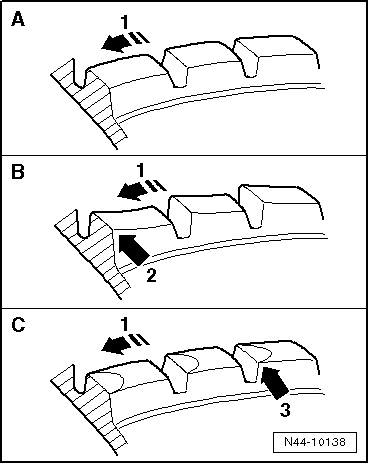
Saw-tooth wear is a stepped wear pattern on the individual tread blocks → Fig. that can cause increased tyre noise. The saw tooth is caused by uneven deformation of the tread blocks in the tyre's contact patch. Saw-tooth wear is more pronounced on non-driven wheels than on driven wheels.

New tyres are more susceptible to saw-tooth wear because of the greater elasticity of the high tread blocks. As the tread depth decreases, the tread blocks become more rigid and the tendency to wear in a saw-tooth pattern decreases.

Appearance of saw tooth
N44-10138
ATread block of a new tyre; seen in direction of motion (arrow 1), tread blocks are equally high in front and back.BDevelopment of saw teeth; seen in the direction of rotation (arrow 1), tread blocks are higher in front (arrow 2) than in back.CSeen in the direction of rotation (arrow 1), tread blocks show greater wear in the front section of the „saw tooth“(arrow 3).

Pronounced saw-tooth wear can lead to customers complaining about tyre noise.

Pronounced saw-tooth wear occurs under the following conditions:

  • toe values are too high
  • tyre pressures are incorrect
  • tread is coarse and open
  • tyres are fitted on the non-driven axle
  • very fast cornering.

non-directional tyres

In the event of saw-tooth wear, the direction of rotation of the tyre must be reversed. If saw-tooth wear is especially pronounced and tyre noise has increased, interchange the tyres diagonally. This will reduce the saw-tooth effect.

On front-wheel-drive vehicles, this effect is intensified by the greater wear on the front axle.

Tyre noise will be somewhat louder immediately after the tyres have been interchanged but will return to a normal level after about 500…1,000 km have been driven.

Directional tyres

In the event of increased saw-tooth wear on the rear tyres – in particular on front-wheel drive vehicles – interchange the front and rear tyres. In the event of increased saw-tooth wear on the outer edges of the tyres on one axle, turn both tyres around on their rims. The left-hand wheel must then be fitted on the right side of the vehicle and the right-hand wheel on the left side.

Parts & tools for this job For Volkswagen Golf

As an Amazon Associate we earn from qualifying purchases.