
Reducing agent (AdBlue®): replenishing
- Make
- Volkswagen
- Model
- Golf Mk7
- Year
- 2013–2020
- Section
- Other controlling and regulating components › Reducing agent (AdBlue®): replenishing
Reducing agent (AdBlue®): replenishing
Note
- To prevent the descriptions from becoming unclear, the “NOx reducing agent AUS 32” (AdBlue®) is merely called reducing agent (AdBlue®) in the following texts.
Warning On Blue TDI vehicles, only the reducing agent (AdBlue®) can be filled in. NEVER fill in additive which has been used in the past. It can destroy the reducing agent.
Note
- The following description applies to diesel vehicles with SCR process (selective catalytic reduction).
- Additional information on SCR process and reducing agent (AdBlue ®) can be found in the glossary → Chapter
General
- The reducing agent (AdBlue®) is not a diesel additive and must not be poured into the diesel fuel tank.
- The reducing agent (AdBlue®) is used for exhaust treatment to reduce nitrogen oxides in the exhaust gas of diesel powered vehicles.
- The reducing agent (AdBlue®) reduces these nitrogen oxides to water and nitrogen.
- The reducing agent (AdBlue®) is a high-purity 32.5% urea solution and is used in systems with exhaust treatment (SCR catalytic converters) → Chapter for diesel engines.
- The reducing agent (AdBlue®) is legally prescribed for operating vehicles with SCR.
- AdBlue® is a registered brand of the VDA (Verband der Automobilindustrie – German association of the automotive industry).
- Do not add additives to the reducing agent (AdBlue®).
- Do not dilute the reducing agent (AdBlue®) with water.
- Do not use fluid which has already been used.
- Only use the reducing agent (AdBlue®) in the intended, original containers. Also note the expiry date information.
- Additionally note the reducing agent manufacturer's usage and storage instructions.
- “NOx reducing agent AUS 32” is the designation according to ISO 22241-1.
- The reducing agent (AdBlue®) is contained in a separate tank in the vehicle. It is NOT therefore mixed with diesel fuel.
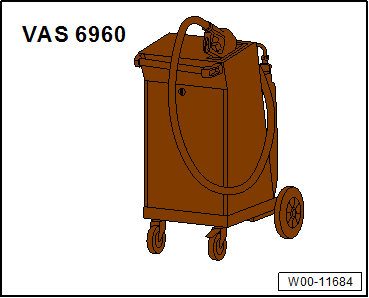
- A refill container approved by Volkswagen must be used for replenishing the reducing agent (AdBlue®).
- The tank for reducing agent has a capacity of 4 US gallons / approx 16 litres.
- The part numbers for available sizes of containers is available in ETKA.
In case of low level of reducing agent, one of the following messages appears on the dash panel insert:
- As of a remaining range of 1500 mi / 2400 km, a gong sounds with “Top up AdBlue! Remaining range 1500 mi / 2400 km”.
- As of a remaining range of 600 mi / 1000 km, a warning buzzer sounds with “Top up AdBlue! 600 mi/1,000 km remaining until engine start is no longer possible”.
- As of a remaining range of 0 km / 0 m, a three-fold warning buzzer sounds with “Top up AdBlue! Engine starting no longer possible”.
Note
- To make a new engine start possible, a minimum of 1 US gallon / 3.8 litres of reducing agent (AdBlue®) must be added.
Warning The vehicle is damaged by filling with reducing agent (AdBlue®) NOT in compliance with the standard or with other fluids.
In case of system malfunction or incorrect filling, one of the following messages appears on the dash panel insert:
- As of a remaining range of 650 mi / 1050 km “Check AdBlue! Remaining range 650 mi / 1050 km”.
- As of a remaining range of 600 mi / 1000 km, a warning buzzer sounds and “Check AdBlue! 600 mi/1,000 km remaining until engine start is no longer possible”.
- As of a remaining range of 0 km / 0 m, a three-fold warning buzzer sounds with “Top up AdBlue! Engine starting no longer possible”.
Warning
- As soon as the “Check AdBlue! No engine start possible!” message is displayed and the engine is switched off; the engine cannot be started again.
- Fault recovery Guided fault finding
Health/endangerment and cleaning
Warning
- The reducing agent (AdBlue®) may irritate the skin, eyes and respiratory organs.
- Protect your hands.
- In the event of skin contact with this fluid, immediately wash off with plenty of water.
- Seek medical attention if necessary.
Warning At all times, ensure that no reducing agent (AdBlue®) is spilled on trim or body parts.
If this has happened, wash the reducing agent (AdBlue®) out again with clear water and a lint-free cotton cloth.
If the reducing agent (AdBlue®) has already crystallised, use warm water and a sponge.
Reducing agent residues which are not removed crystallise after a while and may damage the affected surface.
Disposal instructions
Warning Information reference storage and disposal Infonet, Operation, Strategy and deadlines, Environment, Handbook Service Environmental Protection! Ask your importer about country-specific information on storage and disposal.
The refill container must be disposed of as per the environmental regulations.
Work preparation for filling reducing agent tank
Note
- Ensure that vehicle stays on an even ground.
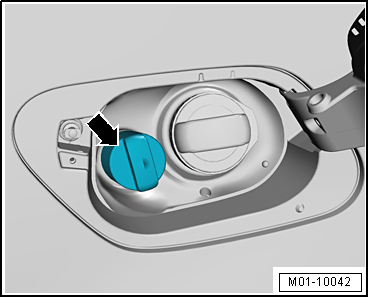
The filler opening for the reduction agent tank (AdBlue®) is located under the fuel tank flap.
Open the tank flap.
Work after filling reducing agent tank
Screw on tank cap (arrow) of the reducing agent tank (AdBlue®) until the cap locks.
Close fuel tank flap.
Parts & tools for this job For 2013 Volkswagen Golf
- TOOLA/C manifold gauge setSearch: AC manifold gauge set
- TOOLUV leak detection kitSearch: AC UV leak detection kit
- PARTCabin filterSearch: Volkswagen Golf 2013 cabin filter
As an Amazon Associate we earn from qualifying purchases.