
Leak test
- Make
- Volkswagen
- Model
- Up! Brazil-market up!
- Year
- 2014–2021
- Section
- Vacuum system › Leak test
Leak test
Note
- The average atmospheric air pressure at seal level (N. N.) is 1013 mbar, which quickly decreases as the elevation increases (approximately 100 mbar/1000 m in elevation). Local and climate variations also affect vacuum generation.
- Cold engines, activated air conditioning systems, or simply an idling engine negatively affect vacuum generation.
First, test all vacuum hoses for damages (e.g. cracks, ruptures, or rodent bites) as well as proper fitting.
Connect the servo brake vacuum measurement device VAS 6721Chapter
Open closing valve (A) .
Close the closing valve (B+C) .
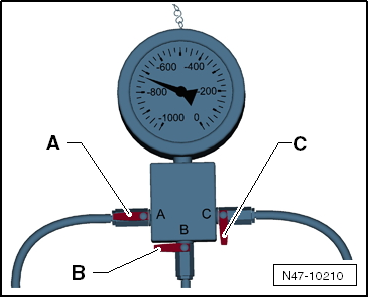
Start the engine at service temperature (>60ºC); briefly press the gas pedal once (engine rotation greater than 2000 rpm).
Under normal circumstances (check indications), the generated vacuum must be between 600 and 950 mbar (depending on the engine).
Open closing valve (C) to remove vacuum from the servo brake.
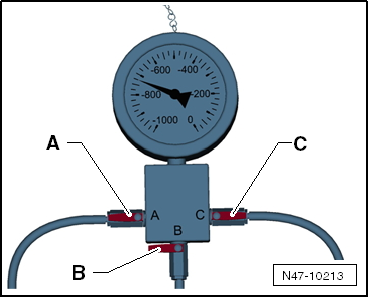
Stop the engine.
Read and register the indicated measurement.
Vacuum must lower by 400 mbar in 12 hours.
In case of greater vacuum drop, you must test the leakage point located in the region of the ...
Brake servoor theretention valve, vacuum hoses with connectors and vacuum pump/suction tube.In case of major leaks, vacuum drops abruptly within a few seconds.
After generating vacuum, close the closing valve (A) , to test the servo brake vacuum system.
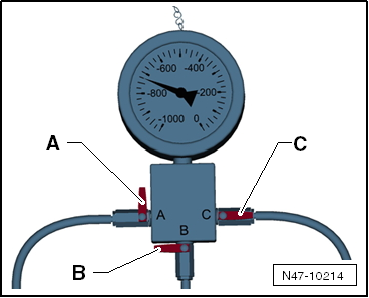
After generating vacuum, close the closing valve (C), to check the vacuum system of the servo brake vacuum measurement device VAS 6721 until the suction tube or vacuum pump.
To facilitate disassembly of adaptor and hose connections, open the closing valve (B) .
Parts & tools for this job For 2014 Volkswagen Up!
- PARTBrake padsSearch: Volkswagen Up! 2014 brake pads
- TOOLBrake bleeder kitSearch: one man brake bleeder kit
- FLUIDBrake fluidSearch: brake fluid
As an Amazon Associate we earn from qualifying purchases.