
Vacuum generation test
- Make
- Volkswagen
- Model
- Up! Brazil-market up!
- Year
- 2014–2021
- Section
- Vacuum system › Vacuum generation test
Vacuum generation test
Note
- The average atmospheric air pressure at seal level (N. N.) is 1013 mbar, which quickly decreases as the elevation increases (approximately 100 mbar/1000 m in elevation). Local and climate variations also affect vacuum generation.
- Cold engines, activated air conditioning systems, or simply an idling engine negatively affect vacuum generation.
First, test all vacuum hoses for damages (e.g. cracks, ruptures, or rodent bites) as well as proper fitting.
Connect the servo brake vacuum measurement device VAS 6721Chapter
Open closing valve (A) .
Close the closing valve (B+C) .
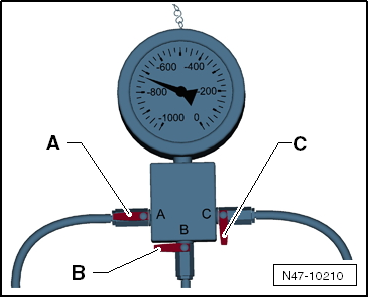
Start the engine at service temperature (>60ºC); briefly press the gas pedal once (engine rotation greater than 2000 rpm).
Read the indicated measurement.
Under normal circumstances (check indications), the generated vacuum must be between 600 and 950 mbar (depending on the engine).
If such values are not reached, despite meeting all requirements (check indications), the vacuum system must initially be tested for leaks.
Similarly, generate vacuum with the manual vacuum pump VAS 6213Chapter.
To facilitate disassembly of adaptor and hose connections, open the closing valve (B) .
Parts & tools for this job For 2014 Volkswagen Up!
- PARTBrake padsSearch: Volkswagen Up! 2014 brake pads
- TOOLBrake bleeder kitSearch: one man brake bleeder kit
- FLUIDBrake fluidSearch: brake fluid
As an Amazon Associate we earn from qualifying purchases.