
Diagnostics
- Make
- Volvo
- Model
- S80 Factory Service Manual
- Year
- 1999–2006
- Section
- 43 Transmission › Design and Function › Diagnostics
Diagnostics
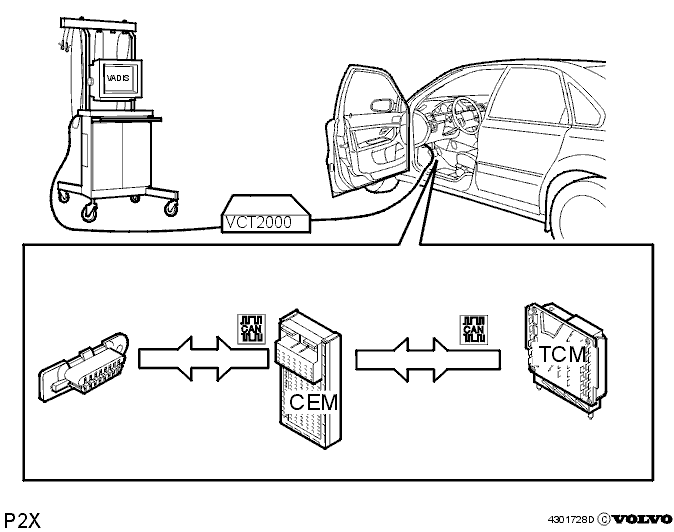
General
The on-board diagnostic (OBD) system was introduced to improve driver safety and to protect the Transmission. Furthermore, it allows for driving with reduced function (through the "Fail Safe Mode" and "Limp-home" programs).
The Transmission Control Module (TCM) has an integrated diagnostic function which checks its own function, the function of all connected components and cables and that the anticipated messages are received. In event of a fault information is stored in the form of Diagnostic trouble codes (DTCs).
If the Transmission Control Module (TCM) detects a fault a diagnostic trouble code (DTC) is stored. If the fault is serious "Limp-home" intervenes to Protect The Transmission from damage. (For information about "Limp-home" refer to the In and output signals, Illustration 2).
At the same that a diagnostic trouble code (DTC) is generated the system stores the relevant parameters with The Diagnostic Trouble code (DTC) as a "Freeze Frame".
The fault message is transmitted on the network and picked up by the affected modules. The signal for to activate the fault message travels to the Driver Information Module (DIM) via the Central Electronic Module (CEM) so that the check and warning lamps begin indication and a fault message is displayed.
Diagnostic trouble codes (DTCs) are read off via the On board diagnostic system OBD II output using VIDA. Diagnostic trouble codes (DTCs), guided fault-tracing and repair instructions are accessible via the symptom input in VIDA.
Diagnostic programs
The following programs are accessible during diagnosis:
- Reading and erasing diagnostic trouble codes (DTCs)
- Activating components and functions
- Reading off input and output signals
- Reading module identification
Diagnostic trouble codes (DTCs) and fault messages
An unlimited number of diagnostic trouble codes (DTCs) can be stored in the Transmission Control Module (TCM) which is different to previously. All diagnostic trouble codes (DTC) stored appear on the VIDA screen when it is connected to the car.
There are 13 standard symptoms in the 4T65EV / EV-GT to select between. There are step-by-step service instructions for each standard symptom.
Self-diagnosis can Identify 44 different faults, most of which are of an electrical nature. 41 of the diagnostic trouble codes (DTCs) are common to the AW 42 and the 4T65EV / EV-GT.
Of the 44 diagnostic trouble codes (DTCs) there are 5 which affect the gear selector module (more than the AW 42).
Specific diagnostic trouble codes (DTCs) for the 4T65EV / EV-GT:
| TCM 15 | Lock-up solenoid SL | Hydraulic fault |
| TCM 008D | Lock-up pressure switch | Faulty signal |
| TCM 96 | Park / neutral position shift lock solenoid | Faulty signal |
The following fault messages can be displayed in the display:
| Replace transmission oil | Fix next service |
| Internal transmission fault | Service urgent |
| Internal transmission fault | Fix next service |
| Internal transmission fault | Service necessary |
| Transmission temperature | High |
Activating components and functions
There are four components and functions which can be activated to make servicing easier:
- Shift solenoid S1
- Shift solenoid S2
- Line pressure solenoid STH
- Lock-up solenoid SL
Emergency programs
The Transmission Control Module (TCM) automatically takes certain corrective steps to protect the transmission and maintain as much driveability as possible.
The Transmission Control Module (TCM) makes an evaluation of whether the discovered fault is critical for safety or not, in the same way as previously. There are different emergency programs depending on the type of fault and how serious it is:
- Emergency program 1
- No lock-up function
- Check and warning lamps flash for certain diagnostic trouble codes (DTCs)
- Emergency program 2
- As above with no line pressure solenoid STH control (hard gearshifts). Indicator and warning lamps flash.
- Emergency position ” Limp-home”
- Interrupted activation of all solenoids (hard gearshifting, impossible to drive in certain gears). Indicator and warning lamps flash.
NOTE: Note that diagnostic trouble codes (DTCs), standard symptoms and help functions are liable to change.
Parts & tools for this job For 1999 Volvo S80
- TOOLOBD2 scannerSearch: OBD2 scanner
- TOOLDigital multimeterSearch: automotive digital multimeter
- TOOLBack-probe test leadsSearch: back probe test leads
Links open Amazon search results in a new tab. As an Amazon Associate I earn from qualifying purchases.