44 Suspension and wheelsRear "multilink" suspension · page 2 of 2
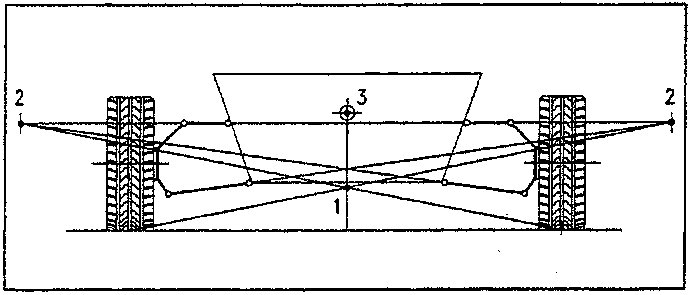
Through a suitable arrangement of the links, it is possible to set the centre of roll (1) near the centre of gravity (3); this means that when lateral forces are applied, it is possible to limit the extent of roll and changes of camber.
The movement of the suspension caused by roll of the car also ensures that the wheels are kept vertical also when cornering: this way the entire tyre tread is exploited to develop lateral adherence.
Centre of roll
Centre of instantaneous rotation
Centre of gravity of the car
Multilink suspension also limits pitching movement; therefore, in addition to improving comfort, during acceleration the weight on the front wheels is reduced less, thus the traction force that can be transmitted to the ground is not limited.
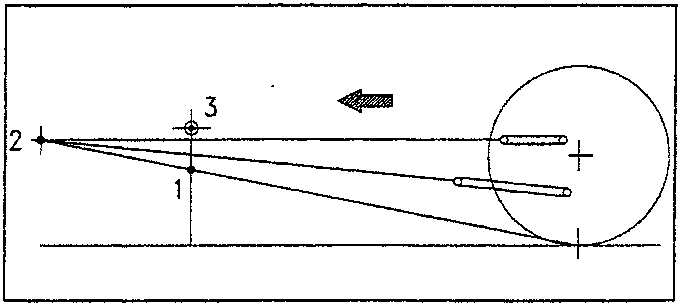
The position of the centre of instantaneous rotation (2) of the car depends on the position of the connection points to the body of the suspension arms.
Also during braking, the multilink system, even though it has only been adopted on the rear suspension, makes it possible to keep the car parallel to the ground.
Centre of pitching
Centre of instantaneous rotation
Centre of gravity of the car
Multilink suspensions involve the use of a number of links between the wheel hub and the body. The trajectories of the points of anchorage are of different radius and they are arranged on planes that are not parallel with one another.
The resulting complex geometrical system which is the outcome of extensive experiments, makes it possible to maintain the centre of instantaneous rotation (2) in such a position as to allow a reduced distance between the centre of pitching (1) and the centre of gravity of the car (3); thus it is possible to minimise the pitching movement.
It is a known fact that a car with front wheel drive, tends to understeer when cornering, due to the prevalence of drift on the driving wheels.
Multilink suspension systems, have better control over the wheel angles (camber and toe-in) and make it possible to recover the understeering effect with better performance when entering a bend, therefore it is not necessary to carry out a series of corrections of the steering angle.
In fact, these suspensions make it possible to control (and optimise both in the project and experimentally) the wheel angles under the effect of lateral and vertical loads developed when cornering and in changes of direction and also the longitudinal ones induced by braking independently.
Links open Amazon search results in a new tab. As an Amazon Associate I earn from qualifying purchases.
Help keep workshop manuals free
workshop-manuals.com provides free online workshop manuals.
If they helped you fix your car, please consider sharing or
making a small donation to keep the servers running.