
Airbag (Supplementary Restraint System)
- Make
- Aston Martin
- Model
- DB7 Factory Workshop Manual Volume 2: Electrics, Body and Air Conditioning
- Year
- 1994–1998
- Section
- Airbag system › Airbag (Supplementary Restraint System)
Airbag (Supplementary Restraint System)
Repair Procedures
Description
Two airbags are fitted to the 97 model year DB7. The drivers airbag is located in the centre of the steering wheel (Fig 1-1), the passenger airbag is located behind the fascia panel (Fig 1-2).
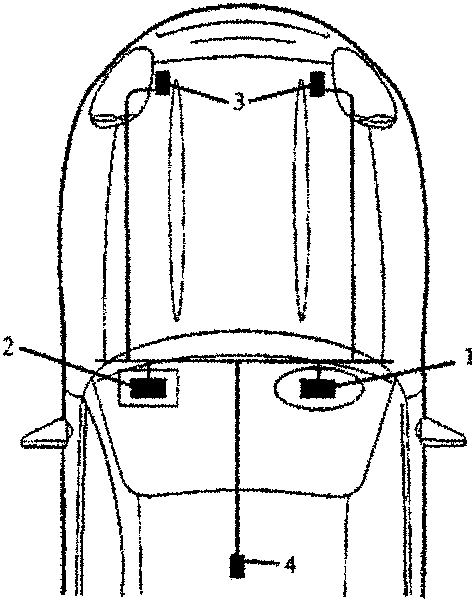
Figure 1. Airbag Locations
The following procedures and safety precautions must be adhered to while handling, installing and testing airbag modules. Failure to observe these precautions could cause the airbag to inadvertently deploy with the risk of personal injury.
The procedures and precautionary guidelines conform to the 'Handling and storage - The Explosives Act 1875 & 1923' and to the 'Health and Safety at Work Act - 1974' or local guidelines as appropriate.
Safety Precautions and Warnings
Handling Undeployed Airbags
The electrically actuated airbag module contains sodium azide and sodium nitrate which are poisonous and extremely flammable substances.
Their contact with acid, water or heavy metals may produce harmful, irritant gases or combustible compounds.
The airbag module is non-serviceable and must not be dismantled, punctured, incinerated or welded.
WARNING: Do not attempt any repairs or electrical measurements on the airbag module.
Never measure the resistance of the airbag module, as this may cause the airbag to deploy. Suspect modules must be returned to Aston Martin Lagonda Limited, or their importer for replacement.
Tampering or mishandling can result in personal injury.
Keep away from heat, sparks and open flames. Do not store at temperatures exceeding 93°C (200°F).
Keep away from electrical equipment as electrical contact may cause ignition.
Do not drop or impact the airbag module. Always position the module 'cover-up'.
Ensure that the module connector is protected to prevent damage. Never carry the airbag module by the wires or connector.
Store modules in a secure lockable cabinet.
Never position material over the undeployed module which could be projected and cause injury in the event of inadvertent deployment.
Do not wrap arms around the module when carrying and always carry the module with the cover and vents facing away from the body to avoid personal injury in the event of inadvertent deployment.
The chemical propellant mixture deploying the airbag is a solid and therefore inhalation exposure is unlikely even if the module is ruptured without deployment.
As far as practical, avoid skin contact with, or ingestion of, the materials present after combustion. Exposure to high concentrations of propellant mixture may cause headache, nausea, blurred vision, faintness, cyanosis, lowering of blood pressure, tachycardia and shortness of breath.
WARNING: Sodium azide has been listed as an 'Extraordinary Hazardous Substance or Carcinogen' by the state of Massachusetts, USA. Sodium azide has been listed on the 'Right to Know Hazardous Substance List' by the state of New Jersey and is also regarded as a 'Special Health Hazard Substance' by the state. The propellant mixture is sensitive to premature ignition by electrical sources if not properly protected and isolated.
Parts & tools for this job For 1994 Aston Martin DB7
- TOOLOBD2 scanner with SRSSearch: OBD2 scanner ABS SRS
- TOOLTrim removal tool kitSearch: trim removal tool kit
Links open Amazon search results in a new tab. As an Amazon Associate I earn from qualifying purchases.