
Remote Transmitter
- Make
- Aston Martin
- Model
- DB9 Factory Workshop Manual
- Year
- Issue 2, 2005
- Section
- Active Anti-Theft System › Remote Transmitter
Remote Transmitter
The security system allows up to eight remote transmitters to be used for controlling the system functions.
The remote transmitter come in packs of two. Each transmitter is associated with a series of numbers, which are shown on a label located on the transmitter packaging. These numbers are required to program the transmitter to a vehicle.
Caution
Do not lose the transmitter packaging, with the number label attached, before programming to the vehicle. The remote transmitters can not be programmed without the Seed and Key ID numbers.
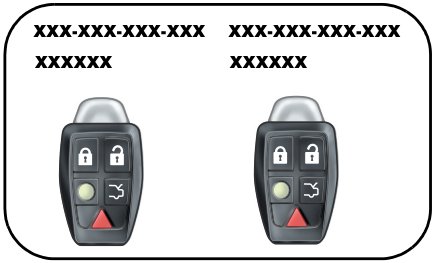
Key Learning Operations
Using WDS.
- Select ‘Set up and Configuration’.
- Select either:
- Transmitter add
- Transmitter Delete
- Follow the on screen instructions. Type in the Key ID and the Seed numbers when prompted.
- If adding a transmitter.
After programming, point a transmitter at the vehicle and attempt to lock / unlock the vehicle. If the vehicle does not lock / unlock, attempt to lock / unlock using the second transmitter from the pack.
After a successful ‘Transmitter add’ operation delete the Key ID and Seed numbers taken from the packaging label.
The remaining Key ID and Seed numbers are for the remaining remote transmitter. Ensure that they remain together.
If the CEM is required to be renewed then all remote transmitter must be renewed as well.
Integrated Passive Anti-Theft System (IPATS)
Description
IPATS (immobilisation system) is responsible for enabling / disabling engine functionality. The system is totally passive and requires no extra intervention from the user.
To prevent the engine from starting the IPATS disables the fuel pumps, injectors, and the crank circuit.
Disarming IPATS
When the ignition key is located in the ignition barrel and turned to position ‘II’, the key is validated. If successful, subsequent requests for crank and engine start will be allowed. If the key validation fails, then engine starting will be prevented.
Arming IPATS
To arm the system the user simply removes the ignition key.
IPATS LED
An IPATS LED is located in the DIM to display the immobilisation status and DTC’s using flash codes.
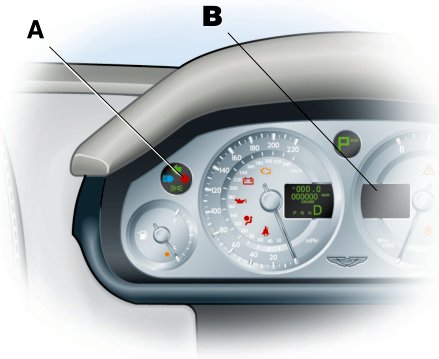
Normal behaviour following a successful key read is for the LED to illuminate for three seconds and then to extinguish.
If the self-test detects any problem with IPATS when the ignition is turned on, the IPATS LED will flash at 4Hz for 1 minute. The IPATS LED will then flash one of the following codes:
| DTC | Flash Code | Description |
|---|---|---|
| B1681 | 11 | Transceiver not connected |
| B2103 | 12 | Transceiver antenna coil malfunction |
| B1600 | 13 | No key-code from the key |
| B1602 | 14 | Invalid/Partial key code from transceiver |
| B1601 | 15 | Keycode not recognised (but correct format) |
| B1213 | 21 | Less than two keys stored |
| B1342 | EEPROM fault (failed store operation) | |
| B2431 | Key would not store, (key fault) |
Parts & tools for this job For 2005 Aston Martin DB9
- TOOLTorque wrenchSearch: 3/8 inch torque wrench
- TOOLSocket setSearch: socket set metric
- BOOKHaynes manualSearch: Haynes manual Aston Martin DB9
Links open Amazon search results in a new tab. As an Amazon Associate I earn from qualifying purchases.