
Data: Traction battery charges
- Make
- Citroën
- Model
- Saxo Factory Workshop Manual
- Year
- 1996–2004
- Section
- Air and fuel supply › Data: Traction battery charges
Data: Traction battery charges
1. Battery charge options
The 3 options for recharging the traction battery are as follows:
- At home using an earthed domestic socket of 230 volts/16 amps
- At terminals located on the public highway, installed at special parking places
- At service station rapid charging terminals
N.B.: Charging at home or at the public charging stations is done using a charging cable supplied with the vehicle.
Composition of the charging lead:
- A 230 volt mains plug with 2 male pins, live and neutral, and an earth
- A special plug to be connected to the charging socket, incorporated in the front right vehicle wing
N.B.: The mains plug also has an additional pin, offset and specific, for checking the earthing of the vehicle on connection to sockets on terminals on the public highway.
2. Charging socket plug
It is possible to gain access to the charging socket after opening the flap.
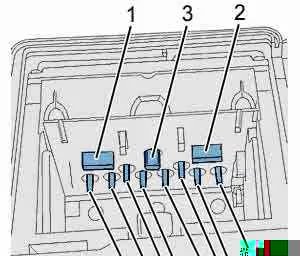
(1) Power contact (+) rapid charge (according to equipment).
(2) Power contact (-) rapid charge (according to equipment).
(3) Earth connection.
(4) Plug presence information.
(5) Pilot line earth.
(6) phase.
(7) 230 volts neutral.
(8) 230 volts live.
(9) phase.
(10) Line L.
(11) Line K rapid charge (according to equipment).
During charging, the energy gauge continuously indicates the battery charge status.
The charge begins as soon as the charging plug is connected, on condition that the flap is closed (opening the flap during charging stops charging).
At the beginning of the charge, the 4 direction indicator lamps come on continuously for 10 seconds, indicating the immediate start of charging.
When the coolant temperature is high, charging is delayed and the four direction indicators flash for 10 seconds.
N.B.: Charging is carried out with the ignition switched off; the "STOP" warning lamp comes on when the charging plug is connected.
3. Charge curves
The battery can be charged in the 4 following ways:
- Normal charge
- Equalisation charge
- Maintenance charge
- Initialisation charge
3.1. Normal charge
This charge is carried out at home using a 230 volt mains socket or using a terminal on the public highway.
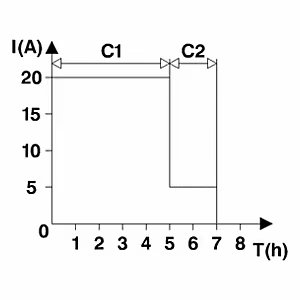
The charging operation takes place at a current of 20 amps to reach the capacity C1 of 100 Ah (maximum duration of 5 hours).
N.B.: The duration of the charge C1 period depends on the charging state of the battery when it is being charged.
In addition to the "normal" charge, an over-charge phase C2 with a current of approximately 5 amperes, fixed at 15% of the "normal" charge, is used to keep the battery capacity at its maximum.
N.B.: Over-charge C2 causes water consumption.
The amp-hours charged and "over-charged" can be counted by the ECU.
3.2. Equalisation charge
This charge is started automatically by the ECU following every charged 1000 Ah registered during "normal" charges.
This charge allows the voltages of the 20 6-volt monoblocs to be "equalised".
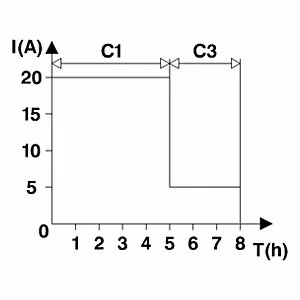
This charge is made up of the 2 following phases:
- A "normal" charge C1
- An over-charge C3 with a current of 5 amperes fixed at 3 hours
N.B.: This overcharging phase may be initiated by the diagnostic control unit.
3.3. Maintenance charge
This charge is carried out in the workshop every 10000 km or when the "low battery water level" warning lamp comes on.
N.B.: After charging, it is necessary to top up with distilled water and ensure that the warning lamp on the dashboard goes out.
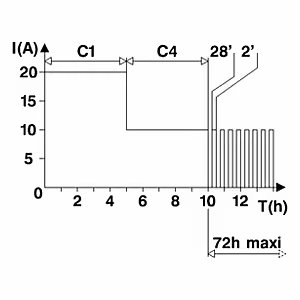
This charge is made up of the 3 following phases:
- A "normal" charge C1
- An over-charge C4 with a current of 10 amperes fixed at 5 hours
- A charging phase with a pulsed current of 10 amperes for 2 minutes every 28 minutes for 72 hours
3.4. Initialisation charge
This charge is necessary when one of the following components is replaced:
- Traction battery compartment
- Computer
- Electronic unit
N.B.: This charge is obligatory, when the ECU or charger pack are replaced, if there is no dialogue between the vehicle and the diagnostic unit.
This charge consists of resetting the ECU Ah counters to zero and equalising the voltages between monoblocs.
N.B.: This overcharging phase may be initiated by the diagnostic control unit.
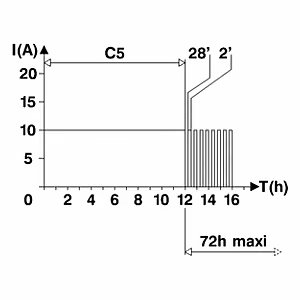
This charge is made up of the 2 following phases:
- A charge C5 with a current of 10 amperes for 15 hours
- An over-charge phase with a pulsed current of 10 amperes for 2 minutes every 28 minutes for 72 hours
N.B.: After charging, it is necessary to top up with distilled water and ensure that the warning lamp on the dashboard goes out.
3.5. Rapid charge (according to equipment)
This charge is carried out at a service station.
N.B.: Use the special lead (supplied with the vehicle) to connect the vehicle charging unit to the charging terminal.
The traction battery is charged with a current of 150 amperes.
The duration of this charge can be programmed by the user (20 minutes is enough to recharge the traction battery to 50% of its capacity).
This charge can not be carried out if there are any faults present.
4. Battery charges in exceptional cases
Depending on the condition of the traction battery, the ECU is able to start the 2 following types of preliminary charges:
- A charge with a low current (200 mA) when the battery voltage is between 10 volts and 80 volts
- A charge with a current of 10 amperes for 12 minutes when the battery voltage is between 80 volts and 105 volts
Parts & tools for this job For 1996 Citroën Saxo
- TOOLBattery testerSearch: car battery tester
- TOOLDigital multimeterSearch: automotive digital multimeter
- TOOLBattery terminal cleanerSearch: battery terminal cleaner
As an Amazon Associate we earn from qualifying purchases.