
Depressurizing the system: Hydraulic circuit
- Make
- Citroën
- Model
- Xantia Factory Workshop Manual
- Year
- 1993–1998
- Section
- Suspension › Depressurizing the system: Hydraulic circuit
Depressurizing the system: Hydraulic circuit
1. Pressure source and reserve circuit
The pressure regulator release screw allows depressurising:
- The main accumulator
- The front brakes
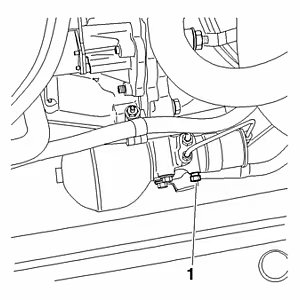
Unscrew by one turn the release screw (1).
N.B.: The whistling sound indicates that the hydraulic fluid under pressure is flowing and returning to the reservoir.
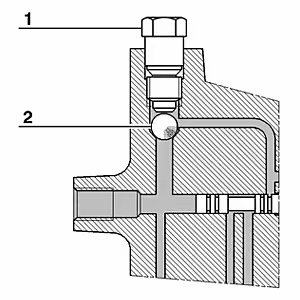
ESSENTIAL: Do not take out the release screw (1), The sealing ball could get lost (2).
2. Suspension circuit
The height control (3) allows depressurising:
- The suspension system
- The rear brakes
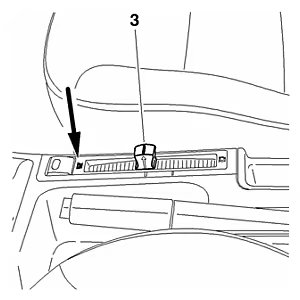
2.1. Hydraulic suspension, Non hydractive
Set the height control (3) to the "LOW" position.
Wait for the vehicle suspension to sink completely.
2.2. Hydractive suspension, engine running
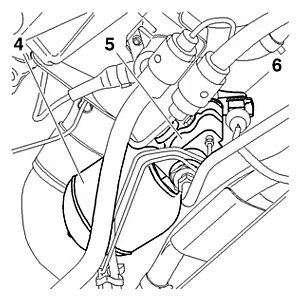
Each axle of the hydractive suspension is fitted with:
- Regulator (5)
- Pneumatic unit (4)
The regulator is operated by an electrovalve (6).
At rest, its circuit is closed, which prevents the pneumatic unit to get empty.
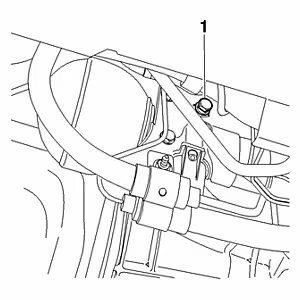
The depressurazing operation should be carried out as follows:
- Source and reserve of pressure circuit under pressure (pressure regulator release screw (1) tightened)
- Engine turning or door open to operate the electrovalve
- Set the height control to the "LOW" position
- Let the engine rotate or the door open, but do not touch the steering wheel
- Wait for the vehicle suspension to sink completely
- Stop the engine
- Unscrew by one turn the release screw (1)
2.3. Hydractive suspension, Engine not running
Should the building up of pressure in the source and pressure reserve circuit prove impossible:
- Unscrew by one turn the release screw (1)
- Set the height control to the "LOW" position
2.4. 1St possibility
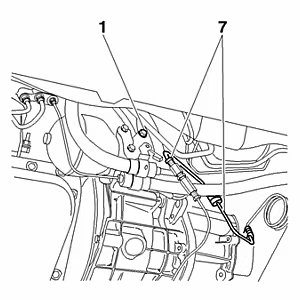
Uncouple the main feed pipe (7) from the pressure regulator.
Couple the hydraulic test bench [4034-T7] with the pipe.
Supply a 12 volt feed to the electrovalve (6), either by switching on the ignition or via a battery.
With the help of the hydraulic test bench, build up a pressure of 150 to 180 bars in order to move the front and rear regulators internal slide valves, thus allowing the pneumatic units to empty.
N.B.: Once the pneumatic units have been discharged, the rear suspension cylinders can move freely in their location.
If the pressure which has been built up does not exceed 80 to 100 bars, proceed as follows.
2.5. 2Nd possibility
Work on each regulator independantly.
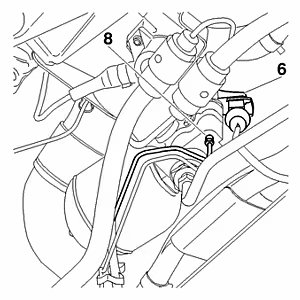
Disconnect the high pressure inlet pipe (8) (pipe opposite the electrovalve).
Couple up the hydraulic test bench [4034-T] with the regulator.
Supply a 12 volt feed to the electrovalve (6), either by switching on the ignition or via a battery.
Using the hydraulic test bench, establish a 150 to 180 bars pressure to move the internal slide valve of the regulator, thus enabling the pneumatic sphere to empty.
Apply the same procedure with the second regulator.
Parts & tools for this job For 1993 Citroën Xantia
- TOOLDigital multimeterSearch: automotive digital multimeter
- PARTAssorted fuse kitSearch: car fuse assortment kit
- TOOLWire crimper and connector kitSearch: wire crimper connector kit
As an Amazon Associate we earn from qualifying purchases.