
Electrical features: Hydractive suspension
- Make
- Citroën
- Model
- Xantia Factory Workshop Manual
- Year
- 1993–1998
- Section
- Suspension › Electrical features: Hydractive suspension
Electrical features: Hydractive suspension
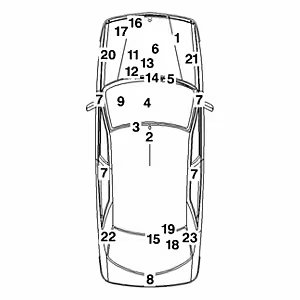
| Specific parts nomenclature | ||
|---|---|---|
| Reference | Designation | Numbers on the electrical diagrams |
| 1 | Suspension control unit | 7715 |
| 2 | switch | 7710 |
| 3 | Steering wheel’s angle sensor | 7700 |
| 4 | Acceleration sensor | 7707 |
| 5 | Sensor for body movement | 7705 |
| 6 | Vehicle speed sensor | 1620 |
| 7 | Door pillar switches | 3000 - 3003 |
| 8 | Contact switch for the trunk | 3100 (8610) |
| 9 | Diagnostic socket | C001 |
| 11 | Security valve | - |
| 12 | Brake control valve | - |
| 13 | Brake pressure sensor | 7706 |
| 14 | Front height corector | - |
| 15 | Rear height corrector | - |
| 16 | Front solenoid valve | 7716 |
| 17 | Front suspension regulator | - |
| 18 | Rear suspension regulator | - |
| 19 | Rear solenoid valve | 7717 |
| 20 | L.H. front suspension unit | - |
| 21 | R.H. front suspension unit | - |
| 22 | L.H. rear suspension unit | - |
| 23 | R.H. rear suspension unit | - |
1. Suspension control unit
Valeo mark.
ECU (1) is connected to the electrical circuit by two white and black 15-way connectors.
Maximum consumption when not running (ignition switched off and after a delay):
- Doors and boot closed: 2mA
- Doors and/or boot open: 100mA
CAUTION: Although the ECUs fitted in production to the CITROEN VALEO and XM bear the same XANTIA reference, their internal parameters are different.
ESSENTIAL: Do not equip a CITROEN XM with a XANTIA ECU and vice versa.
1.1. Purpose of the ECU
It controls the electrovalves (16) and (19) electrically and simultaneously (refer to the Note).
The ECU also monitors the components of the system:
- Sensors
- Actuators
- Electronic connections
- Suspension control unit
- Supply
It watches the operation of the program.
Should a failure occur, the ECU:
- Ensures the max. possible security
- Programs the system to operate in backup mode
- Carries out an autodiagnostic of the main components and functions
N.B.: Supplied by the ECU, the two electrovalves switch the suspension from the"firm" to the "soft" state and vice versa.
1.2. Operating principle of the electrovalves
The suspension mode changes are controlled, in anticipation, by one of the five following parameters:
- Steering wheel angle
- Steering wheel speed
- Braking
- Pressing of the accelerator pedal
- Body vertical movement
These parameters are chosen, according to the speed of the vehicle, to determine in anticipation the lateral, longitudinal or vertical accelerations of the vehicle.
2. Suspension electrovalves
Supplied by the ECU, the two electrovalves switch the suspension from the"firm" to the "soft" state and vice versa.
3. Suspension switch
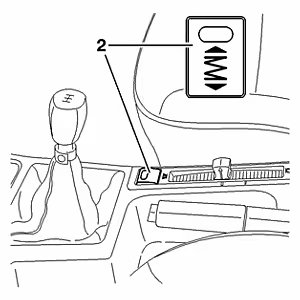
Suspension switch (2) makes it possible to choose between the "NORMAL" position or the "SPORT" position.
The switch, enabling above selection, is:
- Closed in the "NORMAL" position (ECU earthed)
- Open in the "SPORT" position
Normal operation of the warning lamp (with ignition on):
- Switch set to the "NORMAL" position = Lamp off
- Side lamps = Warning lamp slightly illuminated
- Switch in the "SPORT" position = Indicator lamp lit
N.B.: Whatever the position of the switch, the suspension can be in the "soft" or the"firm" mode; but the threshold figures will vary.
4. Vehicle speed sensor
It is a "HALL effect" type sensor:
- 8 Impulses per revolution
- 5 Impulses per metre
The sensor informs the ECU on the vehicle speed.
Supplied with 12 volts, the sensor generates a periodical tooth-shaped signal whose frequency varies with the vehicle speed.
5. Steering wheel’s angle sensor
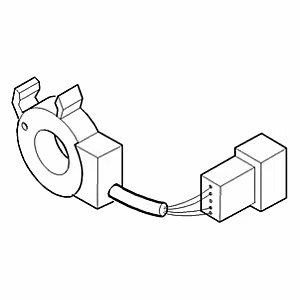
Valeo mark.
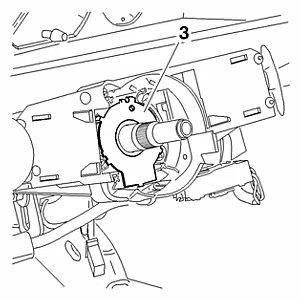
Steering wheel angle sensor (3) consists of a rotor with 28 slots and a double opto-electronic sensor.
The phonic wheel is set in rotation by the steering column.
Supplied with 5 volts, the sensor generates an impulse whenever the optical sensor detects a slot in the rotor.
After processing of the signal, the ECU:
- Determines the direction of the steering wheel rotation
- Calculates the steering wheel’s rotation speed
- Determines the straight-ahead position (if the vehicle speed exceeds 30 miles/h)
- Calculates the angular position of the steering wheel (in relation to the straight line)
- Compares the value found with the speed of the vehicle
- Gives instructions, or not, to change the suspension system to the "firm" mode
The suspension switch-over to "firm" mode is achieved by comparing:
- The steering wheel rotational speed in relation to the vehicle speed
- The rotational angle of the steering wheel in relation to the vehicle speed
5.1. Steering wheel speed thresholds
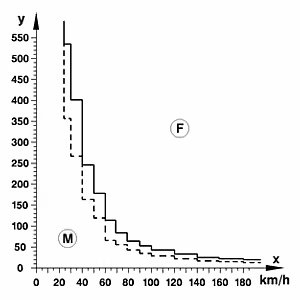
__: Switch set to the "NORMAL" position.
--: Switch in the "SPORT" position.
X: Vehicle speed (miles/h).
Y: Steering wheel speed (degrees/second).
M: "soft" mode.
F: "firm" mode.
| Steering wheel speed (degrees/second) | ||
| Vehicle speed (miles/h) | NORMAL | Sport |
| 24-29 | 535 | 357 |
| 30-39 | 401 | 267 |
| 40-49 | 246 | 164 |
| 50-59 | 178 | 119 |
| 60-68 | 114 | 76 |
| 69-78 | 84 | 56 |
| 79-89 | 64 | 43 |
| 90-99 | 53 | 35 |
| 100-119 | 43 | 29 |
| 120-139 | 33 | 22 |
| 140-158 | 25 | 17 |
| 159-179 | 22 | 15 |
| 180 | 20 | 13 |
As soon as a parameter value exceeds the threshold, a change to the "firm mode" occurs; the suspension will return to the "soft mode" when the parameter value is again lower than the threshold and after a delay.
Time delay: 1 to 2 seconds.
N.B.: During the steering wheel return to the straight-ahead position phase, the transition threshold values are multiplied by two.
5.2. Steering wheel angle thresholds
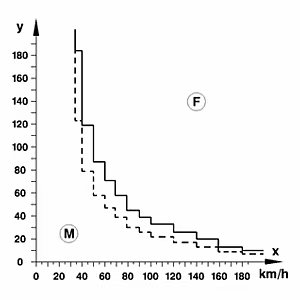
__: Switch set to the "NORMAL" position.
--: Switch in the "SPORT" position.
X: Vehicle speed (miles/h).
Y: Steering wheel angle (degrees).
M: "soft" mode.
F: "firm" mode.
Whenever the sensor data exceeds the threshold value, the suspension system switches into "firm" mode.
Time delay: 1 to 2 seconds.
| Steering wheel angle (degrees) | ||
| Vehicle speed (miles/h) | NORMAL | Sport |
| 34-39 | 184 | 123 |
| 40-49 | 119 | 79 |
| 50-59 | 87 | 58 |
| 60-68 | 71 | 47 |
| 69-78 | 58 | 39 |
| 79-89 | 45 | 30 |
| 90-99 | 39 | 26 |
| 100-119 | 33 | 22 |
| 120-139 | 26 | 17 |
| 140-158 | 20 | 13 |
| 159-179 | 13 | 9 |
| 180 | 10 | 7 |
N.B.: If the time taken to change to "firm" state exceeds 2 minutes, the ECU will switch the system back to "soft" state.
6. Acceleration sensor
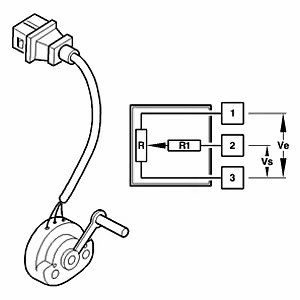
Valeo mark.
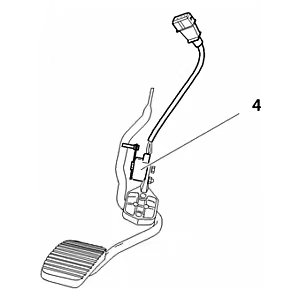
Acceleration sensor (4) consists of a potentiometer mechanically linked to the accelerator pedal.
Supplied in 5 volts, the sensor converts this voltage according to the position of the pedal.
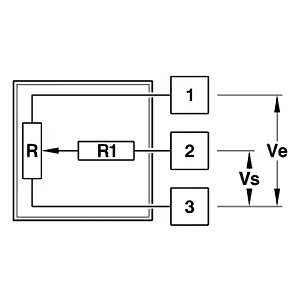
R = 4,2 K.ohms.
R1 = 1,7 K.ohm.
Ve = Supply voltage (5 volts).
Vs = Output voltage (0-5 volts).
After processing of the signal, the ECU:
- Determines the pedal depressed and released speed
- Compares the value found with the speed of the vehicle
- Gives instructions, or not, to change the suspension system to the "firm" mode
The suspension switch-over to "firm" mode is achieved by comparing:
- The accelerator pedal depressed speed in relation to the speed of the vehicle
- The acelerator pedal release speed in relation to the speed of the vehicle
The ECU divides the overall travel of the acelerator pedal into "n" spaces.
The speed of the accelerator pedal is determined in "spaces" per second.
"n" included between 130 and 220 varies according to the min. pedal adjustment.
The ECU determines the number of "spaces" run in 25 ms.
6.1. Accelerator depressed thresholds
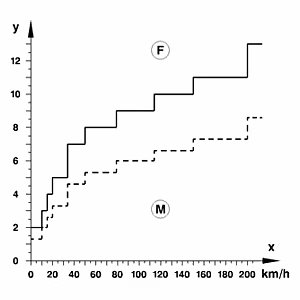
__: Switch set to the "NORMAL" position.
--: Switch in the "SPORT" position.
X: Vehicle speed (miles/h).
Y: Pressing of the accelerator pedal (spaces/ms).
M: "soft" mode.
F: "firm" mode.
Whenever the sensor data exceeds the threshold value, the suspension system switches into "firm" mode.
Time delay 1 to 1,5 seconds.
| Accelerator pedal depressed (spacing/ 25 ms) | ||
| Vehicle speed (miles/h) | NORMAL | Sport |
| 0-9 | 2 | 1,3 |
| 10-14 | 3 | 2 |
| 15-19 | 4 | 2,6 |
| 20-33 | 5 | 3,3 |
| 34-49 | 7 | 4,6 |
| 50-78 | 8 | 5,3 |
| 79-113 | 9 | 6 |
| 114-149 | 10 | 6,6 |
| 150-199 | 11 | 7,3 |
| >199 | 13 | 8,6 |
6.2. Accelerator release thresholds
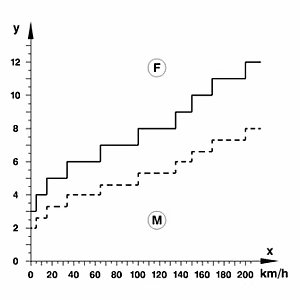
__: Switch set to the "NORMAL" position.
--: Switch in the "SPORT" position.
X: Vehicle speed (miles/h).
Y: Accelerator pedal foot off (spaces/25ms).
M: "soft" mode.
F: "firm" mode.
Whenever the sensor data exceeds the threshold value, the suspension system switches into "firm" mode.
Time delay 1 to 1,5 seconds.
| Accelerator pedal release (spaces/ 25 ms) | ||
| Vehicle speed (miles/h) | NORMAL | Sport |
| 0-4 | 3 | 2 |
| 5-14 | 4 | 2,6 |
| 15-33 | 5 | 3,3 |
| 34-64 | 6 | 4 |
| 65-99 | 7 | 4,6 |
| 100-134 | 8 | 5,3 |
| 135-149 | 9 | 6 |
| 150-168 | 10 | 6,6 |
| 169-199 | 11 | 7,3 |
| >199 | 12 | 8 |
7. Sensor for body movement
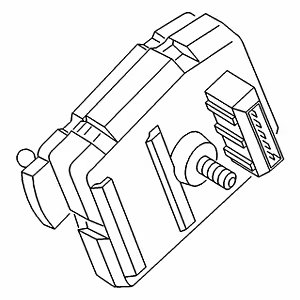
Valeo mark.
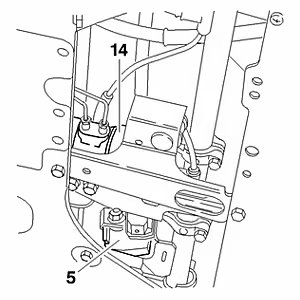
Body movement sensor (5) consists of a 45-tooth crown wheel and a double opto-electronic sensor.
The crown wheel is rotated by the front anti-roll bar.
Supplied with 12 volts, the sensor generates an impulse whenever the opto-electronic sensor detects a slot in the crown wheel.
The body movement sensor is situated on the front subframe, to the right of the front height corrector.
After processing of the signal, the ECU:
- Determines the direction of rotation of the crown wheel
- Calculates the speed of the travel
- Determines the average height and readjusts it
- Calculates the travel by difference with the average height
- Compares the value found with the speed of the vehicle
- Gives instructions, or not, to change the suspension system to the "firm" mode
The suspension switch-over to "firm" mode is achieved by comparing: The movement value with the vehicle speed.
The thresholds for changing into "firm" are identical whatever the position of the switch ("NORMAL" or "SOFT").
7.1. The thresholds for changing in the "firm" mode can be modified - Correction: "wheel shocks"
The threshold figures for switching to the "firm" state will be corrected if the speed of the road wheel movement exceeds 300 mm/s. In that case, the threshold values will be equal to 60 mm for 0,4 second.
7.2. The thresholds for changing in the "firm" mode can be modified - Correction: "damaged road wheel"
The threshold figures for changing to "firm" will be applied if the body movements are equal to 60 mm for 0,4 s, more than 3 times in 3 s. In that case, the threshold values will be equal to 60 mm for 2 seconds.
7.3. The thresholds for changing in the "firm" mode can be modified - Corrections cancelled if:: "wheel shocks" "damaged road wheel"
The above corrections are not applied if:
- Switch in the "SPORT" position
- Vehicle speed over 159 mph
- Steering wheel angle superior to the threshold values indicated on the tables
7.4. Body movement thresholds: Compression (mm)
When the front of the vehicle "sinks", the body movement sensor is activated, which may cause a change to "firm" mode.
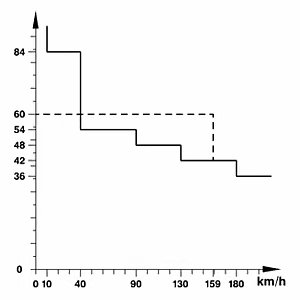
__: Standard threshold.
--: Corrected threshold.
X: Vehicle speed (miles/h).
Y: Body vertical movement - Compression (mm).
M: "soft" mode.
F: "firm" mode.
Whenever the sensor data exceeds the threshold value, the suspension system switches into "firm" mode.
Time delay 0,8 seconds.
| Vehicle speed (miles/h) | Compression (mm) | Correction: Compression (mm) | Correction: Type | Correction cancelled if steering wheel angle upper to (degrees) |
| 10 - 33 | 84 | 60 | "wheel shocks" - "damaged road wheel" | - |
| 34 - 39 | 92 | |||
| 40 - 49 | 54 | 59,5 | ||
| 50 - 59 | 43,5 | |||
| 60 - 68 | 35,5 | |||
| 69 - 78 | 29 | |||
| 79 - 89 | 22,5 | |||
| 90 - 99 | 48 | 19,5 | ||
| 100 - 119 | 16,5 | |||
| 120 - 129 | 13 | |||
| 130 - 139 | 42 | 13 | ||
| 140 - 158 | 10 | |||
| 159 - 179 | - | |||
| >179 | 36 | |||
7.5. Body movement thresholds: Rebound (mm)
When the front of the vehicle "rises", the sensor is activated,which may cause a switch-over to "firm" mode.
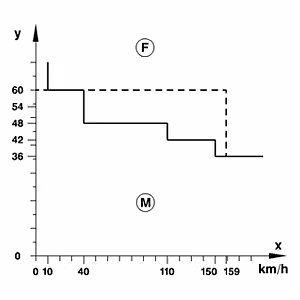
__: Standard threshold.
--: Corrected threshold.
X: Vehicle speed (miles/h).
Y: Body vertical movement - Rebound (mm).
M: "soft" mode.
F: "firm" mode.
Whenever the sensor data exceeds the threshold value, the suspension system switches into "firm" mode.
Time delay 0,8 seconds.
| Vehicle speed (miles/h) | Rebound (mm) | Correction: Compression (mm) | Correction: Type | Correction cancelled if steering wheel angle upper to (degrees) |
| 10 - 33 | 60 | 60 | "wheel shocks" - "damaged road wheel" | - |
| 34 - 39 | 92 | |||
| 40 - 49 | 48 | 59,5 | ||
| 50 - 59 | 43,5 | |||
| 60 - 68 | 35,5 | |||
| 69 - 78 | 29 | |||
| 79 - 89 | 22,5 | |||
| 90 - 99 | 19,5 | |||
| 100 - 109 | 16,5 | |||
| 110 - 119 | 42 | 16,5 | ||
| 120 - 139 | 13 | |||
| 140 - 149 | 10 | |||
| 150 - 158 | 36 | 10 | ||
| >159 | - | |||
Examples:
- Switch in the "NORMAL" or "SPORT" position: At 100 miles/h, with a body movement exceeding 48 mm, the suspension will switch to the "firm" setting. The system will revert to "soft" if the rebound is inferior to 48 mm and after a time delay of 0,8 second
- Switch set to the "NORMAL" position: At 70 miles/h, with a speed of the body movement exceeding 300 mm/s and a turning angle inferior to 35,5 degrees, the suspension will switch to "firm" mode. The system will revert to "soft" state if the body movement returns to normal conditions and after a time delay of 0,8 second
8. Brake pressure sensor
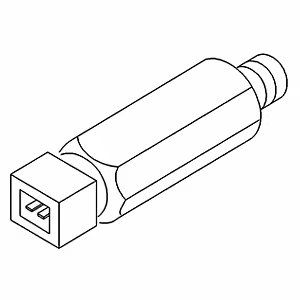
make: BENDIX.
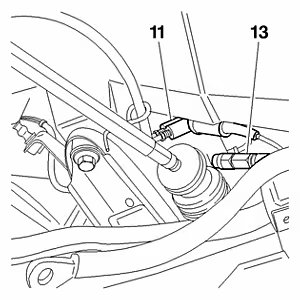
Brake pressure switch (13) consists of a switch hydraulically linked with the brake pedal.
Closed at rest, the switch will open for a pressure, in the brake circuit, of over 30 bars.
The ECU advises the change to "firm" state when:
- The vehicle speed exceeds 24 km/h
- The pressure in the braking circuit, is above 30 bars
9. Doors and boot switches
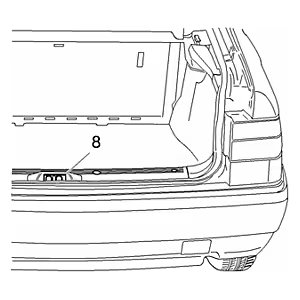
The 4 door pillar switches (7) and boot switch (8) are operated by the boot and doors.
Open at rest, a switch will close whenever the corresponding door is opened.
9.1. Aim of the switches
The doors and boot switches prevent the vehicle from jolting when a door is open.
The anti-jolt function is achieved by balancing the pressure between the spheres of the suspension units and the spheres of the suspension regulators. The ECU supplies the electrovalves, thus inducing "soft" state.
9.2. Principles of operation
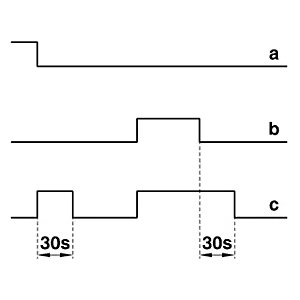
A: +via ignition switch.
B: Doors and boot switch.
C: Solenoid valve.
The electrovalves are supplied:
- For 30 seconds after the ignition is switched off
- During a door opening and for 30 seconds after closing it
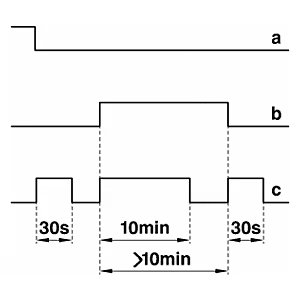
The feed to the electrovalves is limited to 10 minutes if a door remains open.
Parts & tools for this job For 1993 Citroën Xantia
- TOOLCoil spring compressorSearch: coil spring compressor
- TOOLBall joint separatorSearch: ball joint separator
- PARTShock absorbersSearch: Citroën Xantia 1993 shock absorbers
As an Amazon Associate we earn from qualifying purchases.