
Battery
- Make
- Fiat
- Model
- Punto (176) Factory Service Manual
- Year
- 1993–1999
- Section
- Recharging system › Battery
BATTERY
The batteries fitted to all versions of the Punto are of the maintenance-free type and so do not require maintenance.
This type of battery has the following advantages over conventional batteries:
- very low electrolyte consumption owing to the use of a new type of alloy for the construction of the grids and plates;
- extremely low self-discharge rate which offers good starting capacity for a period of 7 months; it therefore lends itself to prolonged storage (at temperatures of below 28°C);
- a reduction in the volumes of gases developed during charging, which are those that cause corrosion and consequently poor contact on the terminals.
If a discharged battery is suspected, after leaving the battery on an open circuit for at least two hours, measure the voltage without load, connecting a digital voltmeter to its terminals. If the reading is below 12.30 V it is 50% charged; if it is 12.48 V it is 75% charged, and if it is 12.66 V it is 100% charged.
If the electrolyte level in one or more cells of the battery is below the minimum level marked on the plastic container, open the cell cover and add distilled and deionized water (as for ordinary batteries).
NOTE Do not subject the battery to fast charging at voltages of over 15.5 V, or to high recharging currents or amperages.
ALTERNATOR
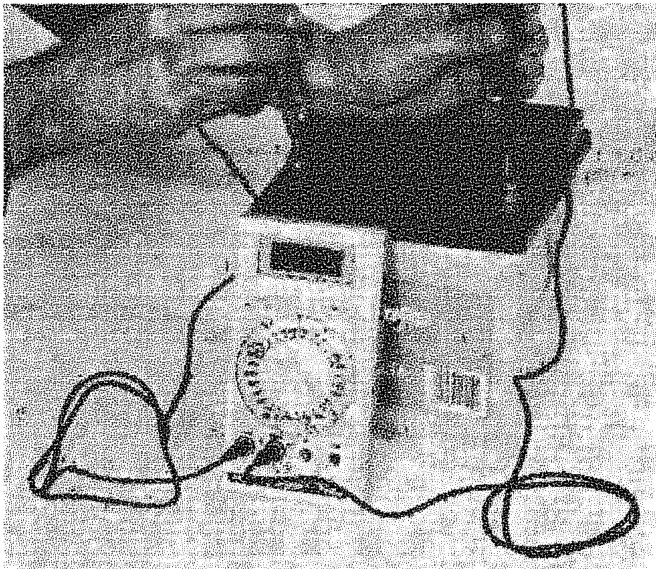
Checking the voltage and maximum current intensity delivered by the alternator on the car, using a digital multimeter and HALL effect clip-on ammeter.
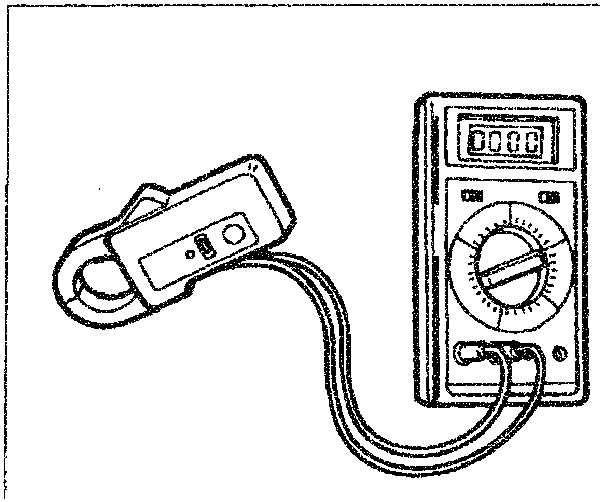
Description and use of the clip-on ammeter
This is clipped to a multimeter and permits the following to be measured: battery charging and discharging current, SCR (silicon-controlled diode) controlled current and currents absorbed by starter motors, between 10 and 600 A without the circuit having to be interrupted. Before starting the measurements:
- set the 'LO-HI'switch on the clip to "LO" for measurements up to 200 A or to "HI" for measurements between 200 and 600 A.
The reading is obtained in both positions for any value, but it is necessary to change the position to ensure greater precision of the reading on the display.
- After connecting the clip to the multimeter, set the multimeter to the 200 mV or 2 V range, alternating or direct depending on the current to be measured.
If the selected range is 200 mV, the reading will be given directly in amperes; if the range is 2 V, the reading must be multiplied by one thousand. - The reading must then be reset by operating the "ZERO ADJUST" button on the clip-on ammeter. If there is reason to suspect the existence of dispersed magnetic fields, the ammeter should be reset while being held at a distance of 5-10 cm from the operator.
When measuring DC, a possible hysteresis phenomenon could render it impossible to reset the clip. In this case, open and close the clip a few times and then reset it.
Parts & tools for this job For 1993 Fiat Punto
- TOOLBattery testerSearch: car battery tester
- TOOLDigital multimeterSearch: automotive digital multimeter
- TOOLBattery terminal cleanerSearch: battery terminal cleaner
Links open Amazon search results in a new tab. As an Amazon Associate I earn from qualifying purchases.