
b) Checking for hydraulic pressure
- Make
- Mazda
- Model
- MX-5 (NA) Factory Workshop Manual
- Year
- 1990–1992
- Section
- P Braking system › b) Checking for hydraulic pressure
Braking systemb) Checking for hydraulic pressure
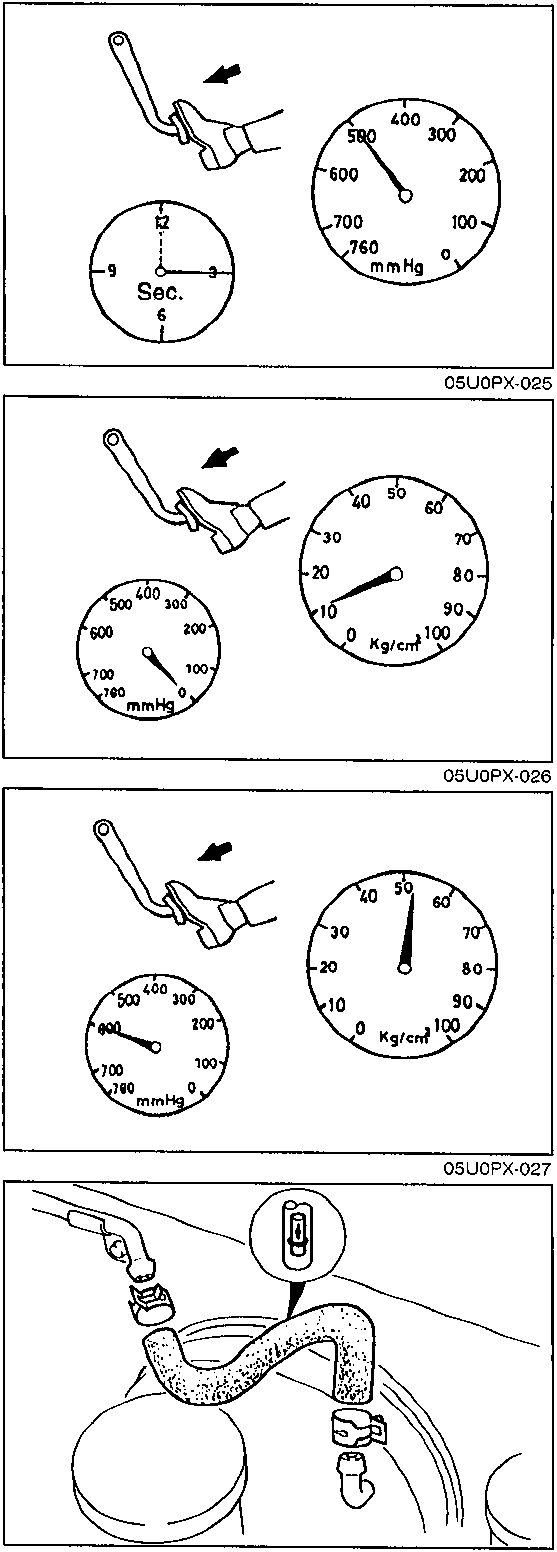
Loaded condition
- Start the engine.
- Depress the brake pedal with a force of 196 N (20 kg, 44 lb).
- With the brake pedal depressed, stop the engine when the vacuum gauge indicates 500 mmHg (19.7 inHg).
- Observe the vacuum gauge for 15 seconds. If the gauge indicates 475—500 mmHg (18.7—19.7 inHg), the unit is operating.
b) Checking for hydraulic pressure
- If with the engine stopped (vacuum 0 mmHg [0 inHg]) the fluid pressure is within specification, the unit is operating.
| Pedal force | Fluid pressure |
|---|---|
| 196 N (20 kg, 44 lb) | 1,079—1,177 kPa (11—12 kg/cm², 156—171 psi) |

- Start the engine. Depress the brake pedal when the vacuum reaches 500 mmHg (19.7 inHg). If the fluid pressure is within specification, the unit is operating.
| Pedal force | Fluid pressure |
|---|---|
| 196 N (20 kg, 44 lb) | 5,199—5,494 kPa (53—56 kg/cm², 754—796 psi) |
Inspection of check valve
Note
• The check valve is pressed into the vacuum hose. There is an arrow on the hose to indicate direction of hose installation.
Inspection
- Disconnect the vacuum hose from the engine.
- Apply suction and pressure to the hose from the engine side. Verify that air flows only toward the engine. If the air passes in both directions or not at all, replace the vacuum hose (along with the check valve).

Parts & tools for this job For 1990 Mazda MX-5
- TOOLTorque wrenchSearch: 3/8 inch torque wrench
- TOOLSocket setSearch: socket set metric
- BOOKHaynes manualSearch: Haynes manual Mazda MX-5
Links open Amazon search results in a new tab. As an Amazon Associate I earn from qualifying purchases.