
Gearbox Interface Unit (GIU)
- Make
- MG
- Model
- TF Factory Workshop Manual
- Year
- 2002–2005
- Section
- Description and operation › Gearbox Interface Unit (GIU)
When the transmission is in any position other than the Park (P) or Neutral (N) positions, the switch interrupts the starter relay coil earth path to the alarm ECU preventing starter operation. This signal is also used by the ECM to adjust the stepper motor of the IAC valve to adjust the engine idle speed when Reverse (R) or Drive (D) is selected.
When Reverse (R) is selected, the switch moves to its second position and activates the reverse lamps.
In selected markets, when the selector lever is in the ’P’ position and the ignition is switched on, the park/neutral switch input causes the GIU to energise a shift lock solenoid on the selector lever. This locks the lever in the ’P’ position. The selector lever cannot be moved from the ’P’ position until the ignition is switched on and the footbrake is applied. The shift lock solenoid is only active when the ignition is on.
Road speed transducer
The road speed transducer is located on the rear face of the gearbox, above the RH drive shaft, adjacent to the gearbox differential speed sensor. The transducer is used by the instrument pack for speedometer drive, the Electronic Power Assisted Steering (EPAS) system and the ECM. See INSTRUMENTS, Information. See STEERING, Information.
Gearbox Interface Unit (GIU)
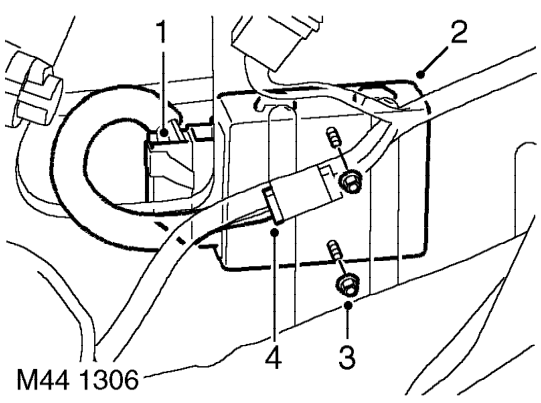
- Harness connector
- GIU
- Mounting nut (2 off)
- GIU fuse (10A)
The GIU is located in the in the LH side of the luggage compartment behind the trim. The GIU has two captive studs which are secured to the body with two nuts.
When the engine control module relay is engaged uner the control of the ECM, battery voltage is supplied to the GIU from fuse 2 in the engine compartment fusebox via a 10 Amp in-line fuse located on the harness near the GIU connector.
The GIU responds to control messages from the ECM to control the gearbox operation. The GIU also passes messages to the ECM in response to driver input commands enabling the ECM to operate the gearbox accordingly.
The ECM and GIU have a programmed default strategy which is engaged when specific faults are detected. Any condition requiring the default strategy will be relayed to the driver by illumination of the gearbox fault lamp in the instrument pack.
The ECM will need to learn the ratio control motor position when a new ECM is fitted. This is performed automatically by the ECM using a fast adaptation procedure. Refer to Operation section for details.
A ’limp-home mode’ is provided if the system detects a fault but is still able to control the gearbox ratio. In addition to the fault lamp illumination, the driver will experience the engine speed being limited to approximately 3000 rev/min.
If the system is unable to control the gearbox ratio, the ECM will be unable to implement the default strategy, the gearbox will remain in a single ratio and the fault lamp will illuminate. If in the lowest gear, the engine speed will increase rapidly to 6000 rev/min and vehicle speed will be limited to a maximum of 30 mph (48.3 km/h). If in the highest gear, the driver will experience very slow acceleration and engine speeds of approximately 2000 to 2250 rev/min at 50 mph (80.5 km/h).
A single multiplug provides all input and output connections to and from the GIU. The following table shows the harness connector pin numbers and input/output information.
Parts & tools for this job For 2002 MG TF
- PARTTransmission filter kitSearch: MG TF 2002 transmission filter kit
- FLUIDAutomatic transmission fluidSearch: MG automatic transmission fluid
- TOOLFluid transfer pumpSearch: fluid transfer pump
Links open Amazon search results in a new tab. As an Amazon Associate I earn from qualifying purchases.