
Function of air quality sensor G238
- Make
- SEAT
- Model
- Leon León
- Year
- 5F, 2012–2020
- Section
- Heating, air conditioning › Function of air quality sensor G238
Function of air quality sensor G238
Note
- air quality sensor G238(1) is only fitted with automatically controlled air conditioners.
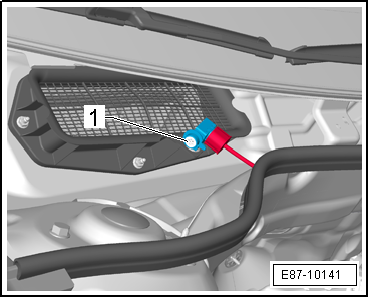
- G238 uses one sensor each to determine the NOx (nitrogen oxide) content and the CO (carbon monoxide) content of the air flowing past and exchanges this information with the onboard supply control unit J519 by way of the data bus.
- G238 is evaluated by J519 and transmitted to the operating unit, Climatronic control unit J255 via the data bus. The J255 switches to recirculated air mode where required as long as no deactivation conditions are fulfilled Vehicle diagnosis, testing and information system VAS in the function .
Note
- ) can be activated and deactivated by way of the MMI (Multi Media Interface) in the function of the / menu.
- G238 needs a short time to attain its operating temperature. The function of G238 is restricted during the warm-up phase.
- G238 detects pollutants in the ambient atmosphere (generally petrol and/or diesel emissions) and causes J255 to switch the air conditioner to air recirculation mode.
- Climatronic control unit J255 recognises the nature and level of the air pollution from the G238 signal. In addition, J255 receives the sensitivity setting via the data bus from the multimedia system operating unit E380. J255 then decides on the basis of this information whether and when to switch the air conditioner to air recirculation mode.
Example:
If the outside temperature is higher than around about 2°C, the recirculated-air mode is changed by requesting the G238 with a minimum increase in the pollutant concentration.
If the outside temperature is lower than around about 1°C and the air conditioner compressor switches off, the switching is only carried out if a considerable increase of the pollutant concentration is measured over a period of 15 seconds. If another increase of the pollutant concentration is measured within a period of 2 minutes, switching of the J255 to the “automatic recirculated-air mode” will not take place.
- AC button does not light, the maximum time is restricted to roughly 15 seconds by J255 to stop the windows in the passenger compartment misting up.
A decrease in the concentration of pollutants in the fresh air drawn in results in the air conditioner being switched back to fresh air mode.
- time is governed by the J255 version, the setting on E380 and the measured values of G355.
With a lower outside temperature of around about +10 °C and a maximum sensitivity of the E380, the system remains in “automatic recirculated-air mode” for about 30 seconds; then it switched to fresh air mode. If another increase of the pollutant concentration is measured within a period of 2 minutes, switching of the J255 to the “automatic recirculated-air mode” will not take place.
- function can be deactivated any time. When the function is active, the air conditioner compressor switches on when requested by the , even at temperatures that are below +2°C. The compressor, however, cannot be put into operation with low temperatures of approx. -5°C.
- set in the MMI (Multi Media Interface), the air conditioner compressor can remain activated down to a temperature of approx. -5 °C.
- G238 is adaptive (its sensitivity is matched to the environmental impact).
- G238 starts to adapt to the change in ambient conditions by way of an adaption program, with the result that an air recirculation request is generally applied for less than 12 minutes given uniform ambient air pollution. If there are several consecutive peak impact levels, the air conditioner may also operate in air recirculation mode for a longer period.
- A certain amount of time is required for repositioning of the air conditioning system flaps. To prevent gaseous pollutants entering the passenger compartment with the fresh air drawn in prior to closure of the air flow/fresh air flaps (and opening of the air recirculation flaps) in the event of a sudden increase in pollutant level (e.g. on driving through a cloud of diesel exhaust fumes), use is made of a dust and pollen filter with ACF layer. A saturated filter cannot perform this task and should be renewed.
- G238 does not transmit a request to J255). The effect of the activated charcoal filter in the dust and pollen filter is adequate for this.
- G238 request for is applied for at least 25 seconds (minimum dwell time) even if the pollutant concentration in the air has decreased again to such an extent that air recirculation mode would no longer be necessary.
- J255 does not permit air recirculation in mode (a request from G238 is not implemented).
- air quality sensor G238 requires a brief period before it is ready for operation (warm-up time). During this period, no request is transmitted to the operating unit, Climatronic control unit J255 for .
- air quality sensor G238 may result in a fault being stored for the G238 in the onboard supply control unit J519 although the sensor is OK. In this case, proceed as follows:
Switch off the ignition for at least 2 minutes.
Switch on the ignition and wait at least 2 minutes.
Interrogate the event recorder of the onboard supply control unit J519. If a static fault is still displayed for the air quality sensor G238, carry out fault-finding Vehicle diagnosis, testing and information system VAS in the function “Guided fault finding”. If G238 is no longer displayed as being faulty or if the fault becomes sporadic, G238 is OK (and requires no further attention). Erase the event memory.
Parts & tools for this job For 2012 SEAT Leon
- TOOLOBD2 scannerSearch: OBD2 scanner
- TOOLDigital multimeterSearch: automotive digital multimeter
- TOOLBack-probe test leadsSearch: back probe test leads
As an Amazon Associate we earn from qualifying purchases.