BrakesBrake Rotor Thickness Variation Measurement
Brake Rotor Thickness Variation Measurement
Warning: Refer to
Brake Dust Warning .
Note: Any disc brake rotor
that exhibits thickness variation exceeding the maximum acceptable
level must be refinished or replaced. Thickness variation exceeding
the maximum acceptable level can cause brake pulsation.
| 2. |
Clean the friction surfaces of
the brake rotor with denatured alcohol, or an equivalent approved
brake cleaner. |
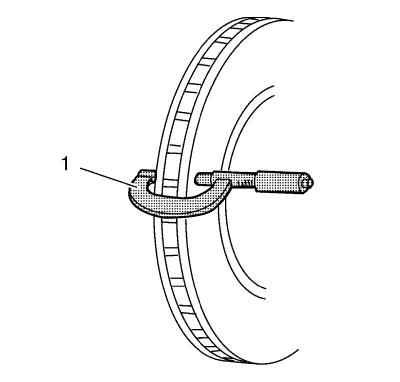
| 3. |
Using a micrometer (1)
calibrated in thousandths-of-a-millimeter, or
ten-thousandths-of-an-inch, measure and record the thickness of the
brake rotor at 4 or more points, evenly spaced around the
rotor. |
| |
Ensure that the measurements are only taken within the friction
surfaces and that the micrometer is positioned the same distance
from the outer edge of the rotor, about 13 mm (0.5
in) , for each measurement. |
| 4. |
Calculate the difference
between the highest and lowest thickness measurements recorded to
obtain the amount of thickness variation. |
| 5. |
Compare the thickness
variation measurement to the disc brake component
specifications. |
|
Note: Whenever a
brake rotor is refinished or replaced, the assembled lateral runout
(LRO) of the rotor must be measured to ensure optimum performance
of the disc brakes.
|
|
|
07 Brakes