
Checking electrolyte level
- Make
- Volkswagen
- Model
- Caddy Mk3
- Year
- 2004–2015
- Section
- Battery › Checking electrolyte level
Checking electrolyte level
Special tools and workshop equipment requiredCommercially available hydrometer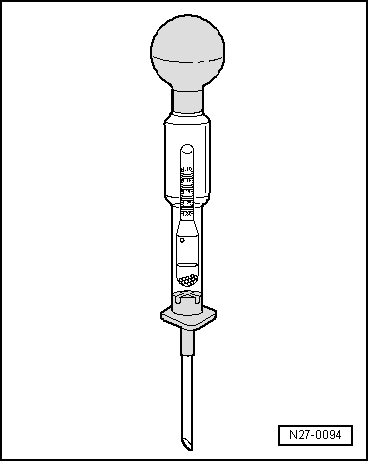
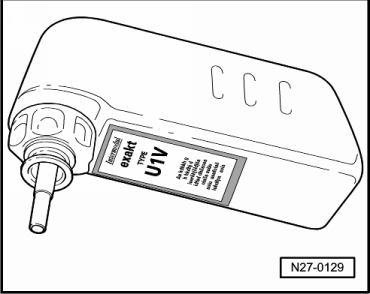
Warning When using sulphuric acid it is absolutely necessary to adhere to the accident prevention procedures.
Suitable protective clothing must be worn.
Only use a torch to illuminate the inside of the battery housing.
Never illuminate the inside of a battery housing with an open flame.
Never work with an open flame or burning cigarette in the vicinity of a battery.
Ensure the legislation for the disposal of batteries and sulphuric acid is observed when disposing batteries.
A correct electrolyte level in the battery is an important factor in ensuring a long battery service life.
An insufficient electrolyte level allows the battery plates to dry which results in a loss of capacity (reduced output) of the battery. If the cell plates are not covered by electrolyte the plates, the plate bridges and the cell connections will corrode. This corrosion ensures the battery function can no longer be guaranteed. The battery is unusable.
If the electrolyte level is too high, damage will be caused outside the battery by the leaking battery acid (sulphuric acid/water mixture) e.g. components in engine compartment.
Switch off ignition.
Check electrolyte level visually at the min. and max. markings on the battery housing (arrow).
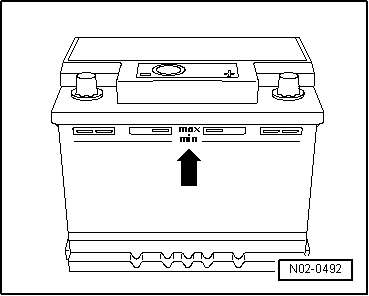
The electrolyte level is OK when the fluid level is between the minimum and maximum marking.
Check electrolyte level visually. Look inside the battery.
If no min. and max. markings are visible on the battery housing or the electrolyte level is not visible, the sealing plugs must be removed. Then you can check the electrolyte level by looking inside the battery housing.
The electrolyte level is OK when the fluid level is the same height as the visible plastic peg or the cell plates are covered.
The plastic peg equates to the max, marking for the electrolyte level.
Note
- If the electrolyte level is low, the Battery filling bottle VAS 5045 is the ideal tool to top-up the battery. The design of the filler nozzle prevents any spilling or over filling. Once the maximum fill level has been reached, further filling of the battery is prevented due to the special nozzle feature of the Battery filling bottle VAS 5045.
- Use distilled water only, this prevents contamination of the battery electrolyte and the therefore associated increased self discharge.
Remove battery cell plug.
If the electrolyte level is too low fill with distilled water using only the Battery filling bottle VAS 5045 up to the max. marking. The Battery filling bottle VAS 5045 is the ideal tool for this purpose.
Note
- If you had to top up distilled water, perform a battery discharge test.
Battery discharge test → Chapter.
If the electrolyte level is too high, use Battery filling bottle VAS 5045 to extract excessive electrolyte until the fluid level is the same as the inner level marking, the plastic peg.
Once the battery has been topped up or the electrolyte level has been reduced to normal the cells must be sealed only with the original cell plugs.
It is absolutely necessary to use original sealing plugs in the battery screwed openings to guarantee the battery is sealed correctly.
Use original sealing plugs of same construction if lost or damaged.
The sealing plugs must be fitted with an O-ring.
Parts & tools for this job For 2004 Volkswagen Caddy
- TOOLBattery testerSearch: car battery tester
- TOOLDigital multimeterSearch: automotive digital multimeter
- TOOLBattery terminal cleanerSearch: battery terminal cleaner
As an Amazon Associate we earn from qualifying purchases.