
Diagonal washout
- Make
- Volkswagen
- Model
- Citi Golf South Africa
- Year
- 1984–2009
- Section
- Facts about wheels and tyres › Diagonal washout
Diagonal washout
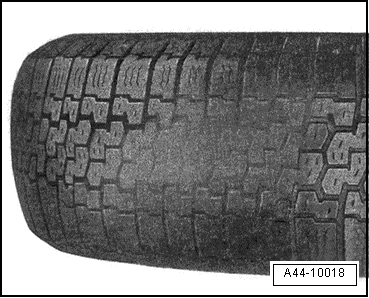
Diagonal washout runs at an angle of approx. 45° to the circumference.
It usually occurs at one point only, but can also occur at several points around the circumference of the tyre.
Washout occurs almost exclusively on the tyres on the non-driven wheels, in particular at the rear left. Washout occurs very often on some models, while it poses no problem at all on other models. The effect is intensified by high toe-in values. Toe-in values in the region of the lower tolerance limits of the specified alignment values improve the wear pattern.
The most pronounced diagonal washout is often found in the area where the tyre components are joined.
Wheels with toe-in also roll with a tyre slip angle when the vehicle is driven in a straight line. This leads to diagonal strain in the contact area between the tyres and road surface.
This wear pattern is intensified when tyre pressure is too low. To avoid such tread wear patterns, the toe-in values of the two rear wheels should be identical and the specified tyre pressures observed.
If washout is detected at an early stage, the wheels should be fitted on the drive axle. Deeper washout cannot be repaired.
If a customer complains of “diagonal wear spots”, the toe adjustment must be examined. If toe-in is correct, the cause of the diagonal washout is very probably the tyre itself.
Tyres with diagonal washout caused by incorrect wheel alignment are not covered by warranty.
Parts & tools for this job For 1984 Volkswagen Citi Golf
- TOOLTyre pressure gaugeSearch: digital tyre pressure gauge
- TOOLTorque wrenchSearch: 1/2 inch torque wrench
- TOOLBreaker barSearch: breaker bar
As an Amazon Associate we earn from qualifying purchases.