
Tyre maintenance
- Make
- Volkswagen
- Model
- Citi Golf South Africa
- Year
- 1984–2009
- Section
- Facts about wheels and tyres › Tyre maintenance
Tyre maintenance
The vehicle's weight causes the tyre's contact patch to flatten. This causes the tread and the entire bracing plies of the tyre continually to be deformed when a tyre is rolling. Low tyre pressure causes greater deformation, resulting in greater warming and increased rolling resistance. This then leads to increased wear and poses a greater safety risk.
Example: Specified standard tyre pressure with cold tyres, according to vehicle load
| Tyre pressure (bar) | Tyre pressure (%) | Tyre life (%) |
|---|---|---|
| 2.3 | 100 | 100 |
| 1.9 | 80 | 85 |
| 1.4 | 60 | 60 |
| 1.0 | 40 | 25 |
Excessive tyre pressure will lead to increased wear around the centre of the tyre's tread and to poor rolling comfort. We recommend always to maintain the tyre pressure specified by the manufacturer.
Note
- The diagrams shown are not applicable in all cases.
- They are intended merely to give an idea of the wear rates of tyres on the front and rear axles and with front-wheel drive and four-wheel drive.
- The tyre service life may differ significantly, depending on operating conditions and running gear.
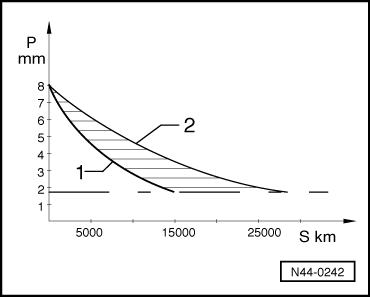
Tread depth versus tyre life for vehicles with front-wheel drive and V-rated tyres
PTread depthSMileage covered1Front axle2Rear axleDiagram 2: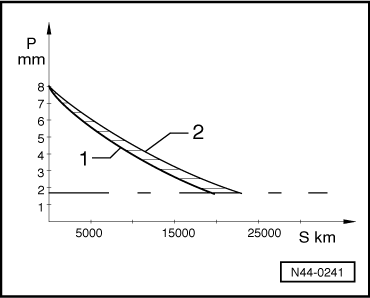
Tread depth versus tyre service life for vehicles with four-wheel drive and V-rated tyres
PTread depthSMileage covered1Front axle2Rear axleDiagrams 1 and 2 show that the tread on a new tyre wears faster than that on a heavily used tyre. Because the wear curve is not linear, it is not possible to estimate the tyre's expected life on the basis of wear after a distance of 5,000 km.
On front-wheel drive vehicles, the front tyres have to transmit not only the steering and driving forces, but also the greater part of the lateral and braking forces. This causes the front tyres on front-wheel drive vehicles to wear much faster than the rear tyres. Even tyre wear can be achieved by rotating (interchanging) the front and rear tyres on a regular basis. Rotating wheels → Chapter.
Parts & tools for this job For 1984 Volkswagen Citi Golf
- PARTOil filterSearch: Volkswagen Citi Golf 1984 oil filter
- TOOLOil filter wrenchSearch: oil filter wrench
- FLUIDEngine oilSearch: Volkswagen Citi Golf engine oil
As an Amazon Associate we earn from qualifying purchases.