
One-sided wear
- Make
- Volkswagen
- Model
- Citi Golf South Africa
- Year
- 1984–2009
- Section
- Facts about wheels and tyres › One-sided wear
One-sided wear
This is often caused by driving style, but can be the result of incorrect wheel alignment.
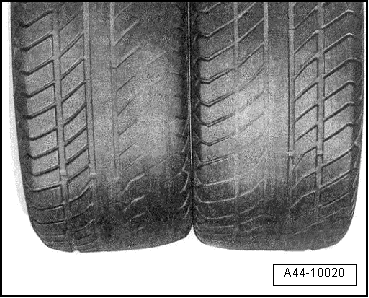
One-sided wear, usually in conjunction with signs of scuffing on the ribs of the tread and in the fine grooves, always occurs when the tyres have been allowed to roll with an extreme tyre slip angle, causing them to “rub” on the road surface.
Driving fast on a stretch of road with lots of curves will cause increased wear, in particular on the outer shoulder.
A rounded outer shoulder on the tyre in conjunction with a particularly high degree of wear on the outer tread blocks indicates fast cornering. This wear pattern is influenced by driving style.
To optimise handling, the suspension is set to certain toe and camber values. Increased one-sided wear can be expected if tyres are allowed to roll under conditions which differ from those specified.
One-sided wear is especially likely if the toe and camber have not been set correctly. Moreover, there is a greater risk of diagonal washout.
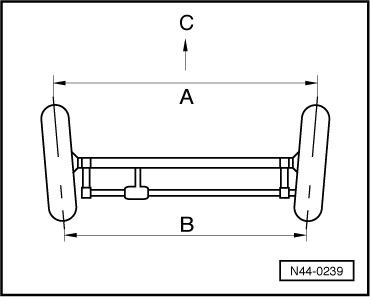
Distance between the front edges of the wheels (A) is greater than distance between the rear edges of the wheels (B) ((C) = direction of travel).
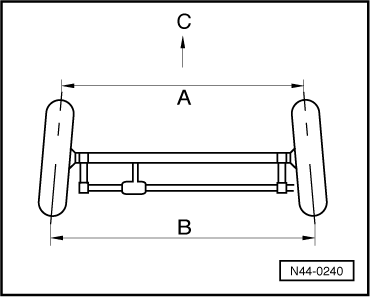
Distance between the front edges of the wheels (A) is less than distance between the rear edges of the wheels (B) ((C) = direction of travel).
To prevent one-sided wear, care must be taken to ensure that the wheel is set within the tolerance specified by the vehicle manufacturer. The most frequent deviation of the wheel alignment is caused by external influences, for example hard contact with the kerbstone when parking.
By measuring the axle geometry, you can check whether the wheel alignment is within the specified tolerances or whether it has to be corrected.
Using “suspension-lowering kits” and/or alloy wheels that have not been approved by VW may result in altered wheel positions which deviate from the specified alignment.
Even if the axle geometry is correct with the vehicle stationary during wheel alignment, the changed vehicle height and wheel positions can cause the wheel suspension to move differently during operation.
Uneven wear is then unavoidable.
Parts & tools for this job For 1984 Volkswagen Citi Golf
- TOOLTyre pressure gaugeSearch: digital tyre pressure gauge
- TOOLTorque wrenchSearch: 1/2 inch torque wrench
- TOOLBreaker barSearch: breaker bar
As an Amazon Associate we earn from qualifying purchases.