
Alarm – Function
- Make
- Volvo
- Model
- V40 Factory Service Manual
- Year
- 2013–2016
- Section
- 09 Miscellaneous › Design and Function › Alarm – Function
Alarm – Function
Activation
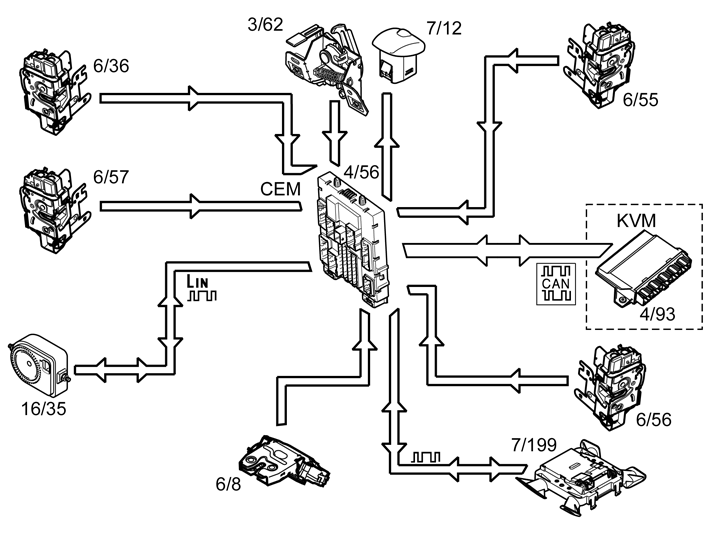
When the central electronic module (CEM) receives a lock command, it first locks the central locking system and then activates the alarm. On cars with the keyless entry system, the lock command is transmitted from the keyless vehicle module (KVM) to the central electronic module (CEM) or via Automatic Armouring (for Belgium). The lock/alarm LED starts to flash as soon as the system has been activated. However, the central electronic module (CEM) will not refer to these signals until after approximately 11 seconds (or until the deadlocks are activated as part of central locking, which happens after approximately 10 seconds).
Triggering the alarm
If the alarm is in activated mode and the central electronic module (CEM) receives an indication from a sensor, an alarm cycle is started. An alarm cycle means that the siren starts sounding and the turn signal indicators start flashing. The siren sounds for 30 seconds and then stops. However, the turn signal lamps continue to flash for approximately a further 5 minutes.
Deactivation
The alarm is deactivated if the vehicle is unlocked. When the central electronic module (CEM) receives an unlock command, it deactivates the alarm and releases the central locking. On vehicles with the keyless entry system, the unlock command is transmitted from the keyless vehicle module (KVM) to the central electronic module (CEM).
NOTE: This means that if the vehicle is locked and alarmed but then unlocked using the key blade instead of the remote key the alarm will be triggered.
Full protection can also be recovered if the function for relocking is activated. In which case the vehicle will be automatically locked and the alarm activated after approx. 2 minutes provided that none of the doors or the tailgate has been opened.
The alarm functions can also be deactivated locally if the button for unlocking the tailgate/trunk lid is pressed on the remote key. In that case the central electronic module (CEM) takes no account of signals from the contact breaker in the tailgate/trunk lid lock unit. The vehicle tilt sensor and motion sensor will also be deactivated temporarily. To regain full protection for the vehicle the locking button on the remote key must be pressed.
Resetting the alarm
If the alarm has been triggered it can be reset in three ways:
- by pressing the unlock button on the remote key
- by inserting the remote key in the starter module
- by pressing the starter button (vehicles with the keyless system where there is a valid key inside the vehicle).
Panic alarm
The panic alarm function is activated either by holding in the alarm button on the remote control for at least 3 seconds or by depressing the alarm button twice within 3 seconds. In the event of an activated panic alarm the vehicle's horn sounds and all direction indicators flash. This continues for at least 5 seconds and for at most 165 seconds. For certain markets, e.g. Hong Kong, only the direction indicators are activated in the event of a panic alarm.
The panic alarm function can be deactivated after 5 seconds at the earliest by depressing any button on the remote control or by inserting the key in the ignition switch.
On vehicles with keyless entry it is sufficient to activate the start/stop button, or to depress the clutch or brake pedal (if valid remote control key is in the passenger compartment) in order to deactivate the panic alarm.
Reduced alarm function
Activating reduced alarm via the menu in the infotainment control module (ICM). Reduced alarm is used to temporarily disconnect the vehicle tilt sensor, movement sensor and immobiliser when the vehicle is locked.
The function is activated during a lock cycle - from when the reduced alarm is activated, the vehicle locked and until the vehicle is started. When the vehicle is started a message is displayed in the driver information module (DIM) that full protection is activated.
An example would be when a pet is left in a locked vehicle. This may also be required if the car is being transported by ferry, train, or truck.
Checking the vehicle's status (Applies only to vehicles with keyless entry)
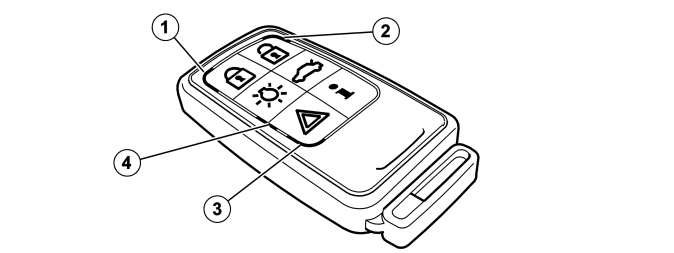
The vehicle's status can be checked via the remote control. The checks are activated using the information button on the remote key. During activation, the remote key transmits a signal to the vehicle, which:
- checks the central locking system status, if the vehicle is locked or not
- checks the alarm status, if the vehicle alarm has been activated or not.
The result is transmitted to the remote key and indicated there by LEDS. There are four LEDs on the remote key:
- Green LED Indicates that the central locking system is in the locked position.
- Yellow LED Indicates that the central locking system is unlocked.
- Red LED (long) Indicates that the vehicle's alarm has been activated during this lock cycle.
- Red LED (short)Indicates that the alarm has been activated during the past 5 minutes of this lock cycle.
If the alarm has been activated in the past 5 minutes, LEDs 3 and 4 will blink alternately.
To clarify the signals from the remote key, only the warning/status that is considered to be the most relevant is displayed during the status check.
- If the status check shows that the vehicle is locked but that the alarm has been activated during the last 5 minutes, only warning 4 will be displayed (no information display about the central locking status or if the alarm has been activated earlier).
- If the status check indicates that the vehicle is locked but that the alarm has been activated during the lock cycle, only the warning for activated alarm is shown (information about central locking system status is not displayed).
- If the status check indicates that the vehicle is locked without the alarm being deployed, the central locking system status is displayed.
If the information button is pressed when the vehicle is outside the remote key's range, the last status received from the vehicle is indicated on the remote key.
The remote key contains an internal battery that is used every time information is transmitted from, or managed by, the remote key. For example, unlocking using the lock button, keyless unlocking/locking and start or status check. The battery in the remote key has a limited service life and may need replacing. If the remote key's battery becomes weak, a message will be displayed in the driver information module (DIM). Another indication that the remote key's battery is almost drained is that the range of the remote key starts to reduce and the button needs to be depressed for longer to carry out a function.
Market adaptations
In the following markets there are certain differences in alarm function. These differences depend on the market for which the vehicle is adapted. The differences are primarily due to different requirements from insurance companies and authorities. The functions are regulated in the vehicle's configuration file.
- British and Swedish markets. If the alarm is triggered the central electronic module (CEM) carries out an alarm cycle. If the cause of the alarm persists, for example an open door that triggered the alarm is still open, a further alarm cycle is carried out. This is repeated up to ten times.
- USA/Canada.In this market there is a "slam-lock arming" function. This means that the vehicle can be locked with the central locking button on either of the front doors even though the door on which the button is pressed is still open. Doors, the hood, trunk lid or tailgate will be locked. The alarm is activated as soon as the last front door is closed.
- Belgium. In this market there is an automatic alarm activation function. If the vehicle has been driven, the engine turned off, the ignition is in position 0 or the remote key is out of the starter module and the vehicle has not been locked, the alarm will automatically be activated after 90 seconds. For the alarm to activate all doors etc. with sensors must be closed and the driver's door must have been opened and closed at least once. When the alarm has been activated, this is indicated by the turn signal lamps flashing.
- Hong Kong. The panic alarm's function is limited to only light indication. No audible signal is given.
Parts & tools for this job For 2013 Volvo V40
- TOOLTorque wrenchSearch: 3/8 inch torque wrench
- TOOLSocket setSearch: socket set metric
- BOOKHaynes manualSearch: Haynes manual Volvo V40
Links open Amazon search results in a new tab. As an Amazon Associate I earn from qualifying purchases.