
Engine – Overview
- Make
- Volvo
- Model
- V40 Factory Service Manual
- Year
- 2013–2016
- Section
- 09 Miscellaneous › Design and Function › Engine – Overview
Engine – Overview
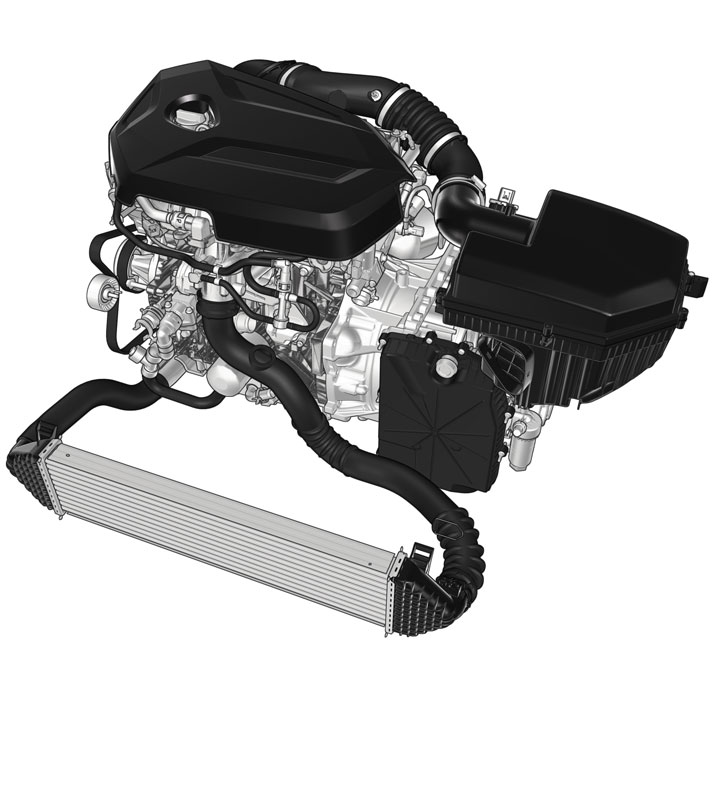
B4164Tx is a transverse 4-cylinder, 1.6-litre gasoline engine with overhead camshafts based on the well-known B4164S3. The most significant new feature is the engine's cutting-edge gasoline-direct injection technology with turbocharger, which gives the following advantages:
- Fuel consumption and CO2-emissions are reduced by up to 20 percent,
- plenty of power at low rpms and sporty response from the engine throughout the entire engine speed range,
- driving performance like that of a bigger engine together with the lower weight, compact dimensions and lower friction losses like those of an engine with smaller cylinder capacity.
B4164Tx has been modified in a number of ways compared to B4164S3:
- Gasoline direct injection instead of conventional fuel injection in the intake manifold.
- Turbocharger to increase torque and power.
- Four separate ignition coils - direct ignition instead of the common electronic ignition coil.
- 'Control when needed' of coolant temperature via
- an overflow valve and
- a shut-off valve.
The firing order is 1-3-4-2. The cylinders are counted from the front, i.e. number one cylinder is closest to the crankshaft's pulley.
From and incl. model year 2008 the cylinder block is die-cast instead of sand-cast. This has resulted in a new design of the cylinder block. The engine block and cylinder head are made of an aluminum alloy.
The engine block is of the type "Open Deck", which means lower weight and that a bigger area around the cylinder is exposed to cooling.
Meets standards for emission levels according to Euro 5.
The camshafts are driven by a ribbed belt.
B4164T has a maximum power of 132 kW (180 hp) and a maximum torque of 240 Nm between 1,600-5,000 rpm.
B4164T3 has a maximum power of 112 kW (150 hp) and a maximum torque of 240 Nm between 1,600-4,000 rpm.
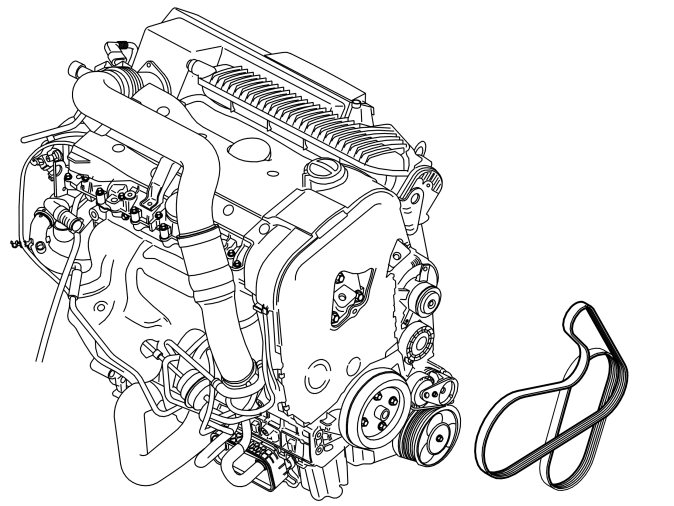
The engine is available in different versions. They are transverse, 5-cylinder 20 valve turbocharged engines with a cylinder volume of 1,984, 2,497 or 2,521 dm³. Depending on the variant different fuels are available; Petrol, Ethanol or biogas. The engine and transmission are pendulum mounted with a mounting on the engine which goes to the side member via a rubber bushing and an engine mounting on the transmission. There is a support point on the bearing mounting to take up the torque.
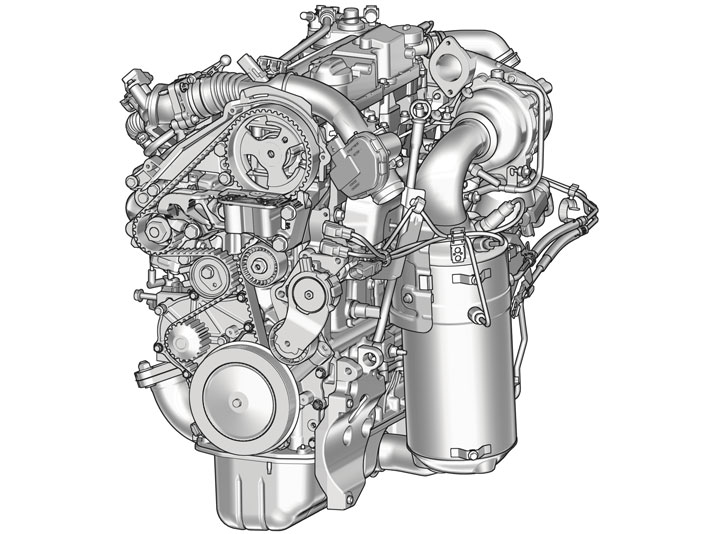
The 1.6L Duratorq-TDCi (DV) diesel D4162T is a four-cylinder, 1.6-litre diesel engine from Peugeot. This is a transverse turbo diesel engine. It has a single overhead camshaft and 8 valves.
D4162T has a maximum output of 85 kW (115 hp) and reaches a torque of 270 Nm at 1,750 rpm.
The engine meets emission standards Euro 5.
To reduce CO2-emissions EHPAS (Electric Hydraulic Power Assisted Steering) is used, which contributes to lowering the engine's fuel consumption by its way of working.
The engine has a Contitech Common Rail injection system. The fuel filter includes a heating coil for use in cold climates. This heating coil is turned on automatically.
The EGR-valve is electrically controlled by the engine control module (ECM). EGR technology is used to reduce the exhaust temperature and thereby to reduce NOx emissions. This involves returning some of the exhaust gases to the combustion chamber.
The amount of exhaust gas returned is controlled by an EGR stepper motor and can thus be adjusted precisely. The exhaust gases returned are cooled by means of an EGR cooler before being fed into the induction manifold.
The turbo system on this engine consists of a turbo unit with a VNT (Variable Nozzle Turbine) which is controlled by a turbo control valve, which in turn influences a pressure box.
The fuel filter is mounted on a retainer directly on the cylinder head and is fitted with electric fuel preheating. The fuel lines are secured using snap-on couplings.
The engine is equipped with a catalytic particle filter that works without fuel additive.
The carbon particles that may remain in the exhaust gases after combustion are filtered out by allowing the exhaust gases to flow into the particle filter.
For information on the control module, valves, and sensors, see Design and Function for Engine Control Module (ECM).
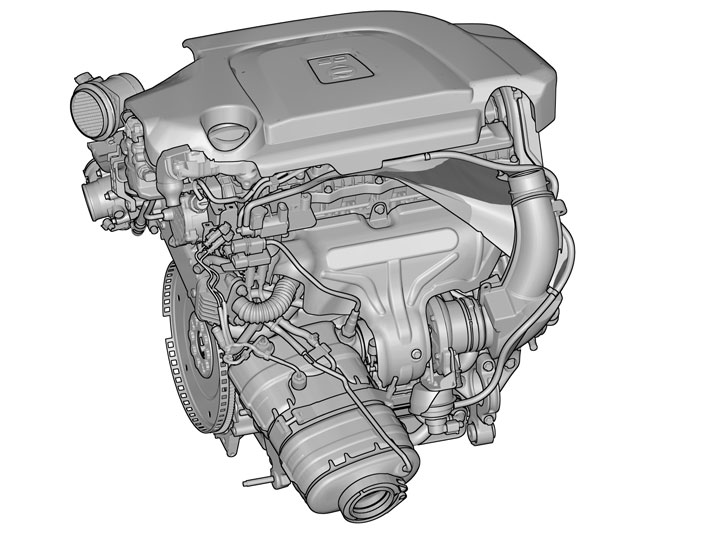
The engine has been developed by Volvo and is a transverse five cylinder direct-injected turbocharged diesel engine. It has double overhead camshafts driven by a timing belt and 20 valves.
The engine features a Bosch Common Rail injection system, where the diesel pump is driven directly by the inlet camshaft. Injection takes place via injection valves with piezo injectors.
The turbo system consists of a turbocharger.
The engine has coolant-cooled return of the exhausts (EGR, Exhaust Gas Recirculation).
There is a particle filter after the catalytic converter. 2WD has CCDPF and 4WD has Underfloor DPF.
For control and monitoring, the system features heated oxygen sensor as well as temperature sensors and differential pressure sensors.
Diagnostics are carried out via the data link connector (DLC).
D5204T3
D5204T3 has engine code 88.
For information about power, see Specifications, mechanical (Engine)
Parts & tools for this job For 2013 Volvo V40
- PARTEngine gasket setSearch: Volvo V40 2013 engine gasket set
- TOOLTorque wrenchSearch: 3/8 inch torque wrench
- TOOLFeeler gauge setSearch: feeler gauge set
Links open Amazon search results in a new tab. As an Amazon Associate I earn from qualifying purchases.