
System description
- Make
- Volvo
- Model
- XC70 V70 XC / XC70 Factory Service Manual
- Year
- 2001–2007
- Section
- 09 Miscellaneous › Design and Function › System description
System description
General
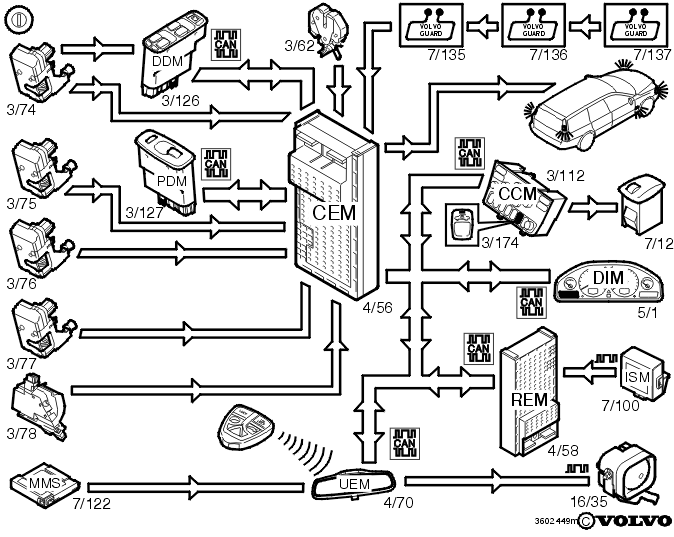
The alarm function is a distributed function and uses a number of control modules for its function.
The control modules used for the alarm function are:
- Central electronic module
- Climate control module
- Driver's door module
- Driver information module
- Inclination sensor module
- Mass movement sensor
- Passenger door module
- Rear electronic module
- Siren control module
- Upper electronic module.
Terminology
The following terms are used in information about the alarm.
Activated: The car is locked and the alarm protects the car.
Deactivated: The alarm is switched off and no longer protects the car.
Reactivating: The alarm has activated itself and protects the car.
Deployed: The alarm has started and the siren sounds.
Central electronic module
The central electronic module (4/56) is the main control module for alarm functionality. The central electronic module determines how the alarm should be activated, deactivated or deployed by receiving information on the Controller Area Network (CAN) from other control modules and via the directly connected signal cables from the components.
Signal cables are directly connected to the central electronic module from:
- Switch in the lock units in all doors (3/74-77), open/closed
- Switch in the lock units in the rear side doors (3/76-77), locked / unlocked
- Switch in the lock unit trunk lid (3/78), open/closed. (S60/S80)
- Switch in the lock unit tailgate (3/78), open/closed. (V70/V70XC). In certain versions the signal is in series with the resistive wire in the rear side window. See the current wiring diagram
- Switch hood (3/62), open/closed
- Resistive wire (7/135-137), broken/unbroken (only V70/V70XC). Protects rear side windows, on certain versions this includes the rear windshield, see the current wiring diagram.
The central electronic module is controlled via a direct cable:
- All turn signal lamps.
For information received and transmitted via the controller area network for alarm functionality see the relevant control module as follows.
Climate control module
The climate control module (3/112) transmits information via the Controller area network (CAN) to the central electronic module about the status of the switch for reduced alarm (3/174).
Signal cables are directly connected to the climate control module from:
- Switch for reduced alarm (3/174), on/off.
The climate control module controls via direct cables:
- Alarm diode (7/12) in the dashboard, on/off. The signal is received via the directly connected cable from the central electronic module.
Driver's door module
The driver's door module, (Left-hand drive; 3/126, Right-hand drive; 3/127) transmits information via the Controller area network (CAN) to the central electronic module if the lock is locked or unlocked in the driver's door and if the door has been unlocked using a key.
Signal cables are directly connected to the driver's door module from:
- Switch in the lock units in the driver's doors (3/74), locked / unlocked
- Switch in the lock units in the driver's doors (3/74),locking / neutral position / unlocking. The signal comes from the door lock and indicates the position of the door key in the lock.
Driver information module
Driver information module (5/1) gives text messages in the text window and receives information from the central electronic module via the Controller area network (CAN). The text messages given are information about the status of the alarm system.
Inclination sensor module (market dependent/option)
The Inclination Sensor Module (7/100) transmits information via the serial communication (Volcano Lite) to the rear electronic module, about the vehicle inclination sensor status. The rear electrical module transmits information to the central electronic module via the Controller area network (CAN).
Mass movement sensor (Market dependent/option)
The mass movement sensor (7/122) transmits information about the movement in the car to the upper electrical module via the serial communication (Volcano Lite). The upper electrical module transmits information to the central electronic module via the Controller area network (CAN).
Passenger door module
The passenger door module (Left-hand drive; 3/127, Right-hand drive; 3/126) transmits information via the Controller area network (CAN) to the central electronic module if the lock is locked or unlocked in the passenger door.
Signal cables are directly connected to the passenger door module from:
- Switch in the lock unit in the passenger door, locked/unlocked.
Rear electronic module
The rear electrical module (4/58) transmits information via the Controller area network (CAN) to the central electronic module about the status of the inclination sensor module. Information about the status is transmitted by the Inclination Sensor Module to the rear electrical module.
Siren control module
The task of the control module is to supply the car with the siren sound. The siren control module (16/35) can activate the siren noise in three ways:
- The central electronic module transmits information via the controller area network to the upper electronic module to deploy the alarm. The upper electronic module transmits information via serial communication (Volcano Lite) to the siren control module, which starts the siren
- The siren control module has an integrated battery which is used as a back-up in the event of an alarm. The battery charges via an integrated charger. The siren control module monitors the power supply from the car battery to the control module. If the voltage from the car battery suddenly drops (open-circuit in the cable) the siren is activated
- The siren control module monitors the communication cable from the upper electronic module (life pulse) and if the communication ceases the siren is activated.
The siren control module transmits information about the status of the internal battery to the UEM via serial communication via serial communication (Volcano Lite).
Upper electronic module
The upper electronic module (4/70) transmits information via the Control area network (CAN) to the central electronic module, about which button on the remote control is depressed and the status of the siren.
The central electronic module in turn sends information to the upper electronic module via the Controller area network (CAN), if the siren must be activated. The upper electronic module transmits information via serial communication (Volcano Lite) to the siren control module, which activates the siren.
General
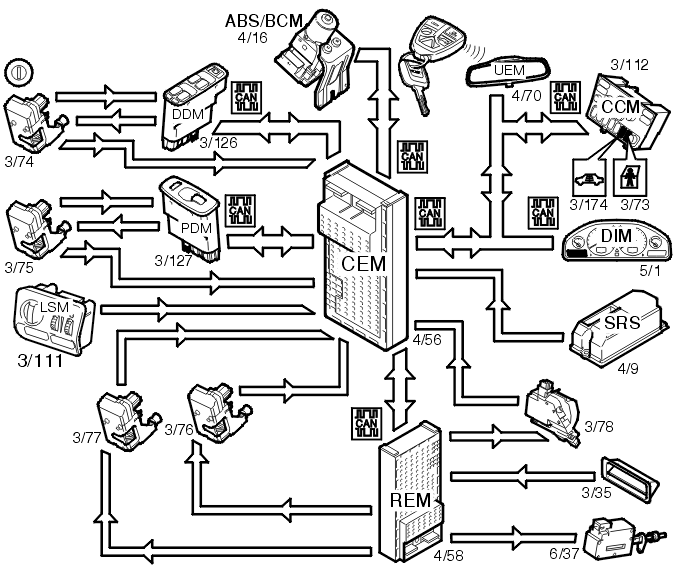
The lock function is a distributed function and uses a number of control modules for its function.
The control modules used for the lock function are:
- Central electronic module
- The brake control module,2002-/ ABS-control module, 1999-2001
- Climate control module
- Driver's door module
- Driver information module
- Passenger door module
- Rear electronic module
- SRS (supplemental restraint system) control module
- Upper electronic module.
Central electronic module
The central electronic module (4/56) is the main control module for central locking functionality. The central electronic module determines how the lock should be locked and unlocked by receiving information on the Controller Area Network (CAN) from other control modules and via the directly connected signal cables from the components.
Signal cables are directly connected to the central electronic module from:
- Lock units in all doors (3/74-77), open / closed
- Lock units in the rear doors (3/76-77), locked / unlocked
- Lock unit tailgate (3/78), open/closed
- SRS (supplemental restraint system) control module (SRS) (4/9), collision/no collision.
The central electronic module is controlled via a direct cable:
- All turn signal lamps, on/off
- Shift relay for power child locks in the rear door, on/off. The shift relay is only installed on those cars equipped with power child locks. The relay shifts between child proof and deadlock positions. The shift between child proof and deadlock occurs by the central electronic module transmitting a signal to the relay, which shifts the relay to the directly connected cable. When the relay has shifted, a control signal is transmitted to the lock motor from the rear electronic module and the lock unit assumes the deadlock or childproof mode depending what the relay shifted to. To ensure that the relay shifts and that the lock unit has time to assume the new status, a control signal is transmitted from the central electronic module for approximately one second.
Brake control module / ABS control module
The brake control module (4/16), (ABS up to and including model year 2001) transmits information about the vehicle speed to the central electronic module via the Controller area network (CAN). The information is used for models with fuel tank filler cover locking via remote switch. The information is also used to prevent unlocking of the trunk using the remote control and automatic locking of the car.
Signal cables are directly connected to the brake control module (ABS) from:
- Vehicle speed sensors (VSS) from all wheels.
Climate control module
Climate control module (3/112) transmits information via the Controller area network (CAN) to the central electronic module about the status of the switch for reduced alarm, valet locking and child locks.
Signal cables are directly connected to the climate control module from:
- Switch for reduced alarm (3/174), on/off
- Switch for valet locking (3/173), on/off
- Switch for child lock (3/73), on/off.
Driver's door module
The driver's door module (3/126) transmits information to the central electronic module via Controller area network (CAN), about whether the driver's door lock is lock or unlocked and the status of the switches in the driver's door. The central electronic module transmits information via the controller area network (CAN) to the driver's door module to activate the lock motor in the driver's door.
Signal cables are directly connected to the driver's door module from:
- Lock units in the driver's doors (3/74), locked / unlocked
- Key, locking / unlocking.
The driver's door module controls via direct cables:
- Driver's door lock motor, lock/unlock
- Lock motor deadlocked, lock/unlock.
Driver information module
Driver information module (5/1) displays a text message in the display. The information comes from the central electronic module via the controller area network (CAN). The text messages given are information about the reduced alarm, valet locking and child locks.
Passenger door module
The passenger door module (3/127) transmits information to the central electronic module via Controller area network (CAN), about whether the passenger door lock is lock or unlocked and the status of the switches in the passenger door. The central electronic module transmits information via the controller area network (CAN) to the passenger door module to activate the lock motor in the passenger door.
Signal cables are directly connected to the passenger door module from:
- Lock unit passenger door, locked/unlocked.
The passenger door module controls via direct cables:
- Passenger door lock motor, lock/unlock
- Lock motor deadlocked, lock/unlock.
Rear electronic module
The rear electronic module (4/58) transmits status information to the central electronic module via the Controller area network (CAN), from the switch in the trunk lid (only S60/S80).
The central electronic module transmits information via the controller area network to the rear electronic module to:
- activate the lock motors in the rear doors
- activate the lock motor for the fuel tank filler cover
- activate the lock motor for the tailgate (only V70/V70XC)
- activate the Pop-up motor for the trunk lid (only S60/S80).
Signal cables are directly connected to the rear electronic module from:
- Trunk lid switch, activated/not activated (sedan models only).
The rear control module controls via direct cables:
- Rear doors lock motors, lock/unlock
- Lock motors deadlocked, lock/unlock
- Power child lock motors, lock/unlock. The same relays in the rear electrical module as in the deadlocked lock motor are used for the power child lock. The shift between the motor for deadlocks and the power child lock motor occurs via direct cable from the central electronic module to a shift relay in the rear doors. For the power child lock the central electronic module transmits a control signal to the shift relay. At the same time the rear electronic module transmits a control signal to the lock motor
- Fuel tank filler cover lock motor, lock/unlock
- Lock motor tailgate, lock/unlock (V70/V70XC only)
- Pop-up motor in the trunk (only S60/S80).
SRS (supplemental restraint system) control module
The SRS (supplemental restraint system) control module (4/9) transmits information about collisions to the central electronic module via a directly connected cable.
Signal cables are directly connected to the SRS (supplemental restraint system) from:
- Collision sensor, collision/no collision.
Signal cables are directly connected to the SRS (supplemental restraint system) from:
- Collision output signal to the central electronic module.
Upper electronic module
The upper electronic module (4/70) transmits remote control signals about which button on the remote control has been pressed to the central electronic module via the Controller area network (CAN).
Parts & tools for this job For 2001 Volvo XC70
- TOOLTorque wrenchSearch: 3/8 inch torque wrench
- TOOLSocket setSearch: socket set metric
- BOOKHaynes manualSearch: Haynes manual Volvo XC70
Links open Amazon search results in a new tab. As an Amazon Associate I earn from qualifying purchases.