
Functioning
- Make
- Alfa Romeo
- Model
- 145/146 Engines, 146 Bodywork and Engine Overhaul Manual
- Year
- 1994–2001
- Section
- Fuel supply system › Functioning
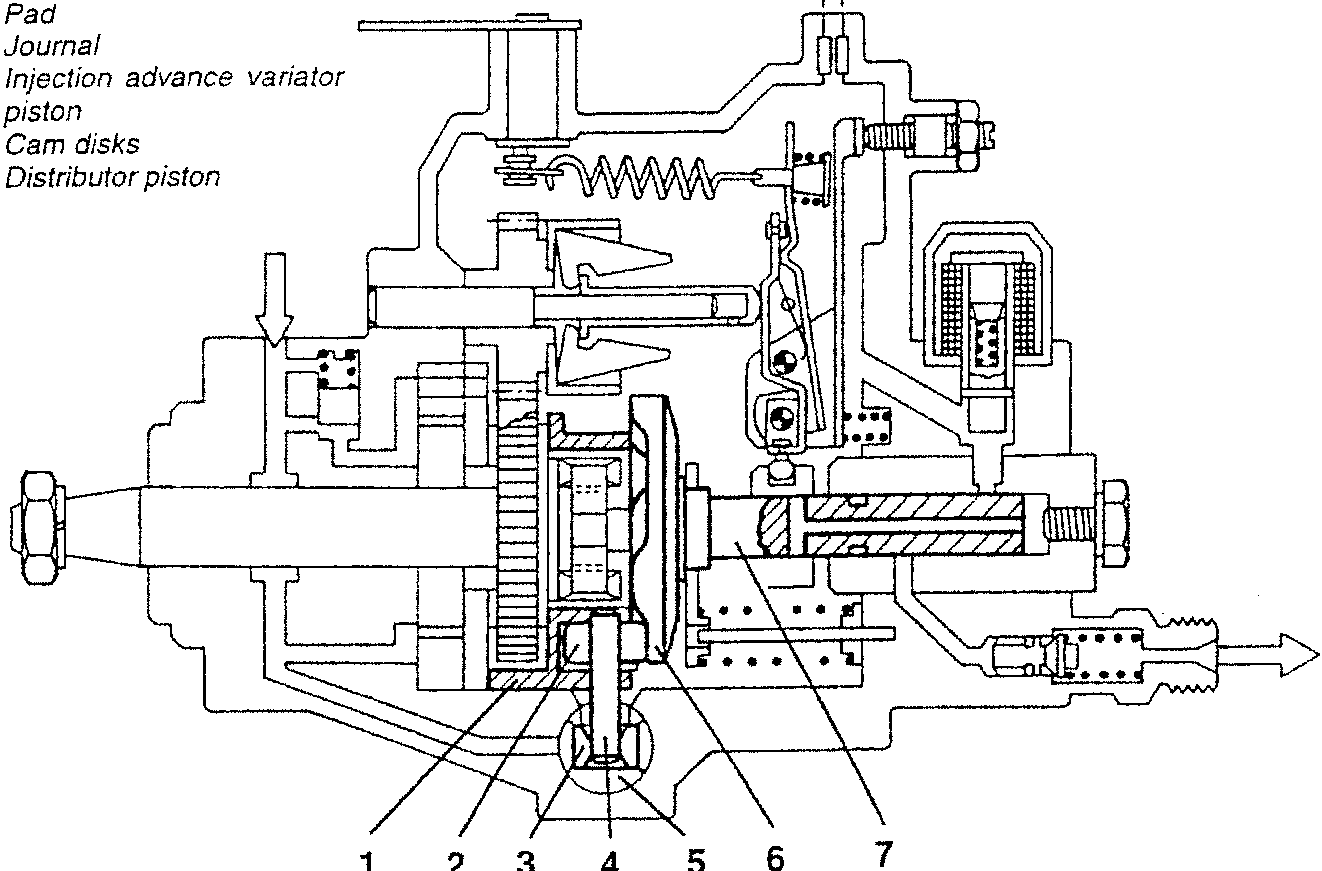
- Roller holder ring
- Rollers
- Pad
- Journal
- Injection advance variator piston
- Cam disks
- Distributor piston
As the spreading time passes irrespective of the r.p.m., the crank angle between the start of the delivery and the start of the injection becomes even greater as the r.p.m. increases.
It is therefore necessary to correct this by anticipating the start of the delivery.
The spreading time of the pressure wave is established by the size of the injection pipe and by the speed of sound, which for diesel is approx. 1500 m/s. This time is known as the "injection delay".
So the start of the injection is delayed with respect to the delivery.
Following this phenomenon, the nozzle opens later at higher speeds than at lower speeds with respect to the position of the engine piston.
After having been injected, the diesel takes a set period of time to pass from the gas state and to form a mixture which together with air is inflammable.
The preparation time for the mixture does not depend on the r.p.m.
In diesel engines, the time which passes between the start of injection and the start of combustion is called the "ignition delay".
The ignition delay depends on the inflammability quality of the diesel (indicated by the cetane number), by the compression ratio, by the air temperature and by the polverization of the fuel.
The ignition delay is usually around 1 millisecond.
When the engine speed is increasing and when the start of delivery is constant, the crank angle between
the start of injection increases so that combustion does not start at the right moment (with reference to the position of the engine piston).
As optimal combustion and the maximum power of the Diesel engine are only reached when the crankshaft, ie. the piston, has reached a clearly defined position, it is necessary to advance the start of delivery of the distributor pump in time with the increase in the engine speed to compensate for the time lost due to injection and ignition delays.
This correction is performed by the injection advance variator, that intervenes in function with the r.p.m.
Functioning
The injection advance variator piston is kept in the start position by the loaded spring.
During functioning, the fuel pressure within the pump is regulated in relation to the r.p.m. through a delivery valve and the flow throttlor.
So the piston head, on the opposite side to the spring, is loaded with the same pressure as the fuel within the pump.
The pressure of the fuel only wins over the spring load and pushes it against the variator piston above a certain r.p.m.
Parts & tools for this job For 1994 Alfa Romeo 145/146
- PARTEngine gasket setSearch: Alfa Romeo 145/146 1994 engine gasket set
- TOOLTorque wrenchSearch: 3/8 inch torque wrench
- TOOLFeeler gauge setSearch: feeler gauge set
Links open Amazon search results in a new tab. As an Amazon Associate I earn from qualifying purchases.