
Pistons and Rods
- Make
- Alfa Romeo
- Model
- 145/146 Engines, 146 Bodywork and Engine Overhaul Manual
- Year
- 1994–2001
- Section
- Generalities › Pistons and Rods
Pistons and Rods
The pistons are made from an aluminium-silicium alloy and are divided into five dimensional classes. The crown of the piston has a lift which connects with the combustion chamber of the cylinder heads. The hole of the grudgeon pin is in axis with respect to the piston axis.
Close to the second and third seal ring housings, there are two grooves. The first is a labyrinth which reduces the passage of combustion gases in the sump, so as to reduce the formation of oil vapours; the second one serves to collect the oil "scraped" from the two rings to avoid it entering the combustion chamber. The seating of the first seal ring is made on a molybdenum coating.
There are three seal rings: the first, seal type, is surface treated with a molybdenum coating, the second is the seal and oil scraper type, the third is the spring oil scraper type. The visible scanso at the base of the piston skirt stops it from interfering with the oil sprayer in the engine block at B.D.C.
The rods are in tempered and hardened steel, with a copper alloy bushing fixed for connection to the piston grudgeon pin.
As the grudgeon pins are floating on both the piston hubs and the bushing fixed at the foot of the rod, they are stopped from moving laterally by two expanding elastic rings which are housed in the grooves on the hubs themselves.
The piston - rod connection must be made so that the lower part of the lift (1) on the piston is facing the same way as the number of the cylinder (2) to which the rod belongs stamped on it.
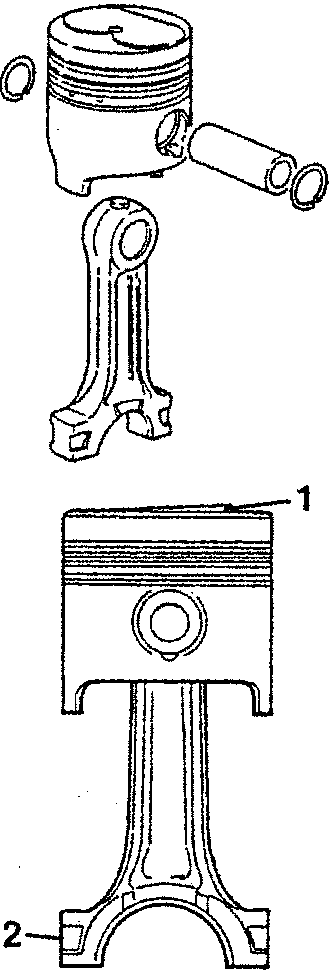
- Lift on piston crown
- Number of cylinder to which rod belongs.
The installation of the piston - rod assembly must be done in such a way that the numbers stamped on the rod face towards the intake-exhaust side.
Timing
Direct drive by drive belt, with on head cam shaft in iron with induction hardening on the cams.
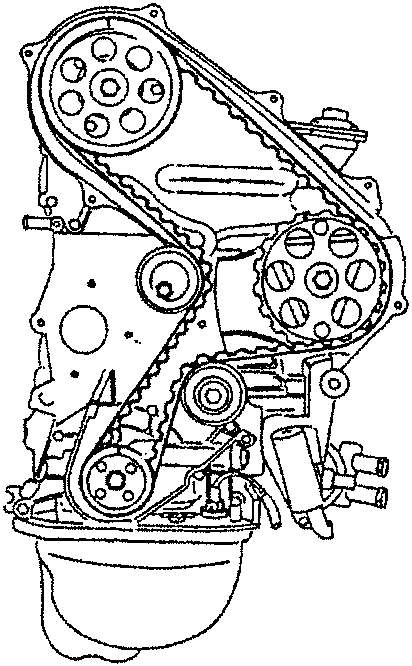
The mechanical tappets are made up of a cap in casehardened and phosphor-plated steel, in contact with the cam, used to regulate the valve clearance. The command is transmitted from the cap to the cup in carbonitridered steel which directly controls the valve. The intake and exhaust valves are made in a steel alloy and the stem is chrome-plated. The valve seatings and valve guides are in iron. Small rubber plugs are mounted on the top of the valve guides to catch any oil between the stem and the valve guides.
Lubrication
The oil, taken from the sump using a suction device, is filtered by the net type filter which is part of the suction device itself and then reaches the oil pump. The oil pump which is the rotating lobe type is front mounted on the engine block and activated directly by the crankshaft through keying.
The oil sent under pressure by the pump, after having passed the pressure relief valve, reaches a thermo-static valve that:
- for temperatures lower than 75 °C, ensures that the oil passes directly into the cartridge filter and then to the engine;
- for temperatures greater than 90 °C, it opens allowing the oil to pass into the coolant radiator so that its temperature is lowered and a better lubrication is guaranteed.
Parts & tools for this job For 1994 Alfa Romeo 145/146
- PARTEngine gasket setSearch: Alfa Romeo 145/146 1994 engine gasket set
- TOOLTorque wrenchSearch: 3/8 inch torque wrench
- TOOLFeeler gauge setSearch: feeler gauge set
Links open Amazon search results in a new tab. As an Amazon Associate I earn from qualifying purchases.