
Description
- Make
- Aston Martin
- Model
- DB7 Factory Workshop Manual Volume 2: Electrics, Body and Air Conditioning
- Year
- 1994–1998
- Section
- Electronic control module and in-car controls › Description
Description
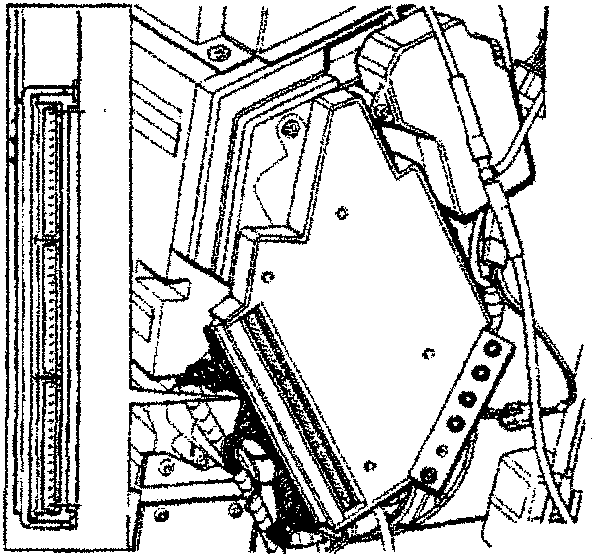
The ECM (Fig 1) controls the air conditioning system so that selected temperatures are maintained. It cannot be repaired but input and output signals can be measured, using the PDU, for diagnostic purposes.
Input-Output Voltage Signals
The following voltage signal levels are input and output from the ECM:
| Signal Type | Level |
|---|---|
| Digital input levels: | |
| Low | 0.16 to 1.1 V |
| High | 3.70 to 4.50 V |
| Analogue input levels: | |
| General | 0 to 0.2885 V |
| Blend Flap Potentiometer | 0 to 5.0 V |
| Digital output levels | |
| Relays On | 8.0 V |
| Relays Off | 1.0 to 5.0 V |
| Vacuum manifold Pull-in | 5.6 V (typical) |
| Vacuum manifold Drop-out | 3.5 V (typical) |
| Analogue output levels | |
| Blend Flap Servo Motors | 0.5 to 6.5 V |
| Blower Motors | 0.5 to 2.5 V |
Figure 1.
The ECM is turned on when the ignition is turned on to auxiliary position 1. Its operating range is 13.5-14.2 volts.
The ECM power unit supplies +5 volts for the temperature sensors, feedback potentiometers and high speed relays.
An integrated circuit protects the ECM against reversed polarity and voltage surges.
Caution: Take care when connecting test equipment. If test pins are allowed to be shorted together, to ground or to positive supplies the ECM will be damaged.
Parts & tools for this job For 1994 Aston Martin DB7
- TOOLOBD2 scannerSearch: OBD2 scanner
- TOOLDigital multimeterSearch: automotive digital multimeter
- TOOLBack-probe test leadsSearch: back probe test leads
Links open Amazon search results in a new tab. As an Amazon Associate I earn from qualifying purchases.