
Description
- Make
- Aston Martin
- Model
- DB9 Factory Workshop Manual
- Year
- Issue 2, 2005
- Section
- Fuel Charging System › Description
Description
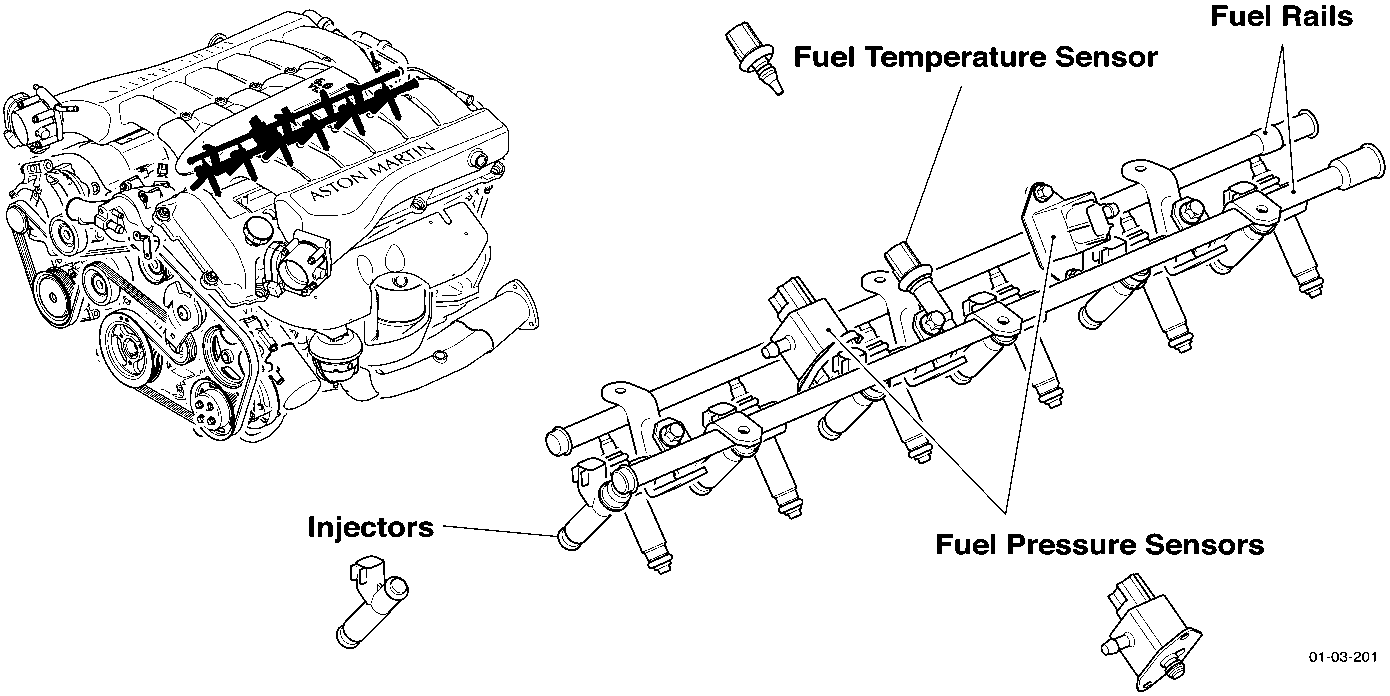
The electronic return-less fuel system utilized has the advantages of reduced fuel tank vapor, requires less electrical power and does not require a fuel return line. Fuel is supplied at high pressure to the injectors via two fuel rails (primary and secondary). Each fuel rail incorporates six fuel injectors, and a fuel pressure regulator. A fuel temperature sensor is installed in the primary fuel rail. Powertrain Control Modules (PCMs) maintain 280 kPa across the injectors, by increasing the pulse width modulation signal to the fuel pump controller. This in turn controls the voltage output to the fuel pump.
Fuel rails and injectors are detailed in this chapter. For fuel delivery to the fuel rails and injectors refer to Chapter 10 (Fuel System).
Safety Precautions
Operations on fuel system will result in fuel liquid and vapour being present in the working environment. This presents a very serious risk and the following precautions must be strictly observed:
| Warning | Warning |
|---|---|
| Operations on refuelling and the fuel system must only be performed by personnel who have completed training on fuel handling. | Dry sand must be available close at hand to soak up any accidental fuel spillage. |
| Smoking must not be allowed near the working area. “NO SMOKING” signs must be posted around the working area. | If necessary, empty the fuel into an explosion proof container using suitable fireproof fuel handling equipment. |
| Any operation which could involve sparks or naked lights (e.g. battery testing, welding, metal grinding, etc.) must not be allowed near the working area. | The working area must be well ventilated. |
| A CO2 fire extinguisher must be available close at hand. | Disconnect the battery before commencing work on the fuel system. |
| Depressurise the fuel system before disconnecting any fuel lines. | |
| The engine must be cool before working on the fuel charging system. |
Parts & tools for this job For 2005 Aston Martin DB9
- PARTEngine gasket setSearch: Aston Martin DB9 2005 engine gasket set
- TOOLTorque wrenchSearch: 3/8 inch torque wrench
- TOOLFeeler gauge setSearch: feeler gauge set
Links open Amazon search results in a new tab. As an Amazon Associate I earn from qualifying purchases.