
Check: Engine compression ratio
- Make
- Citroën
- Model
- C2 Factory Workshop Manual
- Year
- 2003–2009
- Section
- Engine assembly › Check: Engine compression ratio
Check: Engine compression ratio
ESSENTIAL: Observe the safety and cleanliness recommendations.
1. Recommended tools
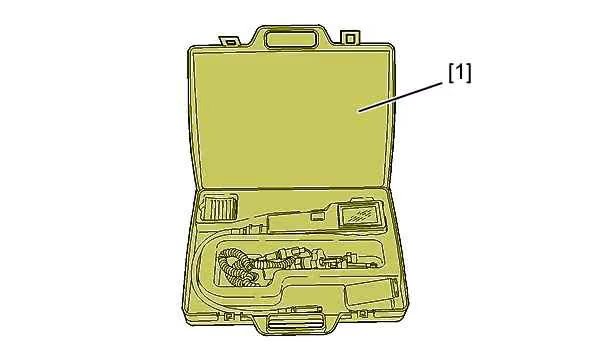
[1] Compression tester MULLER 203102-100.
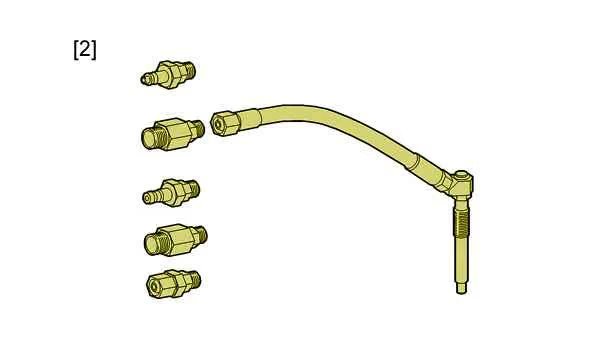
[2] Dummy spark plug (-).0194-G.
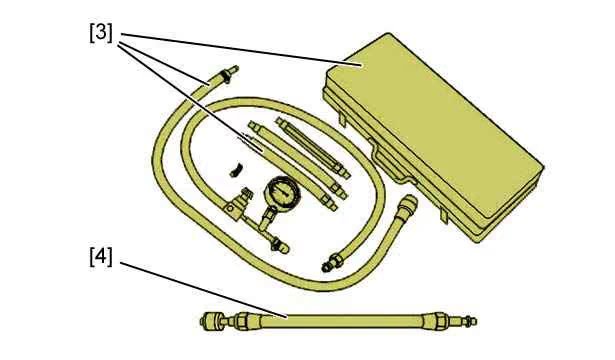
[3] Leakage tester FACOM 910.A.
[4] Diesel engine adaptor FACOM 910.A6.
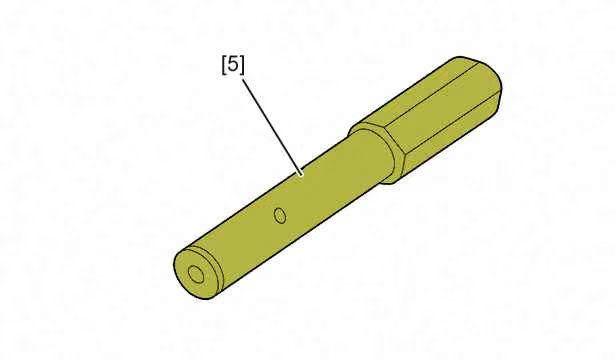
[5] flywheel locking tool (-).0194.C.
2. Removing
ESSENTIAL: Respect the safety and cleanliness recommendations that are specific to high pressure diesel injection (HDi) engines.
Ensure that the speed of engine rotation, driven by the starter, is correct (Minimal value: 250 rpm).
N.B.: Checking is carried out with the engine cold.
Remove:
- The battery style cover
- The pre-heater plugs
Disconnect:
- The battery
- The engine management ECU
Isolate the pre-heat plugs supply wire.
3. Measuring the pressures at the end of compression
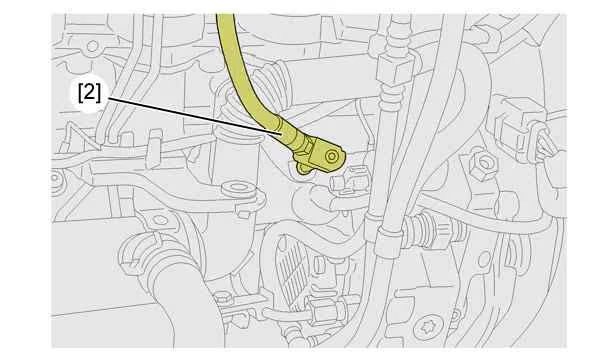
Fit the tool [2]to cylinder N° 1; Tighten to 1 ± 0,1 daN.m.
Connect the tool [1]to the tool [2].
Reconnect the battery.
Operate the starter for 10 seconds (Engine management ECU disconnected).
Measure the pressure at the end of compression, in order, on cylinders 1, 2, 3 and 4: The maximum difference between any 2 cylinders should be 5 bars.
CAUTION: If the pressure values are low, check the condition of the air filter and the head gasket before planning an engine overhaul.
4. Compression loss measurement
CAUTION: Checking is carried out with the engine cold.
Place the vehicle on a lift.
Disconnect the battery.
Remove the under engine protection.
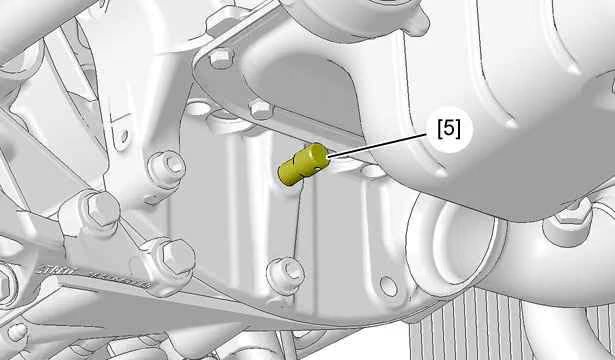
Set the timing belt (see the relevant operation).
Determine which cylinder is at end-of-compression phase; Using the tools [2], [3], [4].
Insert the flywheel stop [5].
Read the loss of compression; Using the tools [2], [3], [4] (average value = 20%).
N.B.: A considerable compression leak results in noise, or causes air bubbles to rise in the cooling system.
If the value is incorrect, faulty parts can be located by locating the noise made by the passage of air.
| Determining the origin of the compression losses | |
|---|---|
| Diagnosis | Check the condition of the following components |
| Air leak: Air inlet manifold | Inlet valves |
| Air leak: Exhaust manifold / Exhaust system | Exhaust valves |
| Air leak: Oil filler cap / Oil gauge well | pistons / Piston rings |
| Air bubbles: Cooling system | Cylinder head gasket / Cylinder head |
Carry out the same operation for the 3 other cylinders, each time rotating the crankshaft halfway by using the pulley/casing identification marks.
5. Refitting
Remove the tools [1], [2], [3], [4], [5].
Reconnect:
- The engine management ECU
- The battery
Refit:
- The protective panel under the engine
- The pre-heater plugs
- The battery style cover
CAUTION: Perform the operations to be carried out following reconnection of the battery.
Parts & tools for this job For 2003 Citroën C2
- PARTEngine gasket setSearch: Citroën C2 2003 engine gasket set
- TOOLTorque wrenchSearch: 3/8 inch torque wrench
- TOOLFeeler gauge setSearch: feeler gauge set
As an Amazon Associate we earn from qualifying purchases.