
Release of brake pedal
- Make
- Fiat
- Model
- Bravo /Brava (182) Factory Service Manual
- Year
- 1995–2001
- Section
- Anti-lock braking system › Release of brake pedal
The braking is therefore intermittent or in steps, and follows a succession of phases dictated by the rolling conditions of the braked wheel in accordance with a repetitive cycle in the form of jerks. This is not perceived by the driver, because of the speed and frequency with which it takes place and because it is regulated by the inertia of the wheel which, in relation to the speed of intervention of the device, prevents the wheel from reaching extreme skid coefficients.
On a car with no A.B.S., the driver is able to intervene intermittently on the brake pedal with a frequency of 2 cycles per second (2 presses and 2 releases).
With the A.B.S. system, the cycles increase to 4-10 per second (depending on the grip).
The intervention of the A.B.S. usually ceases at speeds of less than 2.75 km/h to permit complete locking of the wheels with the car stopped.
NOTE The recycling pump is of the dual-circuit free piston type, and is driven by an electric motor which is always turning during recycling. The pistons are not coupled to the electric motor, but are only moved along their travel, by the cam, when the brake fluid arrives. The pump can therefore only accomplish one pushing travel, and cannot draw in fluid because there is no mechanical connection between motor and pump.
Release of brake pedal
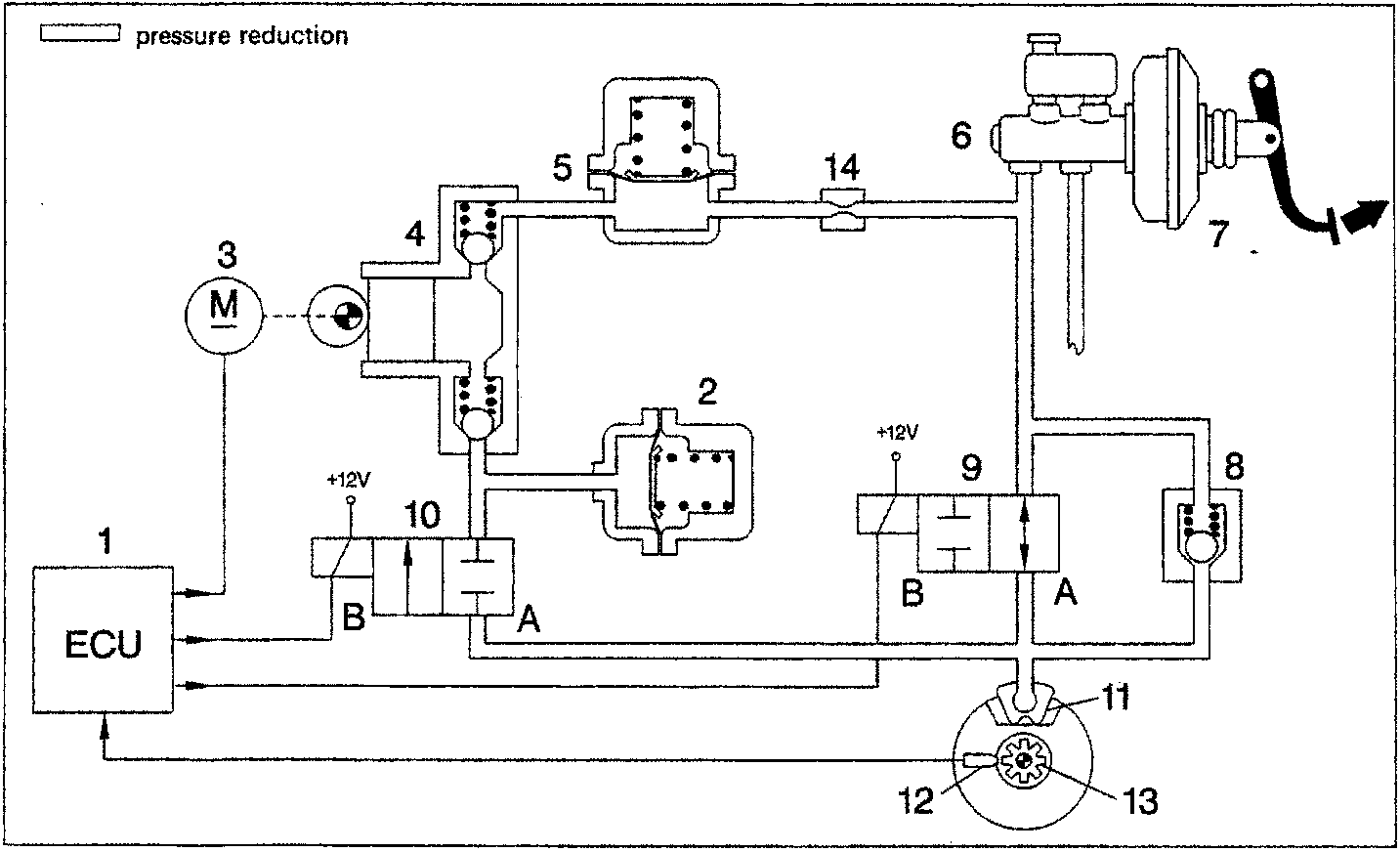
- Electronic control unit
- Low-pressure accumulator (reservoir)
- Recycling pump motor
- Recycling pump
- High-pressure accumulator (damping chamber)
- Brake pump
- Servo unit
- Rapid pressure reducing valve
- Inlet solenoid (A) open (B) closed
- Outlet solenoid (A) closed (B) open
- Brake caliper
- Rpm sensor
- Phonic wheel
- Constriction
To permit a rapid reduction in pressure on the brake caliper (11) when the brake pedal is released, the system has a non-return valve (8) located in parallel with the inlet solenoid (9).
Parts & tools for this job For 1995 Fiat Bravo
- PARTBrake padsSearch: Fiat Bravo 1995 brake pads
- TOOLBrake bleeder kitSearch: one man brake bleeder kit
- FLUIDBrake fluidSearch: brake fluid
Links open Amazon search results in a new tab. As an Amazon Associate I earn from qualifying purchases.