
Transmission
- Make
- Fiat
- Model
- Ducato Factory Service Manual
- Year
- 2002–2006
- Section
- General › Transmission
TRANSMISSION
INTRODUCTION
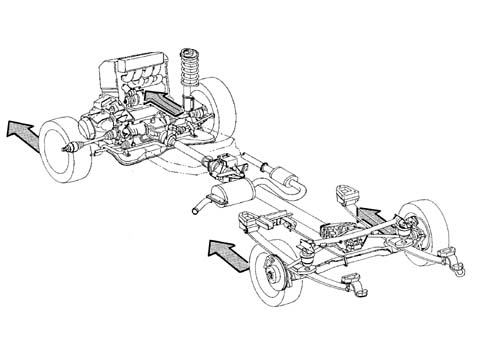
- The DUCATO 4X4 is a vehicle where the four wheel drive can be switched on so that it can tackle road surfaces in poor grip conditions.- Derived from production models and maintaining the same gear ratios, this version is marketed with an MLGU gearbox.
when the four wheel drive is switched on the speed of the vehicle must NOT exceed 60 km/h.
the lockable rear differential (optional) should only be used if the road surface conditions provide little grip.
Use of the vehicle
- It is advisable to switch on the four wheel drive for journies where grip conditions are poor.- If the vehicle is equipped with a gear reduction unit, it is advisable to switch it on immediately after activating the four wheel drive. Switch off the gear reduction unit before deactivating the four wheel drive. Only use reduced gears with the four wheel drive switched on, otherwise there is a risk of damaging the front drive.- Lock the rear differential before driving in muddy conditions.- Remove any mud that may have become deposited on the wheels and on the transmission components. - When cleaning the vehicle avoid directing high pressure water jets directly onto the universal joints or the rubber covers.
Switching on the four wheel drive
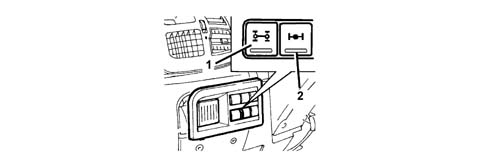
- To switch the four wheel drive on or off, press the green button in the dashboard.- Switch the four wheel drive on/off with the vehicle moving whilst keeping the accelerator released and the front wheels straight.
the four wheel drive is only switched on when the LED in the special button is lit up The LED may light up or go out with a slight delay in relation to the command (the time required for the synchronization of the front and rear transmission).
Locking the rear differential (where fitted)
- In order to lock/release the rear differential, press the special brown button in the dashboard.
only lock/release the rear differential with the vehicle stationery and the four wheel drive on. The rear differential lock is only switched on when the LED in the special button is lit up.
only switch the rear differential lock on for journies on muddy road surfaces with poor grip conditions. Engage the gears without making sharp moves (especially when driving uphill). On leaving the muddy area, unlock the rear differential.
Use of reduced gears (where fitted)
- The vehicle may be equipped with a gear reduction unit which allows two different speed ranges:
*- normal gears,*- reduced gears,
- The lever for engaging the reduced gears is located on the right side of the driver's seat. Changing from one range to the other is synchronized and requires the use of the clutch. The luminous blue warning light in the panel coming on indicates that the reduced gears are engaged.- The gear reduction unit has the following advantages:
*- slow progression on routes that are particularly uneven,*- easy take off on steep inclines or subsiding road surfaces,*- good engine braking.
the lever for engaging the gear reduction unit is in a neutral position in the middle where the wheels are "free"; make sure that the correct gears are engaged when using reduced gears.
on versions with JTD engines the engine cooling fans come on when the reduced gears are engaged.
Drive torque and grip
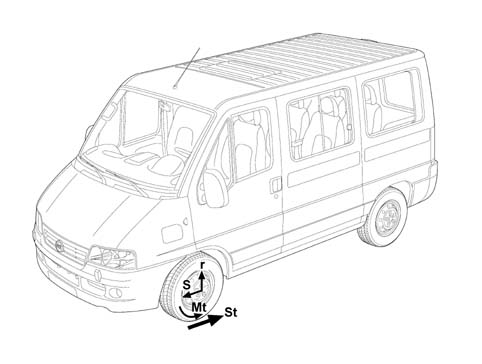
A pair of forces act on a vehicle's drive wheels (figure A), which lead to S (drive or propulsion force) and St (tangential drive force), in the same measure, whose value is determined by the ratio between the drive force Mt applied to the drive wheels and the radius r of the actual wheels: - S=St=Mt/n
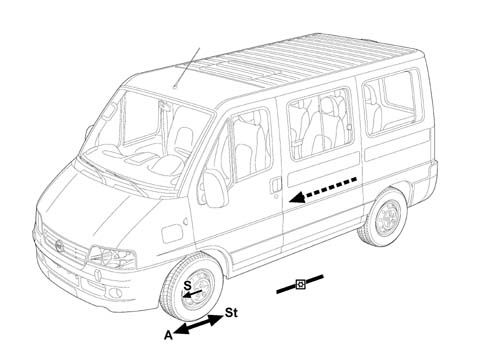
- In order for a vehicle to move (figure B) (take off from stationary) or accelerate, the drive force S must be greater than the total resistance of the advancement R and less than the adherence. More precisely, the tangential force St which is of the same intensity as the drive force S, must be less than the value of the available adherence A.
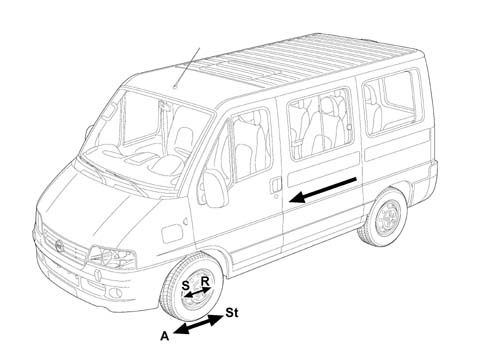
- In conditions of equilibrium, the advancement of the vehicle at an even speed is ensured when the force S is equal to the resistance R.- The value of the total resistance to the advancement R is deteremined by the sum of the resistances due to rolling, air penetration, inertia of the means and gradients.- The value of the available adherence A is determined by the product of the friction coefficient "µ" in force between the bodies in contact (in this case the tyre and the ground) for the weight "P" of the vehicle acting on the wheel: A = µ*P- Since the weight P weighing on the tyre is a constant like the friction coefficient "µ", the adherence available A can be represented in a circular diagram in relation to the point of contact between the tyre and the ground (figure C). The adherence is available in all directions, therefore on both the longitudinal axis of the tyre on which the traction force S and the tangential force St are acting and on the transverse axis on which external disturbing forces Fe (side wind) and/or centrifugal forces Fc (vehicle cornering) are acting. When the intensity of an external force (driving or disturbing) reaches the value of the adherence A this is no longer available in any other direction.
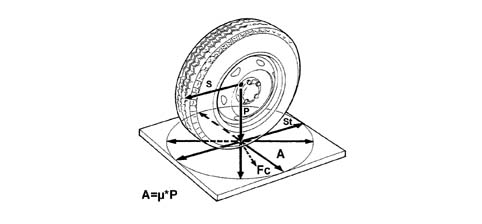
- When the tangential drive force St applied is greater than the adherence available A (snow, ice, mud) the drive wheels tend to slip and the vehicle does not move when setting off from a standstill (figure D).
- Like the drive torque supplied by the engine, distribution to four wheels rather than two (S1 and S2) reduces the value of the tangential drive forces St1 and St2 applied to each drive wheel (figure E).
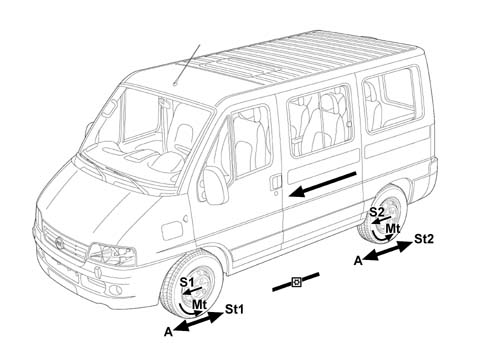
- As the drive torque for each of these has been decreased, the fraction of available adhesion A increases as a result before the wheel starts to slip.- Four wheel drive means that four drive wheels are available with the advantage of sharing the drive torque between four wheels instead of two.- This is useful in all situations where increased torque is required to overcome uneven surfaces or unmade roads or when the grip conditions are poor and only two drive wheels may not be sufficient to propel the vehicle: snow, ice, mud, sand, etc.
Four wheel drive
- In addition to advantages in terms of drive (full use of the available torque) four wheel drive offers further fundamental advantages in terms of safety, stability and even handling of the vehicle. - Safety: this is improved because any lack of grip of one of the drive wheels due to uneveness of the road surface (aquaplaning, icy patches, oil slicks) is compensated for by the other three drive wheels.- Stability: this is increased because there is a greater directional reserve due to a decreased drive commitment. On a vehicle with two drive wheels taking a bend (figure F) for reasons of simplicity force S is considered rather than St of the same intensity. Drive force S totally commits the available adherence range represented by the circle; the centrifugal force Fc produces a resulting T which falls outside the circle: the vehicle loses its direction and consequently its stability.
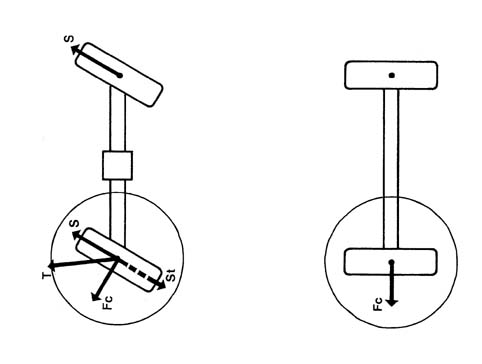
- The rear wheels are barely exploited because the acting Fc leaves adherence available that can be used for drive purposes. On a vehicle with four drive wheels, like the drive torque supplied by the engine (figure G), the force on the wheels S is halved; the resulting ti remaining inside the circle, i.e. available adherence, ensures good stability with a reserve margin. In this situation greater drive torque can be transmitted to the ground using the rear wheels as well.
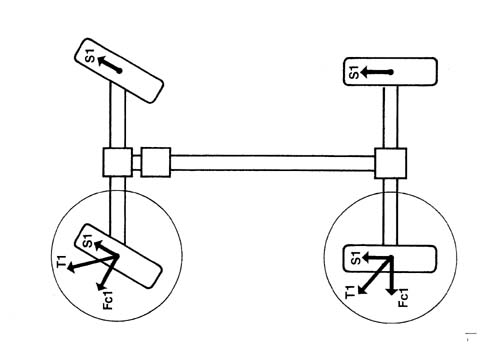
- Neutral behaviour: a front wheel drive vehicle taking a bend tends to follow a trajectory with a greater radius than the trajectory desired by the driver; the vehicle tends to understeer.- A rear wheel drive vehicle taking a bend tends to follow a trajectory with a smaller radius than the trajectory desired by the driver; the vehicle tends to oversteer.- A vehicle with four wheel drive taking a bend tends towards neutral behaviour because the two effects described previously cancel one another out. - The following types of four wheel drive are available:*- Permanent*- Engageable
Permanent four wheel drive
- A vehicle with permanent four wheel drive has four drive wheels permanently engaged. Permanent four wheel drive is achieved by means of a force applied to the front differential crown wheel, an idler, a viscous coupling on the centre section of the propeller shaftt with the task of permanently modulating the front and rear wheel drive and a rear differential integrated in a rigid rear axle.
Four wheel drive that can be switched on
- Four wheel drive that can be switched on allows the user to control the four wheel drive engagement directly, as and when needed (poor grip, steep hills) on vehicles that normally drive on two drive wheels. These vehicles are usually equipped with a drive from the gearbox or from the differential, a propeller shaft which normally freewheels, a rear differential and a drive engagement mechanism. This mechanism can be a clutch, a splined sleeve or a front toothed drive that can be switched on either manually or automatically.- The use of four wheel drive that can be engaged is advisable for poor grip conditions (snow, ice) or steep hills; compared with vehicles with two wheel drive it offers practical advantages in terms of performance and disengagement.
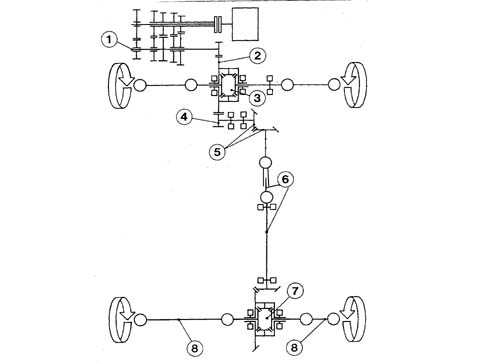
General diagram showing 4x4 transmission with mlgu gearbox
- The diagram below shows a 4x4 transmission.
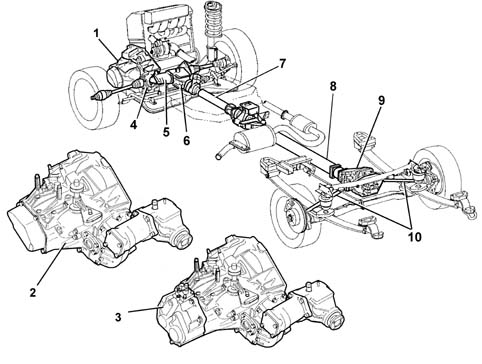
Drive transmission
- On the current Ducato 4x4 version the drive coming from the gearbox layshaft (1), with the ratios unchanged, passes through the front differential (3) ring gear (2) and reaches the front wheels.- At the same time, by means of the drive (4), the idler unit (5) and the longitudinal propeller shaft (6), the power arrives via the rear differential unit (7) and the driveshafts (8) at the rear wheels.
Drive
- The drive comprises a pinion (1) that meshes with the front differential ring gear, housed in a new differential half casing (2) matched with the original gearbox casing. Any irregularities in one of the casing components (bellhousing, centre casing, half casing with drive) means that the complete gearbox casing has to be replaced.- The drive is lubricated by the same transmission fluid as the gearbox.
If the differential ring gear is being replaced, only use the specific replacement part for the 4x4 version.
Parts & tools for this job For 2002 Fiat Ducato
- TOOLTorque wrenchSearch: 3/8 inch torque wrench
- TOOLSocket setSearch: socket set metric
- BOOKHaynes manualSearch: Haynes manual Fiat Ducato
Links open Amazon search results in a new tab. As an Amazon Associate I earn from qualifying purchases.