
Crankshaft
- Make
- Fiat
- Model
- Grande Punto Factory Service Manual
- Year
- 2005–2012
- Section
- Crankshaft and flywheel › Crankshaft
CRANKSHAFT
CONSTRUCTION SPECIFICATIONS
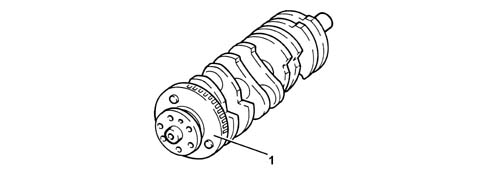
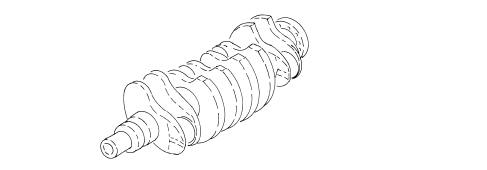
This is cast iron and rests on five main bearings. Shaft axial clearance is governed by two half-rings housed in the rear main bearing.
Eight counterweights balance the crankshaft rotary masses with precision.
A set of channels runs along the length of the crankshaft to lubricate the main journals and crankpins.
A phonic wheel (1) is fitted at the rear for the rpm sensor.
CONSTRUCTION SPECIFICATIONS
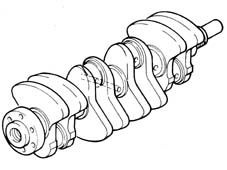
Made from induction hardened cast iron. Resting on five main bearings with interposed half-bearings divided into size categories.
The crankshaft endfloat is adjusted by two half-rings housed on the middle main bearing.
Eight counterweights at 180° balance the crankshaft rotary masses with precision. A channel running along the length of the shaft lubricates the main journals and crankpins.
COMPOSITION
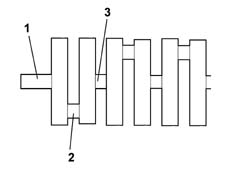
The crankshaft consists of:
- main journals (1), through which it rotates on supports with bearings (bushings) in between;
- crank pins (2) above which the connecting rod big ends are hinged;
- crank arms (3), at the same height as the midway stroke which join the main journals and the crank pins.
In addition, the shaft is also prepared for:
- fitting the flywheel; - fitting the gear which transmits power to the timing system components by means of a toothed belt.
OPERATION
The crankshaft is the component that transforms the alternating rectilinear motion of the piston into a rotary motion by means of the connecting rod.
It is subject to forces that vary sharply in intensity and direction and must therefore be sufficiently resistant.
It''s shape depends on the:
- number of cylinders
- engine type (in line, v-formation, w-formation, etc.)
- number of bearing supports
- number of strokes (2 stroke or 4 stroke)
To prevent damaging vibrations to the engine, the crankshaft should be balanced both statically and dynamically. The vibrations are due to:
- centrifugal forces produced by the masses equipped with a rotary motion (crank pins, connecting rod big end, 1/3 of the weight of the connecting rod, crank arms);
- inertia forces produced by the masses equipped with an alternating rectilinear motion (piston, gudgeon pin, 2/3 of the weight of the connecting rod).
A shaft is statically balanced when, resting on two supports, it remains balanced irrespective of the rotation position.
A shaft is dynamically balanced when, supported between two points on the rotation axis and made to turn, it transmits a reaction equal to half its own weight on each support.
The addition of counter-weights in appropriate positions balances the crankshaft statically or dynamically.
However, it is not enought to balance the crankshaft in order to dampen engine vibrations; the motion must also be made uniform by both offsetting the working cycles (following a given firing order) and providing the shaft with a suitable flywheel.
The firing order is achieved by offsetting the cranks, in engines with several cylinders, at an angle of:
- a = 180° t/ i
where:
- t = engine times
- i = number of cylinders
In our case (4 stroke engine with 4 cylinders).
The crank offset angle is equal to:
- a = 180
- 4/4= 180°
The cranks are arranged on the same plane and parallel, two by two.
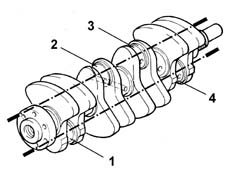
There are two types of firing order: 1, 2, 4, 3 or 1, 3, 4, 2; the better known is the firing order 1, 3, 4, 2 because the centrifugal forces and the inertia forces are more well balanced.
CONSTRUCTION SPECIFICATIONS
This is steel and rests on five main bearings. Shaft axial clearance is governed by two half-rings housed in the middle main bearing.
Eight counterweights balance the crankshaft rotary masses with precision.
A set of channels runs along the length of the crankshaft to lubricate the main journals and crankpins.
Parts & tools for this job For 2005 Fiat Grande Punto
- PARTEngine gasket setSearch: Fiat Grande Punto 2005 engine gasket set
- TOOLTorque wrenchSearch: 3/8 inch torque wrench
- TOOLFeeler gauge setSearch: feeler gauge set
Links open Amazon search results in a new tab. As an Amazon Associate I earn from qualifying purchases.