
2003 RANGE – Main features and technical specifications
- Make
- Lancia
- Model
- Thesis Factory Service Manual
- Year
- 2002–2009
- Section
- Maintenance › 2003 RANGE – Main features and technical specifications
2003 RANGE – Main features and technical specifications
2003 RANGE
Main features and technical specifications
The model range in question has been expanded through the launch of the following new engine types:
- 3.2V6 CAE
- 2.4 JTD 20V
- 2.4 JTD 20V CAE
and through the adoption of the new six speed F40 manual gearbox.
With the addition of the new engine types, the complete range of the LANCIA THESIS comprises the following models:
5 petrol engine types
- 2.0 TB 136 KW
- 2.4 125KW
- 3.0V6 CAE 158KW
- 2.4 CAE 125KW
- 3.2V6 CAE 169KW
3 diesel versions
- 2.4 JTD 110KW
- 2.4 JTD 20V 129KW
- 2.4 JTD 20V CAE 129KW
The pages which follow contain the main specifications for the different engine types and a brief description of the main innovative features of the model.
| VERSIONS | ENGINE CODE | BODYWORK VERSION |
|---|---|---|
| 2.0 TB | 841E000 | 841AXA1B 03D 841AXA1B 03F (*) |
| 2.4 | 841D000 | 841AXB1B 00C 841AXB1B 00D(*) |
| 2.4 CAE | 841D000 | 841AXB11 04C 841AXB11 04D(*) |
| 2.4 JTD | 841C000 | 841AXD1B 02B |
| 2.4 JTD 20v | 841G000 | 841AXE1B 05 |
| 2.4 JTD 20V CAE | 841G000 | 841AXH11 06 |
| 3.0 V6 CAE | 841A000 | 841AXC11 01 |
| 3.2 V6 CAE | 841L000 | 841AXF11 07 |
(*) EURO 4 version (for specific markets)
ENGINES
The specifications of both the new and current engines are listed below for easy reference:
2.0 TB
| 841E000 1998 cm3(5 cylinders - 20 valves) 136 kW (185 CV) 5500 rpm 308 Nm (31.4 kgm) 2200 rpm BOSCH ME7 MPI electronic injection with variable geometry turbocharger and intercooler Electronic, static advance, integrated with the injection 224 km/h |
2.4 - 2.4 CAE
| 841D000 2446 cm3 (5 cylinders - 20 valves) 125 kW (170 CV) 6000 rpm 226 Nm (23 kgm) 3500 rpm MPI BOSCH ME3.1 Electronic, static advance, integrated with the injection 217 km/h (2.4) - 215 km/h (2.4 CAE) |
2.4 JTD
| 841C000 2387 cm3 (5 cylinders - 10 valves) 110 kW (150 CV) 4000 rpm 305 Nm (31kgm) 1800 rpm Bosch Unijet Common Rail direct injection with variable geometry turbocharger and intercooler 206 km/h |
2.4 JTD 20v
| 841G000 2387 cm3 (5 cylinders - 20 valves) 129 kW (175 CV) 4000 rpm 380 Nm (38.7 kgm) 2000 rpm Bosch Common Rail direct injection with electronically controlled variable geometry turbocharger and intercooler 225 km/h |
2.4 JTD 20v CAE
| 841H000 2387 cm3(5 cylinders - 20 valves) 129 kW (175 CV) 4000 rpm 330 Nm (34 kgm) 1750 rpm Bosch Common Rail direct injection with electronically controlled variable geometry turbocharger and intercooler 220 km/h |
3.0 V6 CAE
| 841A000 2959 cm3 (6 cylinders - 24 valves) 158 kW (215 CV) 6300 rpm 263 Nm (26.8 kgm) 5000 rpm BOSCH ME 3.1 MPI electrnonic injection Electronic, static advance, integrated with the injection 234 km/h |
3.2 V6 CAE
| 841L000 3179 cm3 (6 cylinders - 24 valves) 169 kW (230 CV) 6200 rpm 289 Nm (29.4 kgm) 4800 rpm BOSCH ME7 MPI electrnonic injection Electronic, static advance, integrated with the injection 240 km/h |
2.4 JTD 20v ENGINE
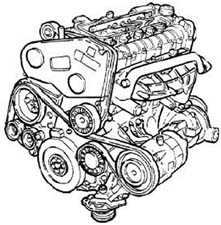
The Thesis 2.4 JTD 20v features a new 2387 cm3, five cylinder in line engine with four valves per cylinder, running on diesel, with a power output of 129KW (175 CV) at 4000 rpm located in the front of the vehicle (Fig. 1).
It is a new engine derived from the current JTD 10v Common Rail engine but offers a power output of about 16% higher.
The new turbodiesel system features various technical innovations designed to improve performance, engine torque at low speeds and quietness.
The Common Rail system adopted on the 20v version includes two automatic control strategies for the calibration and balancing of the diesel injected.
The new power unit which uses the new Multijet system exploits the electronic control of the injectors to make a greater number of injectors during each engine cycle than the Unijet system on the JTD 10v engine.
The direct injection pressure has also been increased brining it to 1400 bar and a new turbocharger calibration has been adopted.
Fig. 1 - 2.4 JTD 20v Engine
Some of the engine components are also new; the main ones are listed below:
- new cylinder head with hydraulic tappets
- new connecting rods and new steel crankshaft
- new pistons with internal duct for the circulation of the cooling fluid
- new main journals and big end bearings made from special materials
- new engine flywheel with twin ramp DVA
- new exhaust manifold in highly resistant material
- new die-cast aluminium intake manifold
- new electronically controlled EGR system and exhaust gas cooling
- new oil pump
- new (air/oil) external heat exchanger for oil cooling
- new water pump for cooling circuit.
The Multijet system
The adoption of the Multijet system makes the JTD 20v the first second generation power unit.
The basic features of the Unijet common rail system such as a high injection pressure and electronic control of the injectors are still present, but with addtional features: the number of injections compared with the Unijet system is increased for each engine cycle. The quantity of diesel fuel burnt inside the cylinder is the same, but it is divided into more sections, thereby producing a more gradual combustion. The advantages include much quieter operation, a reduction in emissions and an improvement in performance accompanied by improved driveability. These results are not inconsiderable, especially because they have been produced with an engine which not only represents an incredible technological leap forward compared with ante-chamber diesel engines but has also recorded enormous improvements compared with first generation JTD engines.
The secret of the Multijet lies in the control unit that controls the electrical opening and closing of the injectors (as well as in the latter). The electronic control unit is the key element and can carry out a series of injections very close together. Developed by Fiat Auto researchers for this very purpose, the component (together with the injectors) controls the individual injectors and makes it possible to produce "multiple injections" which ensure more accurate control of the pressure and temperature developed in the combustion chamber in addition to improved exploitation of the air introduced into the cylinders. This results in reaching higher levels in controlling combustion noise, in reducing emissions and in increasing performance.
Multiple injections, different calibration of the engine management and direct injection pressure at 1400 bar are the main new features of the 2.4 JTD 20v.
3.2V6 24v
The Thesis also features a new 3179 cm3 engine with six cylinders in a V formation, 24 valves, running on petrol, with a power output of 169 KW (230 CV) at 6200 rpm (derived from the current 2.0 V6 24v engine) transversely mounted at the front.
Some of the engine components are also new; the main ones are listed below:
- New crankshaft constructed from new materials and increased piston stroke.
- New pistons and connecting rods selected to support the increase in maximum power.
- New crankcase with specific strengthening operations.
- New inlet and exhaust timing with new design profiles to improve torque supply at low engine speeds.
- Special engine flywheel for housing a reinforced clutch suitable for the new performance.
- New
CLUTCH
The clutch is the dry, single plate, hydraulically operated type (not fitted on the CAE versions because they have automatic transmission)
| There are 3 types of gearbox for the various engine types: | |
| with 6 forward speeds plus reverse all with synchromesh for the 2.0 TB, 2.4 and 2.4 JTD versions with 6 forwards speeds plus reverse all with synchromesh (Fig. 2) for the 2.4 JTD 20v version AISIN type with 5 foward speeds plus reverse for the 2.4 CAE, 2.4 JTD 20v CAE, 3.0 V6 CAE and 3.2 V6 CAE versions. |
F40 Manual Gearbox
The F40 is a new type of gearbox with a transverse type configuration with three shafts: one main shaft A (3 - Fig. 2) and two layshafts B and C (2 and 4 - Fig. 2).
There are five fixed gears on the main shaft A which transmit power to the gears for 1st, 2nd, 3rd, 4th, 5th, 6th and Reverse speeds on the two layshafts B and C which are permanently meshed.
The two layshafts B and C both have a pinion which is permanently meshed with the differential ring gear.
The layshaft B contains 1st and 2nd gears and 5th and 6th gears, whilst layshaft C has 3rd and 4th speeds and reverse gear.
Fig. 2 - F40 Gearbox
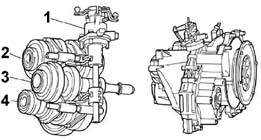
- gear engagement assembly
- layshaft C
- main shaft A
- layshaft B
The gears and drive chains inside the gearbox are lubricated dynamically by channeling oil flows through holes in the casings and on the mainshaft and layshaft and also through additional plastic channels; all this allows improved torque transmission efficiency and more effective wear prevention. The clutch control is hydraulic with a coaxial CSC system coaxial on the mainshaft inside the gearbox.
This system has the following advantages:
- a clutch plate wear recovery device that allows the force on the clutch pedal to be kept constant during the working life of the vehicle.
- improved acoustic comfort
- reduced shift effort
- no vibrations / lever shuddering
Fig. 3 - Section of new F40 gearbox shown in neutral position
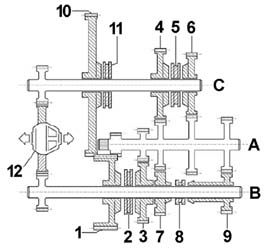
- 1st speed gear
- 1st and 2nd speed synchronizer
- 2nd speed gear
- 3rd speed gear
- 3rd and 4th speed synchronizer
- 4th speed gear
- 5th speed gear
- 5th and 6th speed synchronizer
- 6th speed gear
- Reverse gear
- Reverse gear synchronizer
- Differential
- Main shaft
- Layshaft
- Layshaft
Comfortonic Electronic Automatic Transmission
The CAE versions are equipped with an AISIN type adapative electronically controlled automatic transmission with 5 speeds plus reverse with the possibility of dual operation: completely automatic (Full Auto) or sequential manual (Tip).
WHEEL GEOMETRY
(with tyres inflated to the recommended pressure and vehicle in running order)
| Front wheels | Camber | - 50' +/- 20' |
| Caster | 2˚ 40' | |
| Toe-in | - 2mm +/- 1mm | |
| Rear wheels | Camber | - 13' +/- 20' |
| Toe-in | + 3mm +/- 1mm |
2.0 TB - 2.4 - 2.4CAE 3.0V6 24v CAE 3.2V6 24v CAE | 2.4 JTD 20v 2.4JTD 20v CAE | |
|---|---|---|
| Rims (fitted as standard) | 7Jx16 H2-39 | 7Jx16 H2-39 |
| Tyres (fitted as standard) | 215/60 R16 (95W) 215/60 ZR16 (95W) | 215/60 R16 (95W) 215/60 ZR16 (95W) |
| Rims (fitted as standard) | 7Jx17 H2-41 | 7Jx17 H2-41 |
Tyres (*) (available on request) | 225/50 R17 (94W) 225/50 ZR17 (94W) | 225/50 R17 (94W) 225/50 ZR17 (94W) 245/40 ZR 18 |
| Snow tyres | 215/60 R16 (95H) M+S | 215/60 R16 (95H) M+S |
| Inflation pressures (**) | 2.3 bar | 2.3 bar |
(*) Tyres to which chains cannot be fitted.
(**) Inflation pressures when cold, for front and rear tyres (excluding snow tyres) for both reduced load and full load.
When the tyre is warm, the pressure must be +0.3 bar higher than specified.
BODYWORK
Comfort Seats (for versions/markets where fitted)
Lancia has designed the seats on the Thesis taking into account all the ergonomic parameters: rounded shapes and softness ensure maximum comfort and a pleasing, luxurious appearance.
On the Comfort version, the front seats are not only completely electrical, but they have interesting functions such as ventilation, heating, adaptability and massage.
In addition, the driver's seat position can also be memorized using a single button which includes all the customized adjustements for the seats, rear view mirrors and steering wheel for three different people.
The ventilation function is achieved through three fans (two on the cushion and another on the backrest) which produce a flow of air towards the occupant.
The air is distributed via numerous layers: a special dry-wave material, open cell foam and perforated leather. The heating of the seats can also be activated with a choice of three different temperatures: 36, 39 and 44°C.
In addition to the ventilation and heating functions there is adaptability and massage: the first function allows the cushion and the backrest to be adjusted to the physical shape of the occupant, who, after a few minutes finds themself in a customized armchair that has been moulded to their shape. the second function gives a gentle massage to the occupant's back and along the entire seat.
The adaptability is achieved through several air bags located between the seat upholstery and the cover and is controlled by an electronic control unit. The latter, in effect, regulates the quantity of air inside the bags according to the pressure exerted by the occupant.
The impulse massage on the other hand is produced by inflating and deflating several bags, in cycles, for four minutes at the end of which there is a return to the adaptation function.
The same system is also responsible for the adjustment of the lumbar support.
To activate these functions, select the ones preferred for each seat and simply press the Comfort button at the seat of the actual seat. The centre console display will show the relevant menu: the items concerned can be selected through a few, easy steps.
The rear seats on the Comfort version are also very comfortable with heating, adaptation and massage functions available.
All the adjustments can be made using the buttons inside the Business rear armrest.
Comfort seats are available, on request, on all versions and, in addition to being technologically advanced, they are very pleasing to look at and are covered in the softest Nappa leather.
OPERATIONS IN NETWORK
- For the routine P.D.I. operations refer to the following subjects in Service News 3/2002: 00.04.02 (Various Models - list of operations) and 00.06.02 (specific operations for the Thesis).
- For the Planned Maintenance Programme refer to subject 00.06.03 - S.N. 4/2003.
- For general information, technical data, descriptions and operation, fault diagnosis, tests, repair procedures and wiring diagrams, refer to the Service Manual available on CD ROM which, starting from this model, has been improved to make it easier toconsult.
- For the fault diagnosis of electronic systems, use the Examiner updated with the release of programme 5.40 or later.
- If the following components are being replaced: the instrument panel, Body Computer and Connect (N.I.T.) with ones supplied as spares, the component must be configured, using the Examiner following the PROXI alignment procedure.
- The programming of the CODE 2 function and any central locking and alarm remote controls should always be carried out using the Examiner selecting the Body Computer system if the vehicle is not equipped with the Keyless System; if the vehicle is equipped with the Keyless System, select "Passive Entry DELPHI F.L".
- To order the following parts from the Parts Dept: Body Computer, lock barrel kits, keys, CIDs and CODE Cards, the same procedure for ordering CODE2/Alarm system components is valid, i.e. using a Personal Computer (DCS) for the Network which is on line or by Fax for users who are not connected.
Parts & tools for this job For 2002 Lancia Thesis
Links open Amazon search results in a new tab. As an Amazon Associate I earn from qualifying purchases.