
Twin pressure conscious reducing valve (Brakes)
- Make
- Rover
- Model
- 600 620 Diesel Repair Manual Supplement
- Year
- 1995–1999
- Section
- Description and operation › Twin pressure conscious reducing valve
Twin pressure conscious reducing valve
The fluid lines for the rear hydraulic circuits are connected through the valve to control rear brake pressure whenever the ABS system is not functioning.
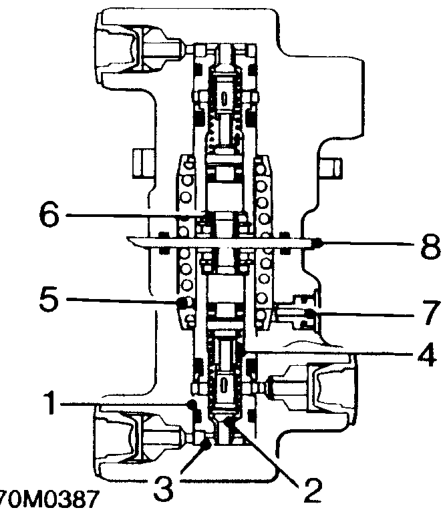
- Piston sleeve
- Poppet valve
- Piston top
- Spring
- Spring
- Spring
- Vent plug
- Mounting plate
Pressure to the rear brake calipers passes through the piston sleeve, past the poppet valve and out to the rear calipers. The same pressure is also felt on the top of the piston, forcing the piston against spring pressure, towards the valve centre until the piston sleeve contacts the poppet valve and forms a seal. Input pressure is now balanced with output pressure. As further input pressure is applied from the master cylinder, it overcomes output pressure being felt on the piston and forces the piston outwards slightly away from the poppet valve allowing pressure past the poppet valve until output pressure is again balanced with input pressure.
This continual action reduces the pressure being applied at the rear calipers and minimises the risk of the rear wheels locking under severe braking conditions.
Because both halves of the valve are operating at the same pressure, each piston is opposed by the other. If a pressure drop is felt in one side of the valve, pressure build up in the other side of the valve causes the piston to move across unopposed, pushing the piston in the low pressure circuit against the pressure of springs.
In the event of a failure of an internal seal, fluid will enter the centre chamber and, when the brake pedal is applied, the increase in pressure will cause the vent plug to rupture and allow brake fluid to escape.
Parts & tools for this job For 1995 Rover 600
- PARTEngine gasket setSearch: Rover 600 1995 engine gasket set
- TOOLTorque wrenchSearch: 3/8 inch torque wrench
- TOOLFeeler gauge setSearch: feeler gauge set
Links open Amazon search results in a new tab. As an Amazon Associate I earn from qualifying purchases.