
Encapsulated bolts and screws
- Make
- Rover
- Model
- Coupé, Cabriolet & Tourer 200/400 Coupé, Cabriolet & Tourer Workshop Manual
- Section
- General precautions and fitting instructions › Encapsulated bolts and screws
RM2652
Encapsulated bolts and screws
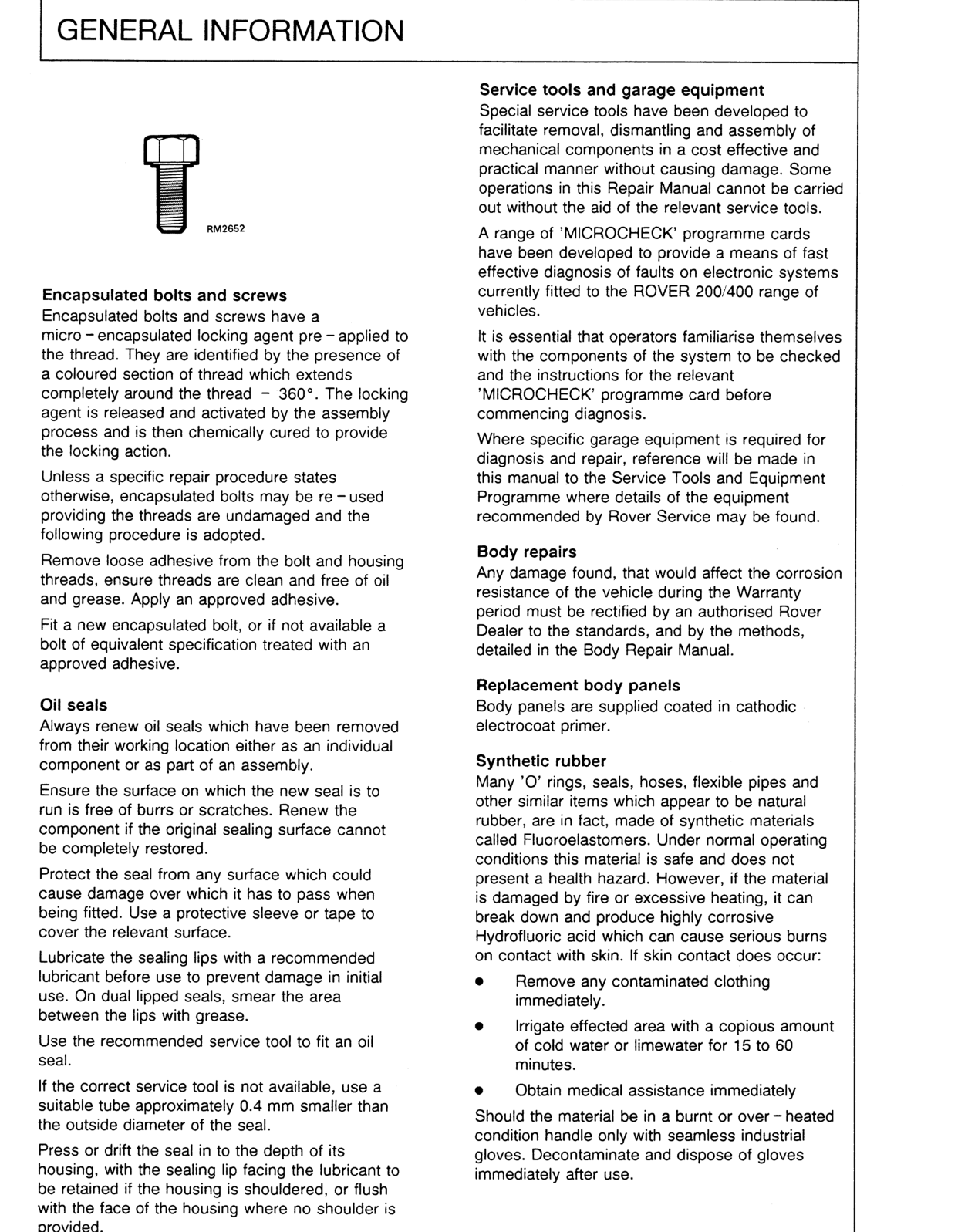
Encapsulated bolts and screws have a micro - encapsulated locking agent pre - applied to the thread. They are identified by the presence of a coloured section of thread which extends completely around the thread - 360°. The locking agent is released and activated by the assembly process and is then chemically cured to provide the locking action.
Unless a specific repair procedure states otherwise, encapsulated bolts may be re - used providing the threads are undamaged and the following procedure is adopted.
Remove loose adhesive from the bolt and housing threads, ensure threads are clean and free of oil and grease. Apply an approved adhesive.
Fit a new encapsulated bolt, or if not available a bolt of equivalent specification treated with an approved adhesive.
Oil seals
Always renew oil seals which have been removed from their working location either as an individual component or as part of an assembly.
Ensure the surface on which the new seal is to run is free of burrs or scratches. Renew the component if the original sealing surface cannot be completely restored.
Protect the seal from any surface which could cause damage over which it has to pass when being fitted. Use a protective sleeve or tape to cover the relevant surface.
Lubricate the sealing lips with a recommended lubricant before use to prevent damage in initial use. On dual lipped seals, smear the area between the lips with grease.
Use the recommended service tool to fit an oil seal.
If the correct service tool is not available, use a suitable tube approximately 0.4 mm smaller than the outside diameter of the seal.
Press or drift the seal in to the depth of its housing, with the sealing lip facing the lubricant to be retained if the housing is shouldered, or flush with the face of the housing where no shoulder is provided.
Service tools and garage equipment
Special service tools have been developed to facilitate removal, dismantling and assembly of mechanical components in a cost effective and practical manner without causing damage. Some operations in this Repair Manual cannot be carried out without the aid of the relevant service tools.
A range of 'MICROCHECK' programme cards have been developed to provide a means of fast effective diagnosis of faults on electronic systems currently fitted to the ROVER 200/400 range of vehicles.
It is essential that operators familiarise themselves with the components of the system to be checked and the instructions for the relevant 'MICROCHECK' programme card before commencing diagnosis.
Where specific garage equipment is required for diagnosis and repair, reference will be made in this manual to the Service Tools and Equipment Programme where details of the equipment recommended by Rover Service may be found.
Body repairs
Any damage found, that would affect the corrosion resistance of the vehicle during the Warranty period must be rectified by an authorised Rover Dealer to the standards, and by the methods, detailed in the Body Repair Manual.
Replacement body panels
Body panels are supplied coated in cathodic electrocoat primer.
Synthetic rubber
Many 'O' rings, seals, hoses, flexible pipes and other similar items which appear to be natural rubber, are in fact, made of synthetic materials called Fluoroelastomers. Under normal operating conditions this material is safe and does not present a health hazard. However, if the material is damaged by fire or excessive heating, it can break down and produce highly corrosive Hydrofluoric acid which can cause serious burns on contact with skin. If skin contact does occur:
- Remove any contaminated clothing immediately.
- Irrigate effected area with a copious amount of cold water or limewater for 15 to 60 minutes.
- Obtain medical assistance immediately
Should the material be in a burnt or over - heated condition handle only with seamless industrial gloves. Decontaminate and dispose of gloves immediately after use.
Original page
Parts & tools for this job For Rover Coupé, Cabriolet & Tourer
- TOOLTorque wrenchSearch: 3/8 inch torque wrench
- TOOLSocket setSearch: socket set metric
- BOOKHaynes manualSearch: Haynes manual Rover Coupé, Cabriolet & Tourer
Links open Amazon search results in a new tab. As an Amazon Associate I earn from qualifying purchases.