
Nut identification
- Make
- Rover
- Model
- Coupé, Cabriolet & Tourer 200/400 Coupé, Cabriolet & Tourer Workshop Manual
- Section
- General precautions and fitting instructions › Nut identification
Always fit new roll pins of an interference fit in the hole.
Always fit new circlips of the correct size for the groove.

Nut identification
A nut with an ISO metric thread is marked on one face or on one of the flats of the hexagon with the strength grade symbol 8, 12, or 14. Some nuts with a strength grade 4, 5 or 6 are also marked and some have the metric symbol M on the flat opposite the strength grade marking.
A clock face system is used as an alternative method of indicating the strength grade. The external chambers or a face of the nut is marked in a position relative to the appropriate hour mark on a clock face to indicate the strength grade.
A dot is used to locate the 12 o'clock position and a dash to indicate the strength grade. If the grade is above 12, two dots identify the 12 o'clock position.
Locking devices
Always release locking tabs and fit new locking washers, do not re-use locking tabs. Always use a backing spanner when slackening or tightening brake and fuel pipe unions.
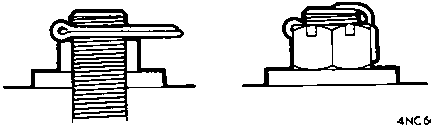
Fitting a split pin
Always fit new split-pins of the correct size for the hole in the bolt or stud. Do not slacken back nut to enter split-pin.
Self - locking nuts
Self - locking nuts, i.e. nylon insert or metal stiff nuts can be re-used providing resistance can be felt when the locking portion of the nut passes over the thread of the bolt or stud.
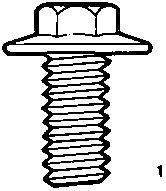
Self - locking bolts and screws
Self - locking bolts and screws, i.e. nylon patched or trilobular thread can be re-used providing resistance can be felt when the locking portion enters the female thread.
Nylon patched bolts and screws have a locking agent pre-applied to the threads. They are identified by the presence of a coloured section of thread which extends for up to 180° around the thread.
Trilobular i.e. Powerlok bolts have a special thread form which creates a slight interference in the tapped hole or threads of the nut into which it is screwed.
DO NOT re-use self-locking fasteners in critical locations e.g. engine bearings. Always use the correct replacement self-locking nut, bolt or screw.
DO NOT fit non self-locking fasteners in applications where a self-locking nut, bolt or screw is specified.
Original page
Parts & tools for this job For Rover Coupé, Cabriolet & Tourer
- TOOLTorque wrenchSearch: 3/8 inch torque wrench
- TOOLSocket setSearch: socket set metric
- BOOKHaynes manualSearch: Haynes manual Rover Coupé, Cabriolet & Tourer
Links open Amazon search results in a new tab. As an Amazon Associate I earn from qualifying purchases.