Modular engine management system - SPi (Ignition system): Description and operation
- Make
- Rover
- Model
- Coupé, Cabriolet & Tourer 200/400 Coupé, Cabriolet & Tourer Workshop Manual
- Section
- Description and operation › Ignition system
Ignition system
M.E.M.S. – S.P.i. system incorporates a programmed ignition system in which the timing is controlled entirely by digital techniques within the E.C.U.
Correct ignition timing is achieve by the E.C.U. using signals received from the following:
Crankshaft sensor – crankshaft position and engine speed.
Manifold absolute pressure sensor – engine load.
Coolant temperature sensor – engine temperature.
M.E.M.S. uses no centrifugal or vacuum advance, timing being controlled by the E.C.U. (1) which is energised by the main relay (2), with spark distribution being achieved by means of a rotor arm and distributor cap mounted at the No.4 cylinder end of the camshaft.
Basic ignition timing
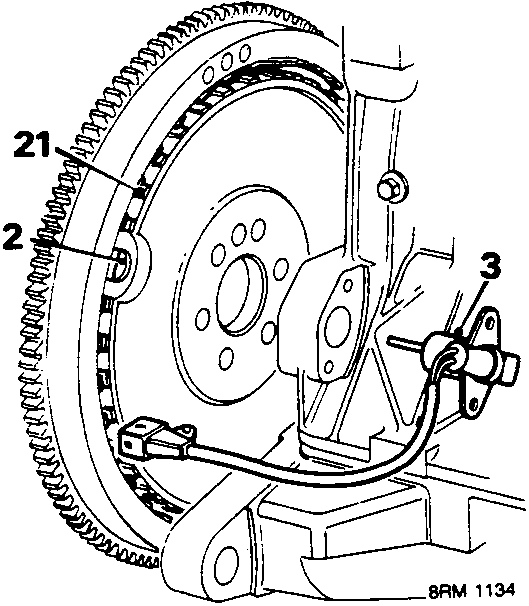
M.E.M.S. provides the optimum ignition timing for the relevant engine speed and load. The speed and position of the engine is detected by the crankshaft sensor (3) which is bolted to, and projects through the gearbox adaptor plate.
The sensor incorporates an armature which runs adjacent to a reluctor insert (21) in the flywheel, the insert consisting of 34 poles spaced at 10° intervals, with two missing poles (22) 180° apart to identify the T.D.C. positions.The sensor 'reads' these poles to provide a constant up – date of engine speed and crankshaft position to the E.C.U.
The load signal is provided by the manifold absolute pressure sensor (4) mounted inside the E.C.U. casing which detect manifold pressure via a pipe and vapour trap connected to the inlet manifold. The sensor converts pressure variations into graduated electrical signals which can be read by the E.C.U.
Ignition timing compensation
Coolant temperature compensation.
The signal from the coolant temperature sensor (5) allows the E.C.U. to provide the optimum driveability at low engine and coolant temperatures by advancing or retarding the basic ignition timing.
Idle speed control.
When the throttle pedal is released the E.C.U. uses the fast response of ignition advance to assist engine idle speed control.
When loads are placed on, or removed from the engine the E.C.U. senses the change in engine speed and in conjuction with the opening of the throttle disc by the stepper motor (7), advances or retards the the ignition timing to maintain the specified idle speed. When load is removed from the engine and the stepper motor returns to it's original position, the ignition timing returns to the idle setting.
Note: Due to the sensitivity of this system the ignition timing will be constantly changing at idle speed.
Ignition components
Ignition coil.
Though similar in appearance to coils used in conventional ignition systems, the coil (8) used in programmed ignition installations has a lower primary winding resistance (0.71 to 0.81 ohms at 20°C 68°F) than it's conventional counterpart. This allows the full h.t. output to be reached faster and so makes the coil operation more consistent throughout the engine speed range.
Parts & tools for this job For Rover Coupé, Cabriolet & Tourer
- PARTSpark plugsSearch: Rover Coupé, Cabriolet & Tourer spark plugs
- TOOLSpark plug socketSearch: spark plug socket
- TOOLSpark plug gap toolSearch: spark plug gap tool
Links open Amazon search results in a new tab. As an Amazon Associate I earn from qualifying purchases.