
Inspecting the shock absorber
- Make
- Skoda
- Model
- Roomster
- Section
- Chassis › Inspecting the shock absorber
Inspecting the shock absorber
Minor oil leakage (sweating) on the piston rod seal does not entail the replacement of the shock absorber.
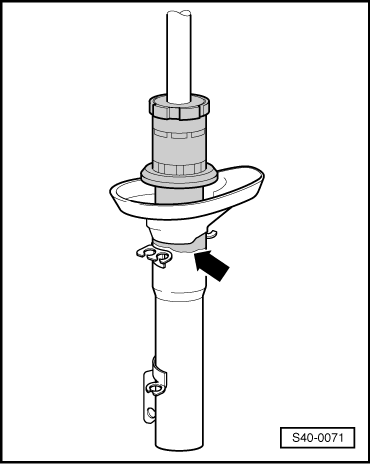
If an oil leak is visible (but blunt, dull, possibly dried by dust) and does not propagate any further than from the top shock-absorber plug (piston rod seal) to the bottom spring cap (arrow), the shock absorber is deemed to be O.K.
Note
- A slight oil leak is beneficial as the gasket ring is therefore oiled and thus its lifetime is increased. This also applies for the shock absorbers on the front and rear axle.
Attention must be drawn to the fact that in the event of complaints about noise, the shock absorbers are very often regarded as being the source of noise.
Possible causes of noise may be for example:
- defective shock absorber
- loosened attachment of the suspension strut on the body
- defective axial grooved ball bearing
- poor operation of the suspension strut
- defective outer joint
- defective wheel bearing
- cracked welding points on body
- parts loosened, possibly overtensioned when installed (exhaust system, adapter, cover, etc.)
Note
- In the event of complaints about noise described as banging or cracking noise, perform a test drive together with the customer and determine where, when and how the noises occur (preferably on a bumpy dry road).
Defective shock absorbers become noticeable while driving because of the knocking noises caused by wheel hopping, more specifically on poor road surfaces and they must be replaced. The failure is mainly caused by the loss of oil. The shock absorber then compresses and/or expands in jolts. It exhibits „idle“, before it begins to operate.
Note
- The shock absorbers are maintenance-free. It is not possible to top up the shock absorber oil.
Defective shock absorbers with gas pressure are also noticeable because of loud knocking noises caused by wheel hopping and externally usually exhibit considerable oil leakage.
Check by hand whether or not the shock absorber is defective as follows:
Compress the shock absorber by hand.
While doing so, the piston rod can be moved during the entire stroke time with a uniform resistance and without jerking.
Slacken the piston rod. On sufficiently pressurized shock absorbers it will automatically return to its original position.
If this is not the case, the shock absorber need not necessarily be replaced, as it will still operate as a conventional shock absorber (see instructions below).
Note
- The shock-absorbing function is still ensured even without sufficient gas pressure, as long as the oil leakage is not too important. However, the noise intensity can deteriorate. On older vehicles it is possible to continue using an operational yet pressureless shock absorber without problem.
- Adequate gas pressure in the shock absorber improves the noise behaviour and function when driving over poor road surfaces.
Parts & tools for this job For Skoda Roomster
- TOOLCoil spring compressorSearch: coil spring compressor
- TOOLBall joint separatorSearch: ball joint separator
- PARTFront shock absorbersSearch: Skoda Roomster front shock absorbers
As an Amazon Associate we earn from qualifying purchases.