
Cylinder head
- Make
- Alfa Romeo
- Model
- 145/146 Engines, 146 Bodywork and Engine Overhaul Manual
- Year
- 1994–2001
- Section
- Generalities › Cylinder head
CYLINDER HEAD
Monolith, compact, mould-cast aluminium and silicon alloy.
The four valves per cylinder are fitted in their respective V guides at approximately 47° and are controlled by two camshafts by means of hydraulic tappets.
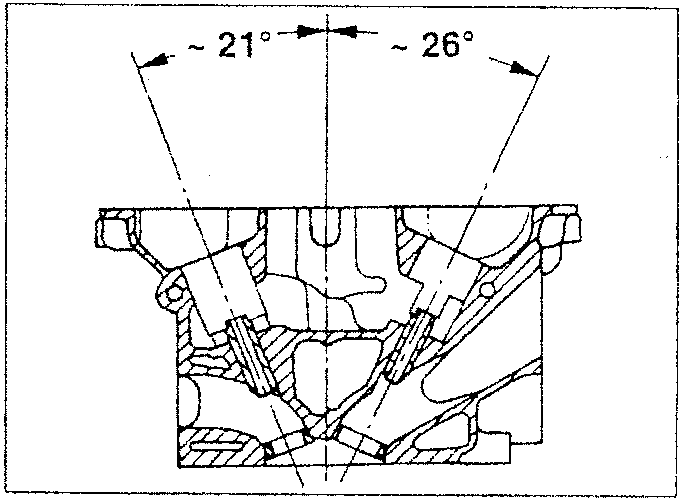
The space is organised so that the combustion chambers can house the four valve caps and the central and side spark plug holes without weakening the head structure.
The central spark plugs (larger) are tightened at a torque of 25 - 35 Nm, while the side (smaller) spark plugs are fastened at a torque of 10 - 12 Nm.
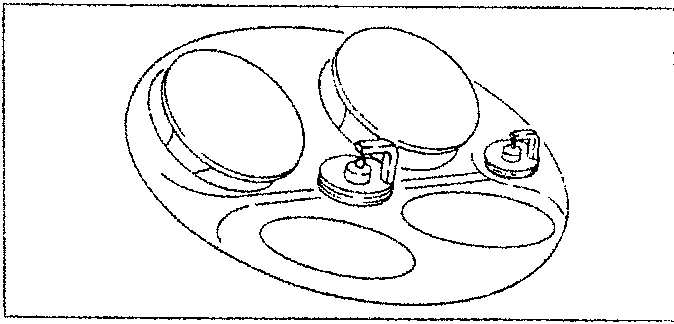
They should be replaced every 100,000 km.
The twin spark plugs positioned in this fashion, the two intake valves and the two exhaust valves ensure uniform distribution of the mixture and optimal combustion with improved engine thermal performance and reduced harmful emission in exhaust.
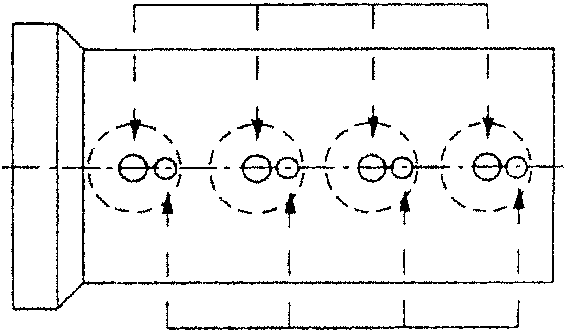
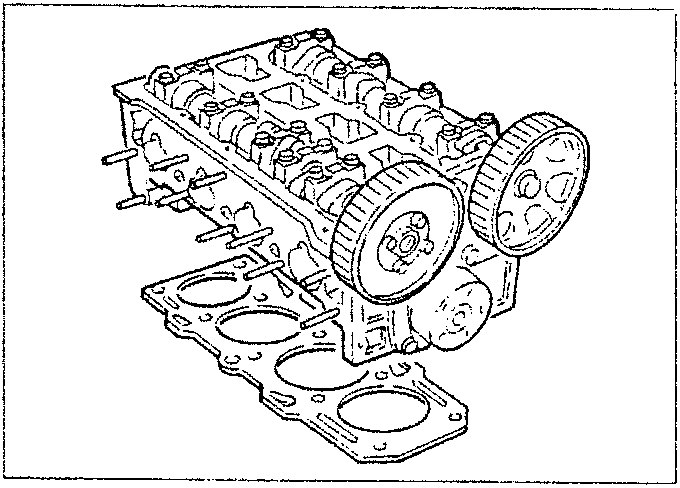
The camshaft on intake side turns on six journals. The camshaft on exhaust side turns on five journals. The shafts are controlled with a timing belt.
The valve seats are fitted in the cylinder head after it is heated to a temperature of 80°C. The seats are then cooled with liquid nitrogen. The valve guides are fitted in their seats in the cylinder head. Interference and internal diameter is perfected after assembly with a specific borer and controlled by means of a go-no-go set of gauges. The cylinder head and crankcase seal is made of aramide fibre. No head re-torque is required for the entire life of the engine.
OIL SUMP
The oil sump is a structural part of the engine with mechanical functions.
It contains the engine oil and is directly connected to the gearbox and to the rear engine mount. It is made of die-cast aluminium alloy and features internal shock-proof partitions.
It is fastened to the crankcase with a specific sealant.
Parts & tools for this job For 1994 Alfa Romeo 145/146
- PARTEngine gasket setSearch: Alfa Romeo 145/146 1994 engine gasket set
- TOOLTorque wrenchSearch: 3/8 inch torque wrench
- TOOLFeeler gauge setSearch: feeler gauge set
Links open Amazon search results in a new tab. As an Amazon Associate I earn from qualifying purchases.