
Valve gear timing
- Make
- Alfa Romeo
- Model
- 145/146 Engines, 146 Bodywork and Engine Overhaul Manual
- Year
- 1994–2001
- Section
- Generalities › Valve gear timing
VALVE GEAR TIMING
Direct drive by toothed belts with automatic tensioner and with overhead camshaft in cast iron with induction tempered cams and bearings. The hydraulic tappets, in contact with the cams, control the valves directly. This device automatically eliminates "valve play" when the engine is running thereby dramatically reducing the need for periodical maintenance.
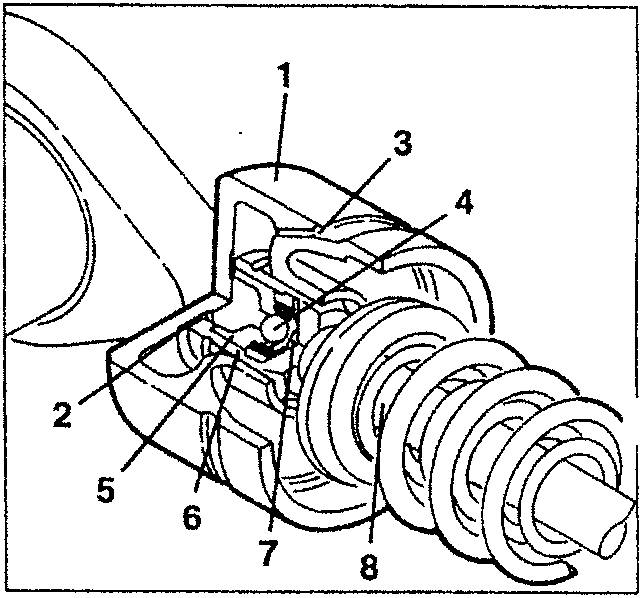
- Cup
- Oil passage between chambers
- Oil inlet groove
- Check valve
- Piston
- Cylinder
- Pressure chamber
- Valve stem
The stem of the exhaust valves is chromium plated and has a cavity inside filled 50 + 60% with sodium to improve dispersion of the heat to which they are subjected.
The valve seats are sintered and made from material suitable for the use of unleaded petrol.
TIMING VARIATOR
This is of the simplified type which ensures considerable timing precision, rapid intervention and high mechanical reliability. It is coupled to the intake pulley and fitted with two half bearings which support it. The inner parts ar nitrided and an O-Ring keeps the oil inside when the engine is not running. In order to reduce the size of the engine, the actuation valve seat has been machined on the intake manifold with suitable grooves which also involve the cylinder head, to regulate the flow of oil to the variator.
- The purpose of this device is to change the intake valve timing according to the engine load and speed required; this parameter is received and processed by the control unit in the form of an electric signal sent by the air flow meter and rpm sensor and transmitted as a command to the electromagnet via a relay.
- When the closed phase is required (idling and full power area), the electromagnet (1) is de-energized, thus the valve distributor (2) pushed by the counter spring (3), stays up preventing the passage of the oil leading from groove (A) from reaching the variator.
In this case the timing of the intake valves remains unchanged (closed).
- If the open phase is required (average speeds at high torque), the electromagnet (1) is energized, thus pushing the valve distributor (2) downwards. In this position the oil, leading from groove (A), enters chamber (B) of the piston, from where it passes through a special hole into groove (C) machined inside the latter.
The oil can only leave this groove through the upper hole (in communication with the oil delivery duct (D) to the variator) as the lower hole no longer leads to the exhaust duct (E) because the valve distributor (2) is lowered. The oil passes through duct (D) and (F) and reaches the chamber (G) moving piston (4) axially towards the engine. The outside of piston (4) is fitted with helical teeth and as a result of the above-mentioned axial movement it is forced to move clockwise (as seen from the timing side). The rotation is transmitted through a straight-toothed grooved profile to the pinion (5) which is screwed onto the threaded lug of the camshaft (6) and transmits the rotation to the shaft. This way the timing of the intake valves is changed by 25°.
When the electromagnet is de-energized, the valve distributor (2) returns to its initial position, shutting off the flow of pressurised oil to the piston (4), but allowing the oil to return to the exhaust due to the thrust of the counter spring (7).
Parts & tools for this job For 1994 Alfa Romeo 145/146
- PARTEngine gasket setSearch: Alfa Romeo 145/146 1994 engine gasket set
- TOOLTorque wrenchSearch: 3/8 inch torque wrench
- TOOLFeeler gauge setSearch: feeler gauge set
Links open Amazon search results in a new tab. As an Amazon Associate I earn from qualifying purchases.