
After-sales operations: immobiliser
- Make
- Citroën
- Model
- Berlingo Factory Workshop Manual
- Year
- 1996–2002
- Section
- Air and fuel supply › After-sales operations: immobiliser
After-sales operations: immobiliser
CAUTION: The BSI, engine ECUs and keys are assigned to a vehicle and therefore cannot be swapped between vehicles.
1. Secure after sales mode
The term "secure after sales" mode refers to cases in which the operator must enter the confidential code indicated on the customer’s card via the diagnostic equipment.
This mode must be selected using the diagnostic tool in order to perform various operations:
- Replacing the BSI
- Replacement of the engine ECU
- Replacing the BSI and the engine ECU
- Replacing the key
- Lost key
To enter secure after sales mode, it is necessary to have the customer’s confidential card (1) and to enter the access code or confidential code (a).
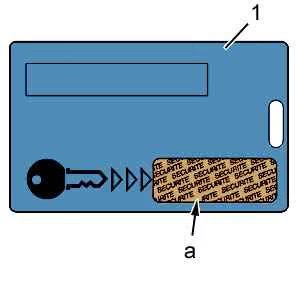
| Reference | Designation |
|---|---|
| 1 | Customer’s confidential card |
| A | Confidential code (Proxia diagnostic tools). Customer access code (Lexia diagnostic tools) |
2. Replacing the BSI
The customer’s access code is required for replacement of the BSI.
Before removing the faulty BSI, parameter and configuration values as well as the list of ECUs fitted on the vehicle must be retrieved from the BSI.
Once the new BSI has been fitted, it must be initialised (programming) to permit matching of the BSI and the engine ECU.
The initialisation of the BSI consists of entering the confidential code indicated on the customer’s card in the memory of the BSI.
N.B.: Matching consists of saving the various codes programmed into the BSI and the engine ECU definitively using the diagnostic tool.
CAUTION: Only one attempt to write the confidential code in the BSI is permitted. If the code is incorrect, the BSI then becomes unusable.
3. Registering the keys
The customer’s access code is necessary in order to programme the keys.
In order to memorise a new key in the BSI, it is essential that all of the keys are reprogrammed.
The ignition keys can only be programmed in a built-in systems interface which has already been matched.
4. Replacement of the engine ECU
The customer’s access code is required when replacing an engine ECU.
When replacing the engine ECU, the following operations must be carried out:
- Programme the customer’s access code into the engine ECU memory
- Match the engine ECU and the BSI
Matching of the engine ECU and the BSI is performed on switching on ignition, so a key recognised by the BSI is at least necessary.
Parts & tools for this job For 1996 Citroën Berlingo
- PARTEngine gasket setSearch: Citroën Berlingo 1996 engine gasket set
- TOOLTorque wrenchSearch: 3/8 inch torque wrench
- TOOLFeeler gauge setSearch: feeler gauge set
As an Amazon Associate we earn from qualifying purchases.