
Pulleys
- Make
- Fiat
- Model
- Punto (176) Factory Service Manual
- Year
- 1993–1999
- Section
- Automatic transmission (Selecta) › Pulleys
The metal drive belt consists of approximately 280 blocks mounted on two steel bands each made from 10 laminated strips.
The belt transmits power via the compression of these blocks; it "pushes" the torque. This is contrary to the operation of traditional rubber belts which are in tension and "pull" the torque.
The metal bands consist of thin strips of laminated steel (thickness 0.2 mm) which are capable of withstanding the compression loading. The steel blocks differ in thickness (2.0 and 2.2 mm) to reduce noise.
To transmit power, friction is necessary between the blocks and the pulley internal faces.
This friction is produced by applying a closing pressure to the secondary pulley, compressing the blocks. This force also causes the belt to move outwards (increasing its diameter).
The increased operating diameter causes tension and this creates friction between the blocks and the primary pulley.
In other words, the steel blocks transmit power by compression, the steel bands then ensure that the necessary tension to create driving friction is maintained
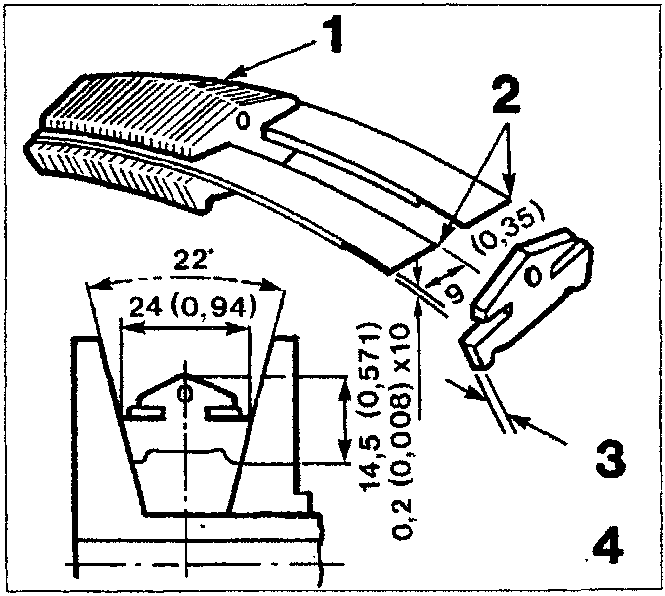
- Steel blocks: Approximately 280
- Steel belt (length approximately 600)
- Approximately 2
- Unit of measurement: mm
PULLEYS
Both the primary pulley and secondary pulley have sliding bearing rings on their rotation axes. The sealing faces are inclined at 11°.
Both pulleys have pressure chambers surrounding the rings.
The pulley width (hence its operating diameter and ratio) is modified by forcing the rings to move along the rotation axis on roller bearings.
Parts & tools for this job For 1993 Fiat Punto
- PARTTransmission filter kitSearch: Fiat Punto 1993 transmission filter kit
- FLUIDAutomatic transmission fluidSearch: Fiat automatic transmission fluid
- TOOLFluid transfer pumpSearch: fluid transfer pump
Links open Amazon search results in a new tab. As an Amazon Associate I earn from qualifying purchases.